
SYLLABUS: International Relations General Studies – : II Important International institutions, agencies and fora – their structure, mandate.
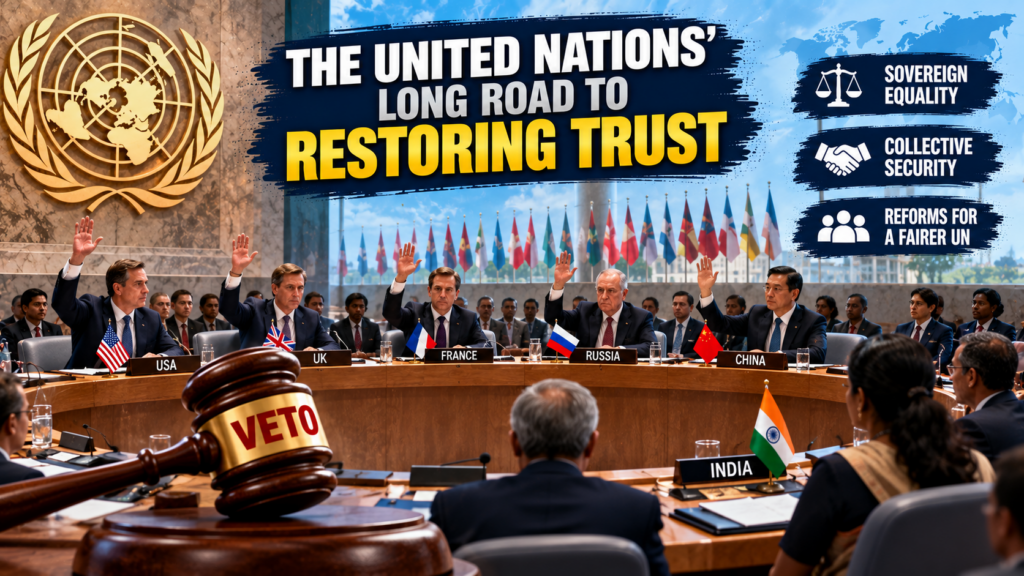
IN NEWS: The United Nations’ long road to restoring trust
QUESTION: How does the veto power of the permanent members of the UN Security Council affect the principles of sovereign equality and collective security? Discuss.
ANSWER: The veto power exercised by the five permanent members (P5) under Article 27(3) of the UN Charter was instituted as a political compromise at the 1945 San Francisco Conference. While intended to ensure great-power participation, it creates an inherent contradiction between the realistic power dynamics of 1945 and the normative principles of Sovereign Equality and Collective Security.
I. Impact on the Principle of Sovereign Equality
Article 2(1) of the UN Charter explicitly states that the UN is based on the “sovereign equality of all its Members.” However, the veto mechanism structurally undermines this:
- Institutionalization of Hegemony: The veto creates a rigid, two-tiered international hierarchy. While the UN General Assembly (UNGA) functions on a democratically equal “one-state, one-vote” principle, P5 unanimity overrides the collective political will of the wider membership.
- Asymmetry in Accountability and Enforcement: P5 members enjoy operational immunity under Chapter VII provisions. A permanent member can block sanctions, investigation, or military intervention against itself or its direct strategic allies, leading to selective compliance with international law.
- Structural Entrenchment via Constitutional Lock: Under Articles 108 and 109, any amendment to the UN Charter requires the concurrence of all P5 members. This gives the P5 an absolute veto over any attempts to reform, dilute, or expand Council membership.
II. Impact on the System of Collective Security
Article 1(1) mandates the UN to take effective collective measures to prevent and remove threats to international peace. The veto affects this in two distinct ways:
- Subversion of Collective Security Mechanisms
- Institutional Gridlock during Major Crises: When a threat to peace involves a P5 state or its strategic interest, the Council becomes paralyzed. This has consistently prevented decisive UN action during major geopolitical and humanitarian crises.
- Erosion of Institutional Credibility: Repeated gridlock forces states to bypass the Security Council entirely, leading to unauthorized unilateral interventions or the proliferation of minilateral regional security alliances outside the UN umbrella.
- Pragmatic Defense of the Veto (Realist Perspective)
- Preventing Direct Great-Power Conflict: The veto acts as a necessary safety valve. Attempting to enforce collective security measures against a nuclear-armed power without its consent could trigger a direct Third World War.
- Ensuring Universal Engagement: The veto ensured that major military powers remained invested inside the system, avoiding the structural collapse that destroyed the League of Nations when major powers withdrew.
III. Institutional Counter-Measures and Workarounds
To mitigate veto-induced paralysis, the international community has developed alternate procedural pathways:
- Uniting for Peace Resolution (UNGA Res 377A): Enables the General Assembly to recommend collective action when the UNSC fails to maintain peace due to a P5 veto.
- Veto Initiative (UNGA Res 76/262): Mandates a UNGA debate within 10 working days of a veto being cast, requiring the vetoing member to justify its position before the global community.
- Voluntary Restraint Initiatives: Proposals such as the French-Mexican initiative and the ACT Group Code of Conduct call on P5 nations to voluntarily refrain from using the veto during situations involving mass atrocities and genocide.
The veto power represents a pragmatic compromise between idealist rules and realist power politics. While it breaches the principle of sovereign equality and frequently cripples operational collective security, it has succeeded in preserving the broader international order by keeping superpowers within a single diplomatic architecture. Meaningful reform requires extending non-permanent representation while curbing arbitrary veto usage through normative restraints.
PYQ REFERENCE UPSC 2015 “Discuss the impediments India is facing in its pursuit of a permanent seat in the UN Security Council.” (12.5 Marks, 200 Words)
SOURCE: The Hindu e-paper – The United Nations’ long road to restoring trust