
SYLLABUS: Indian Polity General Studies – : II Issues relating to development and management of Social Sector/Services relating to Health, Education, Human Resources.
IN NEWS: Firecrackers: Festivity or fallout?
QUESTION: How can the constitutional framework reconcile the Right to Life under Article 21 with the Right to Freedom of Religion under Article 25 in the context of environmental pollution caused by firecrackers?(250 words)
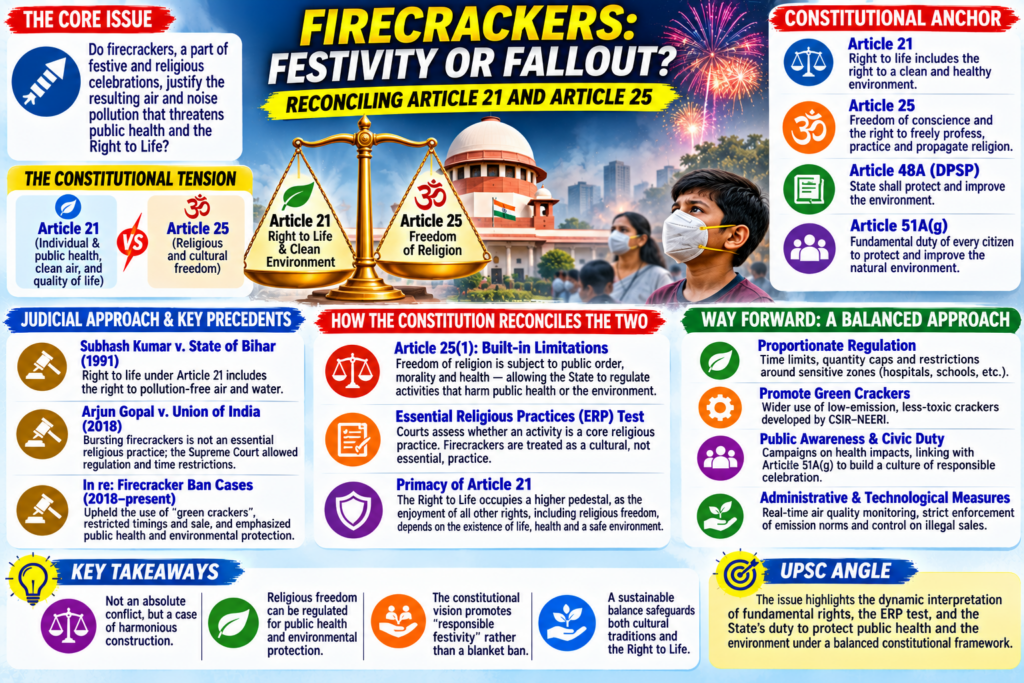
ANSWER: The issue of environmental degradation caused by firecrackers brings into direct conflict the Right to Life and Clean Environment under Article 21 and the Right to Freedom of Religion under Article 25. Resolving this tension requires a constitutional balancing act grounded in judicial precedents and fundamental duties.
Constitutional Tension: Article 21 vs. Article 25
- Scope of Article 21 (Right to Clean Environment): The Supreme Court (Subhash Kumar v. State of Bihar, 1991) held that Article 21 includes the right to enjoy pollution-free water and air for full enjoyment of life. Severe air pollution (PM2.5/PM10 spikes) during festive seasons exacerbates respiratory illnesses, directly threatening the right to health and life.
- Scope of Article 25 (Freedom of Religion): Article 25 guarantees the freedom of conscience and the right to freely profess, practice, and propagate religion. Proponents argue that traditional celebrations involving firecrackers form an integral part of religious festivities.
Judicial Approach and Constitutional Reconciliation
1. Internal Limitations of Article 25
Article 25(1) is explicitly made “subject to public order, morality, and health.”
- The Constitution prioritizes public health over unrestricted religious practices.
- If a religious activity adversely affects public health or degrades environmental quality, state regulation or restriction is constitutionally permissible under Article 25(1).
2. The Essential Religious Practices (ERP) Test
The Judiciary applies the ERP test to determine whether an activity forms the core, essential tenets of a religion.
- The Supreme Court has repeatedly held (Arjun Gopal v. Union of India, 2018) that bursting firecrackers is not an essential or integral religious practice under Article 25, but rather a temporal cultural expression.
- Consequently, health protections under Article 21 override non-essential religious practices.
3. Primacy of Article 21 in the Rights Hierarchy
- The Right to Life (Article 21) occupies a primary position because the enjoyment of all other fundamental rights, including religious freedom under Article 25, depends on the existence of life and basic health.
- Environmental protection is further reinforced by Article 48A (Directive Principle directing the State to protect the environment) and Article 51A(g) (Fundamental Duty of citizens to protect the natural environment).
Sustainable Harmonization: The Policy Way Forward
- Graded and Proportionate Regulation: Complete, blanket bans often encounter compliance resistance. Implementing proportionate measures—such as designated time windows, eco-friendly “green crackers” (developed by CSIR-NEERI), and spatial restrictions around sensitive zones (hospitals, schools)—balances environmental protection with cultural sensibilities.
- Transition to Green Technology: Promoting chemical formulation changes (banning barium salts and heavy metals) reduces particulate emission levels while preserving traditional celebrations.
- Public Education and Civic Duty: Operationalizing Article 51A(g) through community awareness drives shifts public perspective from viewing restrictions as state intrusion to recognizing them as collective health responsibility.
The constitutional framework reconciles Article 21 and Article 25 through the doctrine of harmonious construction, establishing that religious freedom under Article 25 must yield to public health and the supreme mandate of the Right to Life under Article 21.
|
SOURCE: The Hindu epaper – Firecrackers: Festivity or fallout?