
|
IN NEWS: The elephant in the classroom
QUESTION: The increasing digitisation of school administration can improve accountability, but excessive documentation may divert teachers from their primary responsibility of teaching. Critically examine.(250 words)
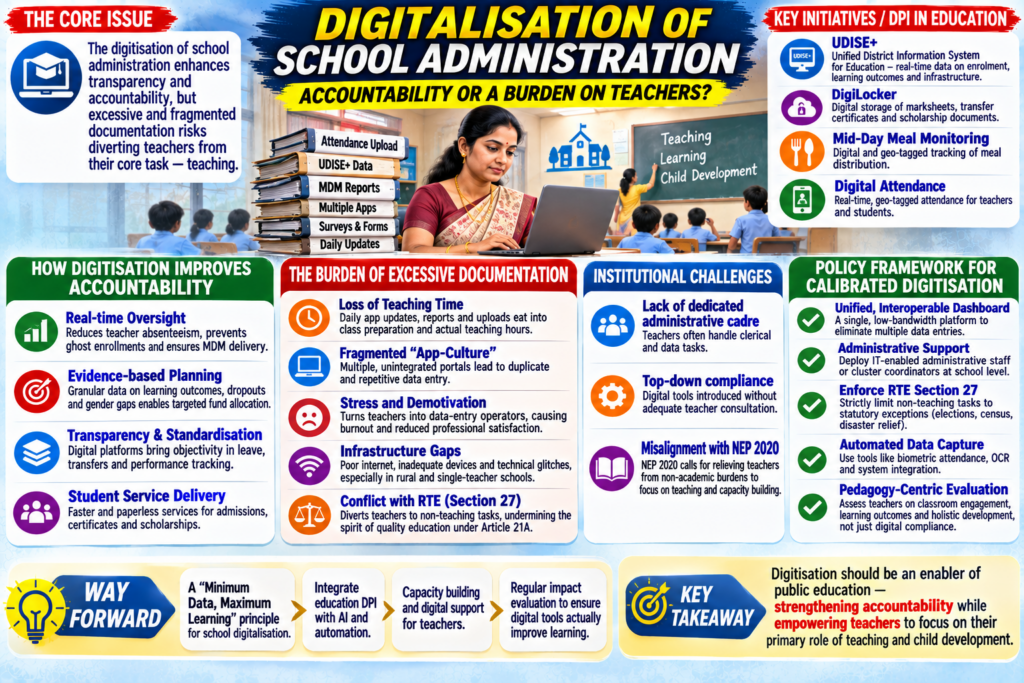
ANSWER: The integration of Digital Public Infrastructure (DPI) and administrative software into school governance—ranging from digital attendance applications and Mid-Day Meal monitoring portals to performance management frameworks—represents a structural shift in public administration. Guided by the principles of New Public Management, this digitisation aims to establish outcome-focused governance and curb absenteeism.
Digitisation as a Catalyst for Educational Accountability
- Real-time Oversight and Ghost Prevention: Centralized portals like Unified District Information System for Education (UDISE+) and geo-tagged attendance apps mitigate teacher absenteeism, eliminate ghost student enrollments, and track Mid-Day Meal distribution transparently.
- Evidence-Based Policy Interventions: Granular digital records yield real-time data on learning outcomes, dropout trends, and gender disparities, enabling target-driven allocation of educational funds and infrastructure.
- Standardization and Professional Transparency: Automated platforms simplify career progression tracking, leave approvals, and duty allocations, replacing opaque discretionary decisions with objective digital metrics.
- Streamlining Student Records: Initiatives like DigiLocker digitize transfer certificates, marksheets, and scholarship applications, cutting administrative friction for parents and administration alike.
The Burden of Excessive Documentation: Disincentivizing Teaching
- Erosion of Instructional Time (Work Intensification): Daily requirements to upload geo-tagged photos, input classroom logs, and compile multi-portal reports consume critical pre-class preparation and direct classroom teaching hours.
- The “App-Culture” and Systemic Redundancy: Teachers are frequently subjected to fragmented, unintegrated government mobile applications—forcing them to perform duplicate manual and digital data entries across state and central databases.
- Pedagogical Distraction and Psychological Fatigue: Transforming educators into data-entry operators causes professional burnout and demotivation. The focus shifts from intuitive, child-centric teaching to satisfying quantitative digital audit trails.
- Exacerbation of Infrastructure Gaps: In rural and single-teacher schools with weak internet connectivity and hardware shortages, digital reporting forces teachers to spend personal time and resources navigating technical glitches.
- Infringement of the Right to Education (RTE) Intent: Diverting teacher focus to non-pedagogical tasks undermines the core guarantee of quality education under Article 21A and violates the spirit of Section 27 of the RTE Act, 2009, which seeks to restrict non-teaching deployments.
Institutional and Structural Challenges
Absence of Dedicated Administrative Cadres: School administrators frequently rely on teachers to handle clerical tasks due to a shortage of non-teaching staff.
- Top-Down Compliance Models: Digital tools are often deployed without consultation with frontline educators, prioritizing state monitoring needs over classroom usability.
- Misalignment with the National Education Policy (NEP) 2020: NEP 2020 explicitly advocates relieving teachers from non-academic administrative burdens so they can prioritize continuous professional development and foundational learning.
Policy Framework for Calibrated Digitisation
- Interoperable Single-Window Dashboards: Consolidate fragmented state and central reporting apps into a unified, low-bandwidth dashboard requiring minimal data entries.
- Deployment of Auxiliary Administrative Support: Appoint dedicated IT-enabled administrative staff or cluster coordinators at the school/panchayat level to handle data entry, surveys, and logistics.
- Strict Adherence to RTE Guidelines: Enforce Section 27 of the RTE Act, strictly limiting non-teaching tasks to mandated statutory exceptions (Elections, Census, Disaster Relief) while restricting ad-hoc surveys.
- Automated Data Capture: Leverage low-friction automated tools (e.g., optical character recognition, automated attendance hardware) to reduce manual app updates.
- Pedagogy-Centric Evaluation: Shift teacher performance evaluations away from procedural compliance logs toward classroom engagement, continuous professional learning, and holistic child development.
Digitisation should serve as an enabler for public education rather than an administrative bottleneck. Achieving educational equity requires digital governance that empowers teachers rather than burdening them with data collection. Realigning digital administrative tools to support—rather than displace—instructional time is essential to fulfilling the vision of NEP 2020 and ensuring quality education under Article 21A.
|