
SYLLABUS: Indian History General Studies – : I Post Independence consolidation
IN NEWS: Sardar Patel and the many facets of his political legacy
QUESTION: Discuss the significance of Patel’s relationship with Mahatma Gandhi and Jawaharlal Nehru in shaping India’s political transition during the early years of Independence.
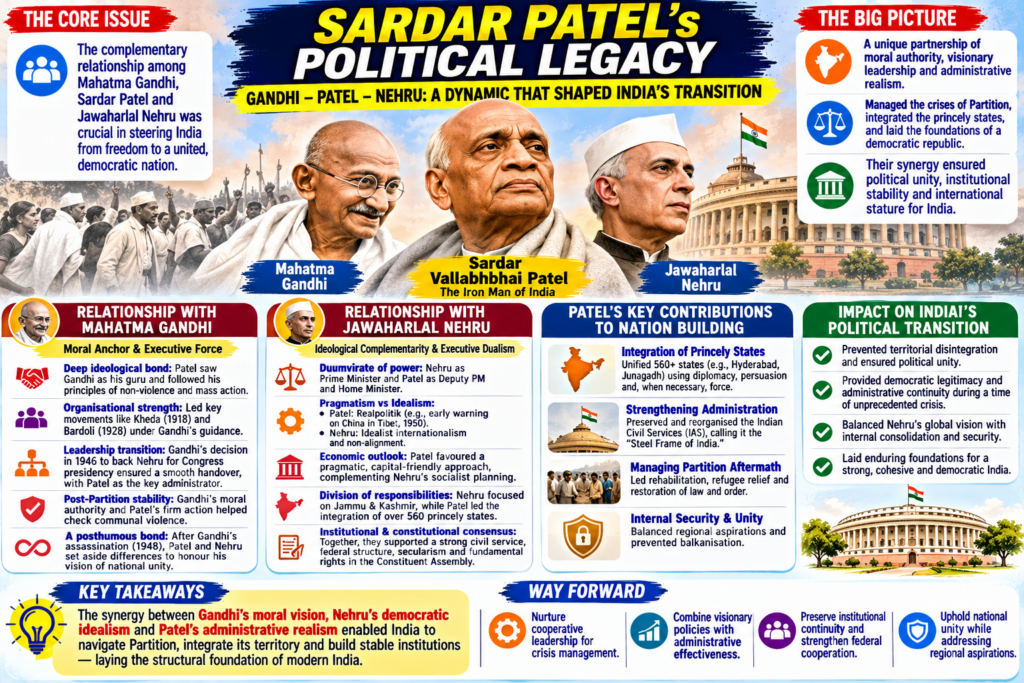
ANSWER: The triumvirate of Mahatma Gandhi, Jawaharlal Nehru, and Sardar Vallabhbhai Patel formed the political core of India’s freedom movement and its immediate post-independence consolidation. Their dynamic provided both moral legitimacy and administrative stability during the turbulent period of Partition and state integration.
Relationship with Mahatma Gandhi: Moral Anchor & Executive Force
- Ideological Alignment and Discipline: Patel viewed Gandhi as his master (guru). While Gandhi provided the ideological orientation of non-violence and mass mobilization, Patel served as the decisive organizational engine (e.g., Kheda and Bardoli Satyagrahas).
- Selection of Leadership: Gandhi’s intervention in 1946 to appoint Nehru over Patel as Congress President ensured a smooth leadership transition while keeping Patel as the indispensable strongman managing state machinery.
- Post-Partition Calm: Gandhi’s moral authority combined with Patel’s firm administrative hand helped quell communal violence following Partition, preventing complete state collapse.
- The Posthumous Pact: Gandhi’s tragic assassination in 1948 bound Patel and Nehru together despite personal differences, as both felt duty-bound to honor Gandhi’s last wish for national unity.
Relationship with Jawaharlal Nehru: Ideological Complementarity & Executive Dualism
- Duumvirate of Power: Nehru served as the visionary Prime Minister projecting India’s international status and democratic ideals, while Patel acted as Deputy Prime Minister and Home Minister enforcing internal cohesion.
- Pragmatic vs. Idealist Vision:
- Foreign Policy and Defense: Patel advocated realpolitik (warning against Chinese motives in Tibet in 1950), balancing Nehru’s idealist internationalism.
- Economic Outlook: Patel favored a pragmatic, capital-friendly approach to rapid industrialization, counterbalancing Nehru’s socialist planning model.
- Integration of Princely States: While Nehru focused on Jammu & Kashmir, Patel led the integration of over 560 princely states using a firm “carrot and stick” diplomacy alongside V.P. Menon.
- Institutional Foundation: Patel fiercely protected and reorganized the Indian Civil Services (calling it the “Steel Frame”), overriding leftist skepticism to ensure administrative continuity post-British departure.
- Constitutional Consensus: Together, they navigated internal Congress debates to forge a consensus on fundamental rights, federal structure, and secularism in the Constituent Assembly.
Impact on India’s Political Transition
- Prevented balkanization of the Indian subcontinent post-1947 through seamless territorial and political consolidation.
- Provided democratic legitimacy alongside institutional resilience by protecting administrative structures during crisis.
- Established a balanced policy path that merged international stature with internal administrative stability.
The complementary synergy between Gandhi’s moral vision, Nehru’s democratic idealism, and Patel’s administrative realism laid the structural foundation of modern democratic India.
|
SOURCE: The Hindu epaper – Sardar Patel and the many facets of his political legacy