
SYLLABUS: Governance General Studies – : II Government policies and interventions for development in various sectors and issues arising out of their design and implementation.
IN NEWS: Surveillance is not the only privacy issue
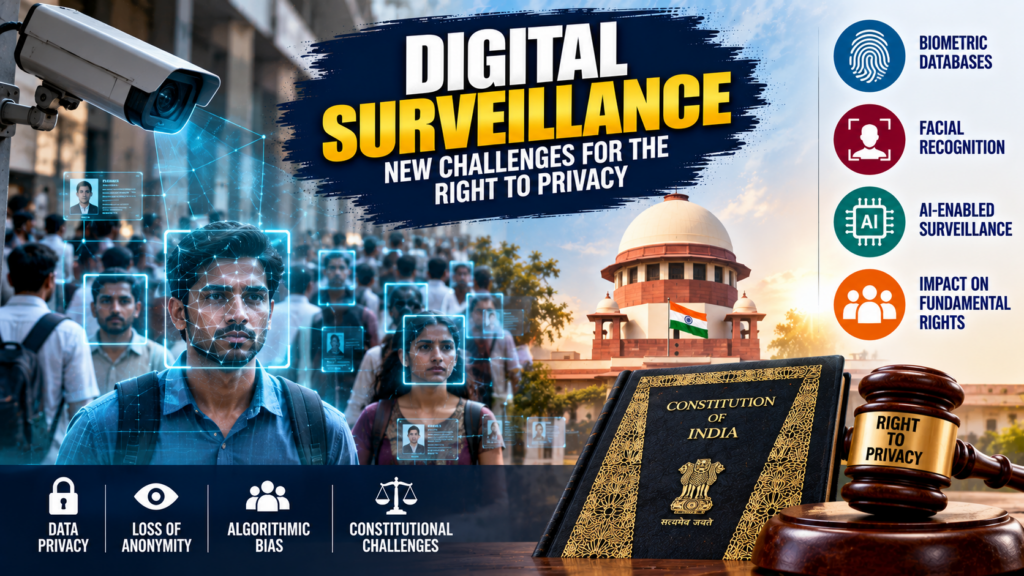
QUESTION: The proliferation of facial recognition, biometric databases and AI-enabled surveillance has created new challenges for the constitutional right to privacy. Discuss
ANSWER: The deployment of Automated Facial Recognition Systems (AFRS), centralized biometric databases, and AI-enabled predictive policing has transformed law enforcement and welfare governance. However, this unchecked expansion poses severe constitutional challenges to the Right to Privacy, recognized as an intrinsic facet of the Right to Life under Article 21 in K.S. Puttaswamy v. Union of India (2017).
I. Key Constitutional Challenges to Privacy
- Threat to Informational Privacy & Personal Autonomy
- Involuntary Data Harvesting: AI systems collect unique, immutable biological markers (facial vectors, iris scans, gait analysis) without explicit individual consent or opt-out mechanisms.
- Function Creep: Biometric records collected for welfare schemes or civil registration are frequently cross-linked with law enforcement databases without fresh statutory backing, eroding individual data agencies.
- Erosion of Spatial Privacy & Violation of Fundamental Freedoms
- Elimination of Public Anonymity: Real-time remote biometric identification destroys the expectation of spatial privacy in public squares, markets, and transit hubs.
- Chilling Effect on Fundamental Rights: Mass tracking suppresses Article 19(1)(a) (Freedom of Speech) and Article 19(1)(b) (Peaceful Assembly), as citizens self-censor or avoid peaceful protests due to fear of automated profiling and state retaliation.
- Algorithmic Inaccuracy & Denial of Basic Entitlements
- Exclusion from Welfare: Biometric authentication failures (due to manual labor wear, aging, or network latency) result in the denial of food rations, pensions, and healthcare, violating human dignity under Article 21.
- Algorithmic Bias: Skewed training datasets lead to higher False Positive Rates (FPR) for racial minorities, women, and marginalized communities, violating Article 14 (Equality) and Article 15 (Non-Discrimination).
- Inversion of Criminal Jurisprudence
- Predictive Profiling: AI surveillance utilizes historical crime data to label specific communities or geographic zones as “high risk.”
- Presumption of Guilt: This shifts criminal law from the foundational principle of presumption of innocence to automated, algorithmic suspicion without procedural due process.
II. Evaluation Against the Constitutional Test of Proportionality
In Puttaswamy (2017), the Supreme Court laid down a 4-Pronged Proportionality Test that state intrusion into privacy must pass:
- Legality (Absence of Law): Most facial recognition deployments currently function through departmental guidelines, tenders, or executive orders rather than specific acts passed by Parliament.
- Legitimate State Aim: While public order and crime prevention are legitimate state interests, routine mass surveillance in non-emergency situations oversteps this boundary.
- Necessity: The State must demonstrate that mass biometric tracking is the least restrictive method available to achieve its objective.
- Proportionality & Safeguards: Current systems lack statutory safeguards, independent oversight, data minimization standards, and defined data retention limits.
III. Regulatory and Governance Gaps
- Broad State Exemptions: Frameworks like the Digital Personal Data Protection (DPDP) Act, 2023 grant broad exemptions to state agencies under generic grounds of “security of the State” and “public order,” diluting accountability.
- Lack of Independent Surveillance Oversight: India lacks an independent statutory authority or judicial warrant mechanism to authorize real-time biometric tracking before deployment.
- Absence of Algorithmic Impact Assessments: Deployments proceed without mandatory prior human rights, algorithmic bias, or privacy impact audits.
IV. Way Forward
- Dedicated Surveillance Legislation: Enact a comprehensive statutory framework for surveillance that sets strict boundaries, replacing executive discretion with parliamentary law.
- Mandatory Judicial Authorization: Require prior judicial warrants for targeted biometric monitoring and real-time remote facial recognition.
- Narrow Exemption Clauses: Subject state exemptions under data protection laws to strict necessity, proportionality, and periodic review by an independent Data Protection Board.
- Algorithmic Auditing & Bias Testing: Institute mandatory third-party technical audits for all AI models used in policing and social welfare to ensure transparency and accuracy.
PYQ REFERENCE UPSC 2026 Q. “Right to privacy relating to self-identity is very dear to every human being and well protected under Article 21 of the Constitution.” Examine. (10 Marks, 150 Words)
SOURCE: The Hindu e-paper – Surveillance is not the only privacy issue