
|
IN NEWS: How the SC ruling redefined ‘industry’
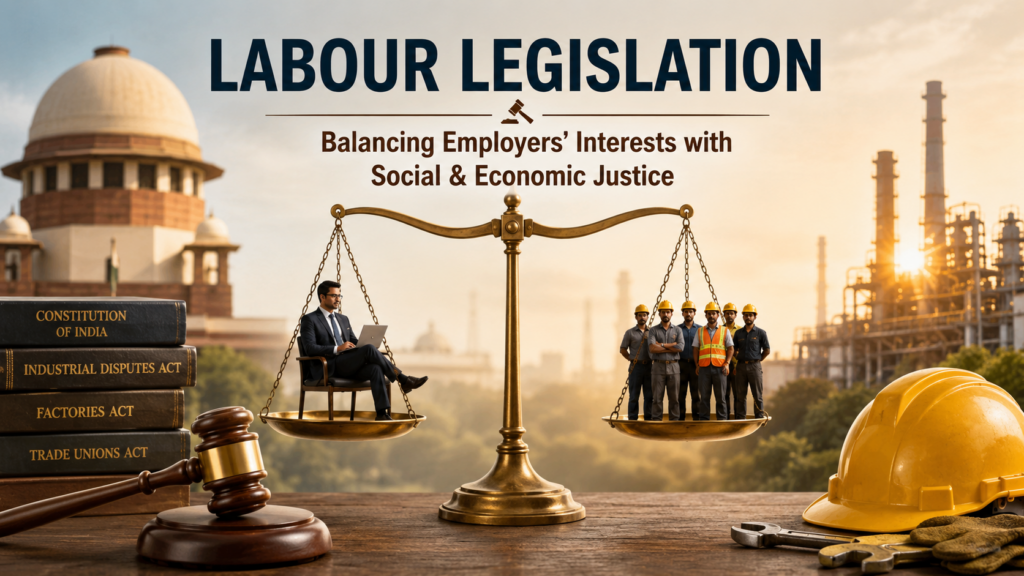
QUESTION: Judicial interpretation of labour legislation must balance the interests of employers with the constitutional commitment to social and economic justice. Examine
ANSWER: The judicial interpretation of labour legislation in India represents a complex tightrope walk. Courts are continuously tasked with harmonizing the fundamental right to carry on trade and business with the constitutional mandate to secure social and economic justice for the working class.
1. The Constitutional Framework
- Social and Economic Justice: The Preamble explicitly promises social, economic, and political justice.
- Directive Principles of State Policy (DPSP): Articles 38, 39, 41, 42, and 43 direct the State to ensure equal pay for equal work, humane conditions of work, a living wage, and workers’ participation in management. Courts heavily rely on these to interpret labour laws favorably for workers.
- Employer’s Rights: Conversely, Article 19(1)(g) guarantees citizens the fundamental right to practice any profession or carry on any occupation, trade, or business.
2. The Need for Balance
Labour laws inherently aim to correct the unequal bargaining power between capital (employers) and labour (employees). However, the judiciary recognizes that a completely one-sided interpretation can be counterproductive.
- Protecting Workers: Left unregulated, the pursuit of profit can lead to exploitation, unfair wages, and arbitrary dismissals. Judicial interpretation must prevent the commodification of labour.
- Protecting Industry: If interpretations are excessively rigid or unconditionally pro-labour, they can cripple industries, deter investment, and ultimately lead to job losses, which hurts the very workers the laws aim to protect. The right to close a loss-making business or manage workforce size efficiently is crucial for economic viability.
3. Evolution of Judicial Interpretation
The Welfare State Era (Pre-1990s)
In the early decades post-independence, the judiciary adopted a distinctly protectionist and socialist approach, heavily prioritizing the DPSP.
- Beneficial Construction: The thumb rule was that in cases of ambiguity within a labour statute, the interpretation that favored the weaker party (the worker) was adopted.
- Example: The landmark Bangalore Water Supply & Sewerage Board vs. A. Rajappa (1978) case expansively defined the term “industry” under the Industrial Disputes Act, bringing a vast number of institutions (like hospitals and universities) under labour law protection to secure workers’ rights.
The Era of Globalization and Pragmatism (Post-1991)
With the liberalization of the Indian economy in 1991, the judiciary’s approach shifted toward pragmatism. Courts began to emphasize that industrial growth and global competitiveness are essential for generating employment.
- Harmonious Construction: The courts started emphasizing “industrial harmony” rather than just workers’ rights. They recognized the employer’s right to discipline and the negative economic impact of militant trade unionism.
- Example: In cases like Umakant Saran vs. State of Bihar, the courts recognized that employers have the managerial prerogative to organize their business, provided they do not act with mala fide intent (bad faith) or violate statutory procedures.
4. Key Areas of Judicial Balancing
- Contract Labour: The Supreme Court in Steel Authority of India Ltd (SAIL) vs. National Union Waterfront Workers (2001) balanced interests by ruling that while sham contracts to evade labour laws are illegal, the automatic absorption of contract workers into the principal employer’s workforce is not legally mandated unless specifically directed by the government.
- Right to Strike: While recognizing the right to form trade unions as a fundamental right (Article 19(1)(c)), the Supreme Court (K. Rangarajan vs. Government of Tamil Nadu) has clarified that there is no fundamental, absolute right to strike. Strikes must strictly follow statutory mechanisms to prevent industrial paralysis.
- Retrenchment and Closure: In Excel Wear vs. Union of India, the Court held that a law compelling an employer to continue running a business at a loss violates Article 19(1)(g). Employers have a right to close down, provided they follow statutory compensation and notice requirements.
Judicial interpretation of labour legislation is no longer viewed through a purely paternalistic lens. Today, the judiciary employs a doctrine of proportionality. It ensures that the constitutional commitment to human dignity and social justice (preventing exploitation) remains intact, while simultaneously fostering an environment where businesses can adapt, thrive, and create the economic growth necessary to sustain that very welfare state.
|
SOURCE: The Hindu e-paper – How the SC ruling redefined ‘industry’