
|
IN NEWS: A civilisational approach to social media
QUESTION: Should social media use by minors be regulated? Discuss the role of parents, schools and the government in ensuring responsible digital behaviour. (10 Marks | 150 Words)
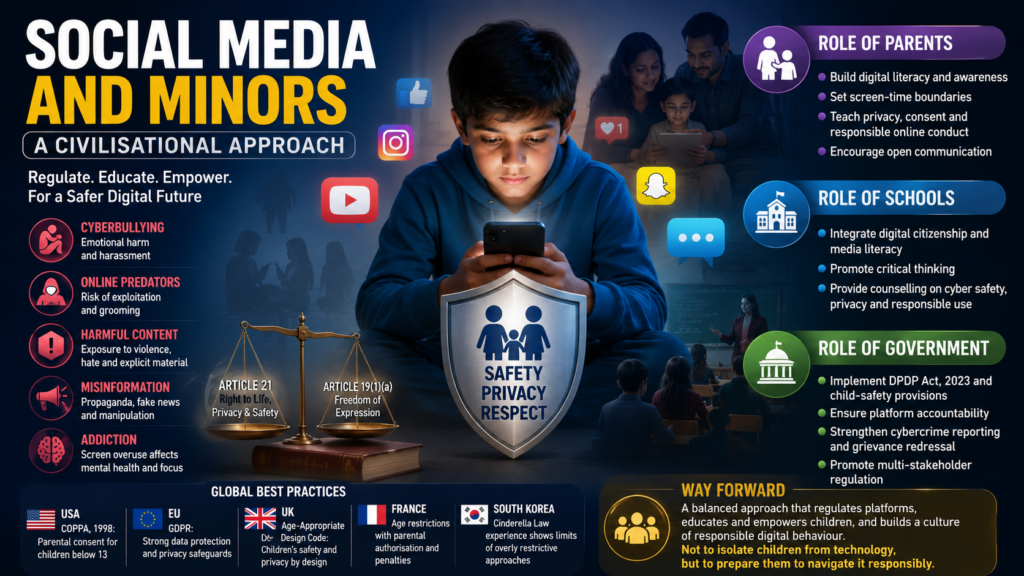
The expansion of social media has created opportunities for learning, creativity, and socialisation, but also exposes minors to cyberbullying, harmful content, online predators, misinformation, and addiction. Therefore, India needs proportionate regulation rather than a blanket ban, complemented by social and educational interventions.
Why Regulation is Necessary
➤ Child protection: Protect minors from harmful content, exploitation, and cyberbullying.
➤ Data privacy: The Digital Personal Data Protection Act, 2023 provides for verifiable parental consent for processing children’s data and restricts tracking and targeted advertising.
➤ Platform accountability: Platforms should adopt age-appropriate design, privacy-by-default, and effective grievance redressal.
➤ Constitutional balance: Regulation must reconcile Article 21 – right to life and personal liberty, including privacy, with children’s safety and welfare, while respecting freedom of expression under Article 19(1)(a).
Role of Parents
➤ Develop digital literacy and understand children’s online experiences.
➤ Establish reasonable screen-time boundaries and encourage dialogue rather than excessive surveillance.
➤ Teach privacy, consent, cyber ethics and responsible online conduct.
Example: The concept of sharenting highlights why parents themselves need awareness about children’s digital privacy.
Role of Schools
➤ Integrate digital citizenship and media literacy into education.
➤ Develop critical thinking to identify misinformation, propaganda and algorithmic manipulation.
➤ Provide counselling and awareness on cyberbullying, privacy and responsible AI/social-media use.
Role of Government
➤ Strengthen implementation of the DPDP Act, 2023 and child-safety provisions.
➤ Make technology platforms accountable for harmful content, data misuse and unsafe platform design.
➤ Strengthen cybercrime reporting and grievance-redressal mechanisms.
➤ Promote multi-stakeholder regulation involving parents, schools, civil society and technology companies.
Global Best Practices
➤ USA – COPPA, 1998: Requires parental consent before collecting personal information from children below 13.
➤ EU – GDPR: Establishes strong data-protection and privacy safeguards.
➤ UK – Age-Appropriate Design Code: Requires platforms to design services with children’s safety and privacy as priorities.
➤ France: Uses age restrictions with parental authorisation, coupled with penalties for non-compliance.
➤ South Korea: The experience of the Cinderella Law, eventually abolished in 2021, demonstrates the limitations of excessively restrictive approaches.
Way Forward
India should follow a “regulate–educate–empower” approach: regulate platforms, educate children and parents, and empower young people with critical thinking and digital resilience.
The objective should not be to isolate children from technology but to prepare them to navigate it responsibly. A combination of proportionate regulation, parental guidance, school-based digital literacy, and accountable platforms can create a safer digital ecosystem while preserving the benefits of technological innovation.
|