
SYLLABUS: ECONOMY General Studies – : III Indian Economy and issues relating to planning, mobilization of resources, growth, development and employment.
IN NEWS: Economics beyond the individual
QUESTION: Explain the concept of animal spirits in Keynesian economics. How do uncertainty and herd behaviour influence investment decisions and contribute to financial instability?.
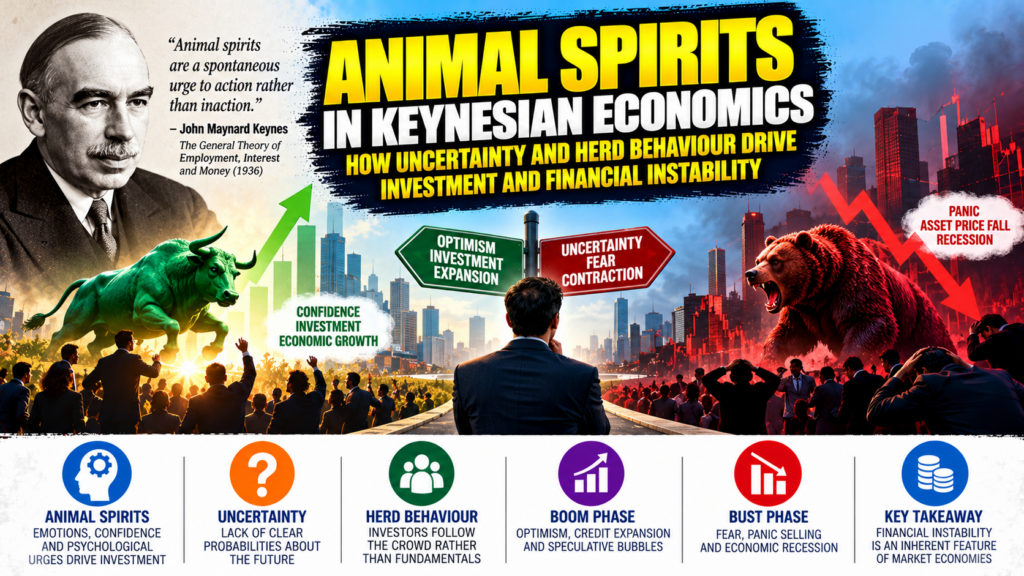
ANSWER: The concept of “animal spirits” originates from John Maynard Keynes in his seminal work, The General Theory of Employment, Interest and Money (1936). Keynes introduced the term to describe the spontaneous, non-rational, and psychological impulses that drive human economic action, particularly when individuals make decisions under conditions of deep uncertainty.
1. The Concept of “Animal Spirits” in Keynesian Economics
- Spontaneous Optimism and Emotion: Animal spirits represent the inherent confidence, enthusiasm, wave of optimism, or fear that drives entrepreneurs to take risks, launch businesses, or invest capital, even when the future is inherently unknowable.
- The Driven Impulse: If human nature were governed solely by deliberate mathematical calculation, investment would stagnate due to the sheer unpredictability of the future. Animal spirits serve as the psychological engine that overcomes inaction and propels investment forward.
- Fluctuation in Sentiment: Because animal spirits are grounded in psychology rather than objective economic fundamentals, they are volatile. A shift from optimism to pessimism can occur suddenly without any change in real underlying economic productivity or technology.
2. Role of Fundamental Uncertainty in Investment Decisions
- Risk vs. Uncertainty:
- Risk: Refers to situations where the outcome is unknown, but the probability distribution of possible outcomes can be accurately calculated (e.g., rolling a die or life insurance actuarial tables).
- Fundamental Uncertainty: Refers to future events for which there is no scientific basis on which to calculate any quantifiable probability (e.g., predicting technological innovations, political shifts, or consumer tastes 10 or 20 years into the future).
Impact on Investment
Because long-term capital investments (such as building a factory or developing infrastructure) yield returns far into the future, they are subject to fundamental uncertainty.
When rational calculation fails due to a lack of reliable future data, investors rely on conventions, current mood, and animal spirits:
- Reliance on Conventions: Investors assume the present state of affairs will continue indefinitely unless there are specific reasons to expect a change.
- Extreme Sensitivity to Confidence: Because conventions are fragile, any sudden shock or doubt can shatter business confidence, causing animal spirits to collapse.
- Investment Contraction: When confidence falls, the expected yield on capital drops precipitously. Investors prefer liquidity over capital investment, causing total private investment (I) to plunge.
3. Herd Behavior and Investment Decisions
In financial markets and real investment, individual agents face asymmetric information and uncertainty. As a result, they frequently look to the actions of others to guide their own choices—a phenomenon known as herd behavior.
Mechanisms of Herd Behavior
- Informational Cascades: Investors infer that others possess superior information. If a few prominent market participants start buying an asset or expanding investments, others follow suit under the assumption that the leaders know something they do not.
- Reputational Risk and Conventions: As Keynes famously noted, “Worldly wisdom teaches that it is better for reputation to fail conventionally than to succeed unconventionally.” Fund managers and corporate executives face institutional pressure to follow consensus strategies so they are not singled out if a bold, independent investment fails.
- Keynesian Beauty Contest: Keynes compared stock market investment to a newspaper beauty contest where judges win by predicting which face other judges will find most attractive, rather than choosing the face they personally find most attractive. Similarly, investors buy assets not based on their intrinsic long-term fundamental value, but based on what they anticipate other investors will pay for them in the short term.
4. Animal Spirits, Herd Behavior, and Financial Instability
The interaction between volatile animal spirits, uncertainty, and herd behavior creates systemic booms and busts, directly contributing to macroeconomic and financial instability.
The Upward Phase: Speculative Bubbles and Over-Investment
- Rising Optimism: A positive economic development elevates animal spirits, generating widespread optimism.
- Herding and Self-Fulfilling Expectations: As early investors make profits, herd behavior kicks in. A broad consensus emerges that asset prices will continue rising indefinitely.
- Credit and Leverage Expansion: Driven by high confidence, banks relax lending standards, and firms borrow aggressively to finance expansion. Asset prices detach from their intrinsic fundamental values, creating speculative bubbles.
The Downward Phase: Panic and Financial Crises
- The Sudden Shift (Minsky Moment): An unexpected shock or bad news reveals that investments are overvalued or unviable. The fragile convention of optimistic expectations shatters.
- Collapse of Animal Spirits: Optimism transforms rapidly into fear, panic, and risk aversion.
- Panic Herding and Liquidity Preference: Herd behavior reverses. Investors rush simultaneously to sell assets and exit positions to hoard liquid money (liquidity preference).
- Deleveraging and Recession: Fire sales lower asset prices further, causing balance sheet distress, debt deflation, and credit freezes. Firms slash capital expenditure, leading to widespread layoffs, falling aggregate demand, and prolonged economic recession.
Keynesian economics views financial instability as an inherent feature of market economies driven by volatile animal spirits and herd behavior, it rejects the notion that unmanaged markets naturally self-correct smoothly.
|
SOURCE: The Hindu epaper – Economics beyond the individual