
|
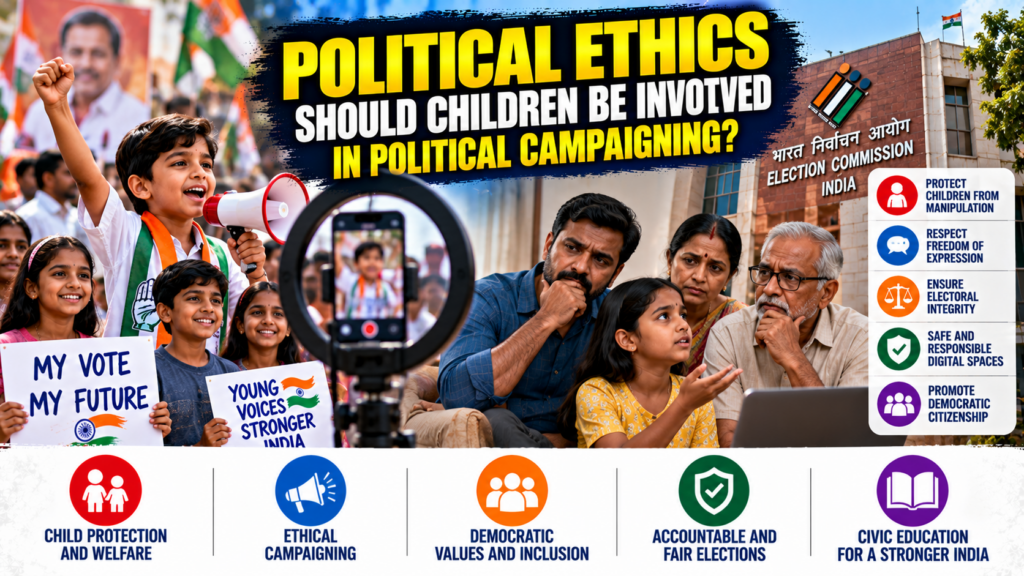
IN NEWS: Should children be involved in political campaigning?
QUESTION: A political party uses popular celebrities to attract young supporters. During an election campaign, children are encouraged to create social media videos and repeatedly persuade their parents and grandparents to vote for a particular candidate. The party argues that the children are voluntarily expressing their preferences and that restricting them would violate their freedom of expression.
As a District Election Officer, you receive complaints from parents and civil society organisations alleging that children are being manipulated for electoral gains.
(a) Identify the ethical issues and competing values involved in the situation.
(b) What are the ethical dilemmas between protecting children from manipulation and respecting their freedom of expression?
(c) What course of action would you adopt to protect children’s interests without unnecessarily restricting their democratic participation?
ANSWER: As a District Election Officer (DEO), navigating the intersection of child rights, ethical campaigning, and constitutional freedoms requires a balanced, objective, and legally sound administrative approach.
(a) Ethical Issues and Competing Values
Key Ethical Issues
- Instrumentalization of Children: Using children—who lack legal age to vote or fully grasp political ideologies—as tools or proxies for political persuasion and campaign outreach.
- Coercion and Family Friction: Encouraging children to repeatedly badger parents and grandparents creates domestic pressure, potential conflict, and undue influence within households.
- Exploitation of Celebrity Influence: Leveraging media icons popular among youth to target impressionable minds who may not yet possess critical evaluation skills regarding political manifestos.
- Digital Rights and Privacy Risks: Exposing minors on public social media platforms for political publicity can lead to cyberbullying, digital footprint persistence, and online safety risks.
Competing Values
- Political Freedom vs. Child Protection: The right of political entities and citizens to express preferences versus the state’s duty (parens patriae) to safeguard minors from political exploitation.
- Autonomy vs. Vulnerability: Respecting a child’s evolving capacity and voice versus acknowledging their developmental vulnerability to indoctrination and subtle coercion.
- Democratic Inclusivity vs. Electoral Integrity: Fostering early civic awareness versus preserving the ethical integrity and fairness of the electoral process.
(b) Ethical Dilemmas: Protection vs. Freedom of Expression
| Dimension | Protection from Manipulation | Respecting Freedom of Expression |
| Core Principle | Paternalistic Safeguard: Protecting minors from economic, political, or social exploitation due to their limited cognitive maturity. | Child Autonomy: Upholding Article 12 (Right to be heard/expressed) and Article 13 of the UN Convention on the Rights of the Child (UNCRC) and constitutional rights. |
| Dilemma | Intervening to block child-led political videos may suppress genuine, voluntary civic engagement and democratic curiosity among youth. | Allowing unrestrained campaigning under the guise of free expression enables political parties to exploit children as low-cost, high-empathy campaign workers. |
| Boundaries of Consent | Informed consent by minors is legally and developmentally questionable, especially under adult/celebrity influence. | Restricting expressiveness assumes all participation is coerced, discounting legitimate youth passion for public issues (e.g., climate, education). |
(c) Proposed Course of Action
To protect children’s interests while maintaining respect for democratic participation and constitutional norms, the following phased framework will be executed:
1. Verification and Fact-Finding
- Appoint a Task Force: Form a joint inquiry committee consisting of the District Child Protection Officer (DCPO), a representative from the National/State Commission for Protection of Child Rights (NCPCR/SCPCR), and a senior police/electoral official.
- Assess Content & Coercion: Investigate whether political parties/candidates are directly funding, organizing, or instructing children to produce this content, or if it is purely organic individual expression.
2. Enforcement of Statutory Directives
- Issue Directives based on Election Commission Guidelines: Issue an immediate advisory to all political parties citing statutory frameworks (e.g., Election Commission of India guidelines and Child Labour Laws) prohibiting the active use of children in election campaigning, rallies, and organized promotional material.
- Distinguish Organic Participation from Organized Campaigning:
- Organized Campaigning (Restricted): Direct involvement in party-branded video production, door-to-door solicitation, or official campaign events organized by parties.
- Organic Expression (Permitted): Non-coerced, independent expressions of civic views by youth on personal platforms without party endorsement, compensation, or script direction.
3. Guidelines for Social Media Platforms & Parties
- Notice to Campaign Managers: Direct party campaign managers to desist from reposting, amplifying, or monetizing videos featuring minors.
- Takedown Requests for Coerced Media: Request platform intermediaries to restrict visibility or take down content where children are systematically used for targeted political advertising or party-funded promotions.
4. Constructive Alternatives & Awareness Building
- Promote Non-Partisan Civic Literacy: Direct schools and youth forums to conduct non-partisan electoral literacy activities (e.g., mock elections, debate clubs, Electoral Literacy Clubs) that focus on constitutional values and democratic rights rather than partisan support.
- Parental & Community Sensitization: Issue public notices emphasizing parental responsibility in protecting children’s digital footprints and preventing political pressures within households.
By distinguishing between coerced political mobilization and genuine civic expression, the administration can uphold electoral integrity and child protection standards without stifling the democratic spirit of the younger generation.
SOURCE: The Hindu epaper – Should children be involved in political campaigning?