
|
IN NEWS: What do the Centre’s steps mean for Ladakh?
QUESTION: The demand for statehood and constitutional safeguards in Ladakh reflects the challenges of balancing regional aspirations with administrative efficiency and national security. Discuss.
ANSWER: The reorganization of Jammu and Kashmir under the J&K Reorganisation Act, 2019 created Ladakh as a Union Territory (UT) without a legislature. While this initially fulfilled a long-standing demand for administrative separation from J&K, it subsequently gave rise to political unrest led by the Leh Apex Body (LAB) and Kargil Democratic Alliance (KDA).
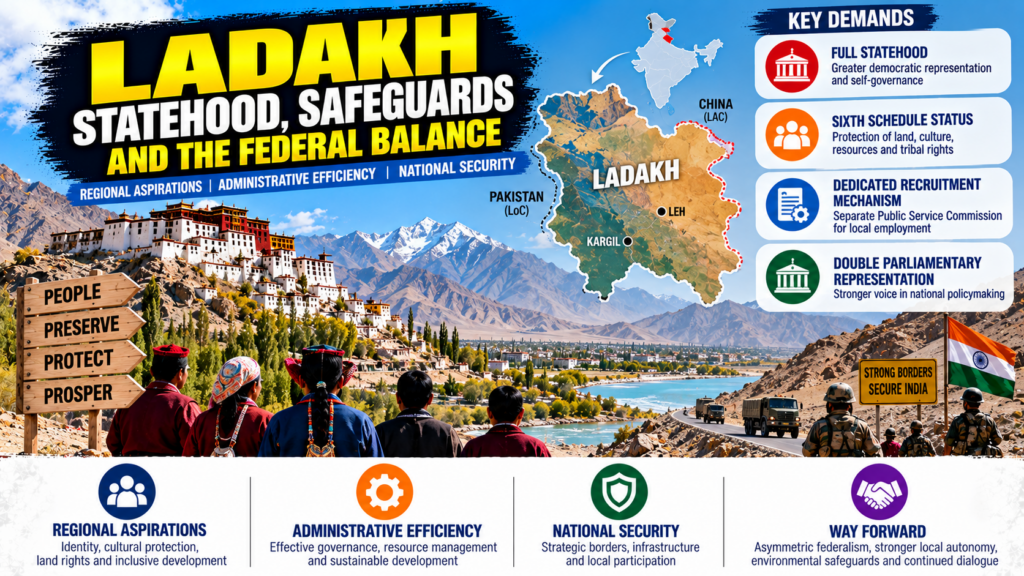
The region’s major four-point demands—full statehood, Sixth Schedule status under Article 244(2), dedicated recruitment mechanisms (Public Service Commission), and double parliamentary representation—highlight a tri-fold challenge: satisfying regional democratic aspirations, maintaining administrative efficiency, and securing critical international borders.
1. Regional Aspirations: Core Demands and Rationale
- Preservation of Identity and Environment: Over 97% of Ladakh’s population belongs to Scheduled Tribes. The removal of Article 370 heightened anxieties over demographic dilution, land alienation, and unchecked commercial development that could harm its high-altitude, fragile eco-system.
- Bridging the Representation Deficit: Governance directly by a Central-appointed Lieutenant Governor (LG) has led to grievances regarding bureaucratic dominance over local public representatives.
- Resource Sovereignty via the Sixth Schedule: Extending the Sixth Schedule would empower local Autonomous District Councils (ADCs) with legislative authority over land, water, forests, and customary law.
- Local Employment: The lack of a local Public Service Commission (PSC) since 2019 created recruitment bottlenecks, prompting demands for domicile-based job protection.
2. Administrative Efficiency: Challenges of Governance and Viability
- Institutional Conflict: Friction exists between the existing Ladakh Autonomous Hill Development Councils (LAHDCs of Leh and Kargil) and the centralized UT administration regarding fiscal delegation and legislative power.
- Economics of Statehood: Establishing full state machinery (Assembly, High Court, Public Service Commission) for a population of ~300,000 presents challenges regarding fiscal self-sustainability and reliance on central grants.
- Constitutional Architecture: Extending the Sixth Schedule outside the North-Eastern states (Assam, Meghalaya, Tripura, Mizoram) requires a Constitutional Amendment under Article 368 and could establish precedents for other non-Northeastern tribal regions.
3. National Security Imperatives: Strategic Realities
- Border Vulnerability: Ladakh shares sensitive international borders with China (LAC) and Pakistan (LoC). Geopolitical tensions along the Line of Actual Control require unified, swift decision-making and seamless central coordination over military logistics and infrastructure creation.
- Border Population as Strategic Assets: Local populations in border areas serve as essential eyes and ears for national defense. Sustained political dissatisfaction risks alienation, which could impact civil-military integration.
Comparative Assessment: Perspectives on Ladakh’s Governance
| Dimension | Regional Aspirations | Central Administrative & Security View |
| Governance Structure | Full Statehood with an elected Assembly. | Centrally managed UT status to maintain unified command in a strategic frontier. |
| Land & Tribal Rights | Sixth Schedule status to grant full legislative autonomy over land and resources. | Special statutory protections (e.g., Article 371-style safeguards or updated land laws) without amending the Sixth Schedule. |
| Development | Eco-friendly, locally planned growth prioritizing fragile ecology. | Rapid strategic infrastructure, renewable energy, and connectivity projects. |
The Way Forward: Towards Asymmetric Federalism
- Enhanced Local Autonomy (Asymmetric Federalism): Rather than full statehood, an asymmetric governance model—similar to Article 371 provisions applied to other states—can be introduced to grant explicit protections for Ladakhi land, culture, and employment.
- Empowerment of LAHDCs: Strengthen the legislative, executive, and financial powers of the twin councils (Leh and Kargil), providing them authority over land management, ecological regulation, and local recruitment without creating a heavy state bureaucracy.
- Environmentally Sustainable Carrying-Capacity Framework: Establish environmental regulations and carrying-capacity caps on tourism and commercial exploitation to safeguard the fragile high-altitude ecosystem.
- Institutionalized Consultation: Maintain structured dialogue between the Ministry of Home Affairs, the LG administration, and representatives from LAB and KDA to build trust and address recruitment and developmental issues.
|
SOURCE: The Hindu epaper – What do the Centre’s steps mean for Ladakh?