
|
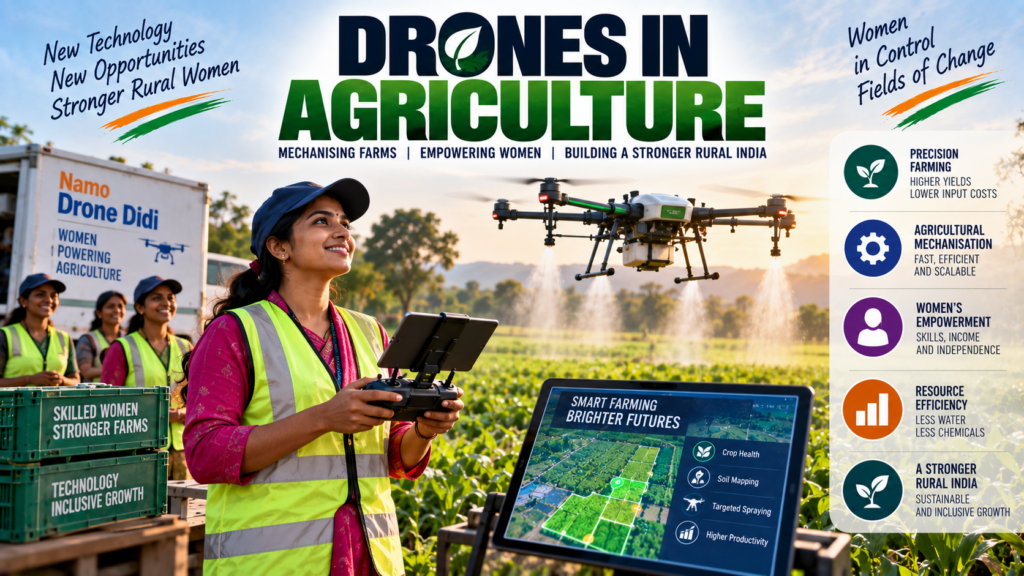
IN NEWS: Women take the controls as farms embrace new tech
QUESTION: How can drone technology address the twin challenges of agricultural mechanisation and women’s economic empowerment in rural India? Examine the opportunities and constraints. (250 Words)
ANSWER: Agricultural mechanisation in India has historically suffered from structural bottlenecks—such as extreme land fragmentation, high capital costs of heavy machinery, and gendered disparities in technology adoption. Concurrently, while rural women contribute significantly to agricultural labor, their roles have largely remained confined to low-paid, labor-intensive, and informal tasks.
Drone technology (Unmanned Aerial Vehicles – UAVs) offers a disruptive solution to these dual challenges by democratizing access to micro-mechanisation and transitioning rural women from informal laborers to high-tech service providers.
Addressing Agricultural Mechanisation
- Precision Farming and Micro-Mechanisation: Drones enable targeted spraying of liquid fertilizers (like Nano-Urea), pesticides, and micro-nutrients, along with ultra-precise crop monitoring and soil mapping. This replaces inefficient, manual broadcasting methods.
- Overcoming Topographical and Scale Constraints: Unlike heavy machinery, drones operate seamlessly over small, fragmented plots, undulating terrains, and dense canopy crops without causing soil compaction or damaging standing crops.
- Input Efficiency and Resource Conservation: Drones reduce water consumption for spraying by up to 90% and lower pesticide/fertilizer usage by 20–30% through targeted ultra-low volume (ULV) applications, drastically reducing input costs for farmers.
- Addressing Agricultural Labor Shortages: During peak cropping seasons, seasonal labor shortages delay operations. Drones can cover 15–20 acres per day, completing tasks in minutes that would otherwise take hours of manual labor.
Addressing Women’s Economic Empowerment
- Asset Ownership and Capital Creation: Initiatives like the Namo Drone Didi scheme provide central financial assistance (up to 80% subsidy) to Women Self-Help Groups (SHGs) under the DAY-NRLM. This places high-value productive technology assets directly under female ownership.
- Transition to High-Skilled Livelihoods: Women undergo formal training as DGCA-certified Remote Pilots and drone technicians. This shifts their role from unpaid or low-wage manual labor to certified technical professionals and service providers.
- Income Enhancement and Financial Independence: Operating drone-as-a-service (DaaS) models allows women SHGs to earn sustainable rental income (projected at ₹1 lakh per annum per SHG member), increasing their household decision-making power.
- Health and Occupational Safety: Manual spraying exposes workers—predominantly women in many manual labor setups—to toxic chemical inhalation and dermal hazard. Drone spraying eliminates direct human exposure to hazardous agro-chemicals.
- Social Status and Breaking Gender Stereotypes: Operating cutting-edge technology elevates women’s social standing within patriarchal village dynamics, recasting them as key drivers of local agricultural modernization.
Opportunities Presented by Agricultural Drones
- Custom Hiring Centre (CHC) Business Models: Drones allow SHGs to function as micro-enterprises, renting out spraying and mapping services across multiple villages.
- Integration with Agri-Tech Ecosystems: Drones provide actionable data that can be linked with climate-smart agriculture platforms, crop insurance verification (PM Fasal Bima Yojana), and yield estimation.
- Scalability through SHG Architecture: India’s extensive network of over 9 million women SHGs provides a built-in social infrastructure for rapid technology diffusion and collective bargaining power.
Key Constraints and Implementation Challenges
- High Initial Capital and Financial Viability: Despite subsidies, the high capital cost of commercial agricultural drones, along with costly replacement batteries (which degrade over time), creates financial stress for rural SHGs if utilization rates remain low.
- Infrastructure and Technical Gaps: Rural areas frequently face unstable power grids (impeding fast-charging of drone batteries), lack of local repair/maintenance hubs, and poor internet connectivity for real-time data mapping.
- Regulatory and Airspace Constraints: Strict Civil Aviation Requirements (CAR), Digital Sky platform compliance, and restriction zones (red/yellow zones) can create operational friction for rural pilots.
- Social Resistance and Deep-Seated Patriarchy: Women drone operators often face local skepticism from male farmers, restricted mobility due to domestic responsibilities, and resistance from existing male custom-hiring operators.
- Seasonal Utilization Risk: Agricultural spraying demands are highly seasonal (peak during Kharif/Rabi spraying windows). Generating a year-round sustainable income requires diversifying drone usage beyond spraying (e.g., into seed-bombing, forestry, or local survey work).
Integrating drone technology into rural India presents a transformative convergence of agricultural modernization and gender inclusion. By shifting women from informal field labor to certified drone pilots and business operators, initiatives like Namo Drone Didi operationalize a capability-enhancement model of development. To realize its full potential, India must complement asset distribution with robust rural charging infrastructure, localized repair hubs, and long-term market links with Farmer Producer Organizations (FPOs). Overcoming these structural constraints will ensure that agricultural mechanisation becomes both technologically sustainable and socially equitable.
|
SOURCE: The Hindu e-paper – Women take the controls as farms embrace new tech