
|
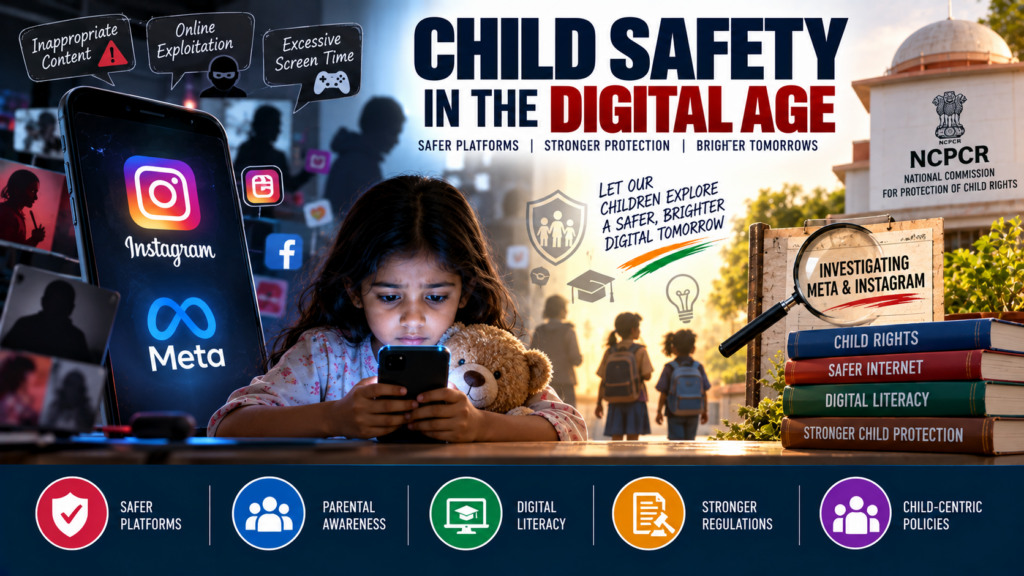
IN NEWS: Why is NCPCR investigating Meta, Instagram?
QUESTION: Digital platforms and unregulated technology exposure have emerged as new-age threats to child welfare in India, compounding existing gaps in the country’s child protection ecosystem. Discuss, and suggest measures to strengthen child welfare mechanisms in this context. (15 Marks, 250 Words)
ANSWER: The digital ecosystem, while enabling learning and connectivity, has also exposed children to serious risks ranging from exploitative content on social media platforms to unregulated AI use in classrooms making child safety in the digital age a critical social concern that existing welfare frameworks are only beginning to address.
1. Emerging threats to child welfare:
Online sexual exploitation:
- A BBC investigation revealed Instagram carrying paid ads promoting child sexual exploitation and abuse material (CSEAM) in India, a direct violation of child rights and a criminal offence.
- The Tech Transparency Project found that Meta’s AI-moderation systems failed to catch all violative content, and even misclassified CSEAM as “adult content,” effectively undercounting abuse.
- Alarmingly, even when abuse content was human-reported, 57% of complaints were dismissed by the platform as non-violative showing a systemic failure of the private redressal mechanism that vulnerable children depend on.
Unregulated technology/screen exposure:
- ASER 2024 shows 82.2% of children aged 14-16 can operate a smartphone, but a majority use it for social media/gaming rather than education indicating a welfare gap in digital literacy, not just access.
- The Economic Survey has flagged rising teen digital addiction as carrying real economic and social costs as a public health and developmental welfare concern.
- Nearly half of urban parents report children spending 3+ hours daily on screens, reflecting weak parental and institutional safeguards.
- Gaps in India’s child welfare ecosystem
- The NCPCR, despite quasi-judicial powers under the Commissions for Protection of Child Rights Act, 2005, functions largely reactively issuing notices after media exposés (BBC report, Netflix’s Bombay Begums, Bournvita case) rather than through proactive monitoring.
- Platforms cite investigation confidentiality to deny transparency even to statutory bodies (Meta declined an RTI request), weakening institutional oversight.
- India lacks a dedicated, age-tiered policy on AI/screen use in schools unlike New York’s graded model (device removal for pre-K to Grade 2, capped screen time for elementary grades, supervised AI literacy for high schoolers).
- Welfare architecture remains skewed toward physical/nutritional protection (ICDS, POSHAN, Mid-Day Meal) with digital welfare comparatively under-institutionalised.
- Measures to strengthen child welfare mechanisms
- Strengthen NCPCR’s proactive monitoring mandate, with statutory powers to conduct periodic platform audits, not just post-facto inquiries triggered by media exposés.
- Fast-track the Digital India Act to fix intermediary accountability gaps left by the IT Rules, 2021, particularly around CSEAM detection standards and mandatory takedown timelines.
- Integrate digital welfare indicators (screen time, online safety, digital literacy) into existing frameworks like the Integrated Child Protection Scheme (ICPS).
- Introduce a national, age-tiered framework on AI/screen exposure in schools, backed by teacher training, given India currently has no equivalent policy.
- Strengthen inter-ministerial coordination (Ministry of Women & Child Development, MeitY, Ministry of Education) for a unified child online-safety code.
Global Best practice:
New York’s Age-Tiered AI/Screen Policy (Sept 2026)
| Age Group | NY’s Policy |
| Pre-K to Grade 2 | One-to-one devices removed from classrooms entirely |
| Grade 3–5 | Recommended cap of 30 minutes screen time/day |
| Middle school (6–8) | Cap of 45 minutes/day; student-facing AI tools barred for a year |
| High school | Small, vetted set of AI tools in pilot programmes, paired with twice-yearly modules on how AI works, what it gets wrong, and its limits. |
Child welfare in the digital age cannot rest solely on legacy protections against physical harm; it must evolve to address online exploitation and close regulatory gaps around technology in schools. A proactive, well-coordinated welfare architecture is essential to secure India’s children as much online as offline.
|
SOURCE: The Hindu e-paper – Why is NCPCR investigating Meta, Instagram?