
SYLLABUS: Indian Society General Studies – : I Salient features of Indian Society, Diversity of India.
IN NEWS: Realising Lohia’s vision among top posts
QUESTION: Representation at the entry level does not necessarily translate into representation in the highest levels of administration. Examine (250 words)
ANSWER: The Indian civil services have witnessed a remarkable demographic democratization over recent decades. Driven by competitive examinations, affirmative action, and widening access to higher education, entry-level recruitment reflects an increasingly diverse cross-section of Indian society. However, a glaring structural anomaly persists: entry-level diversity does not automatically translate into apex-level representation.
1. The Reality of the Pyramid: Entry vs. Apex Data
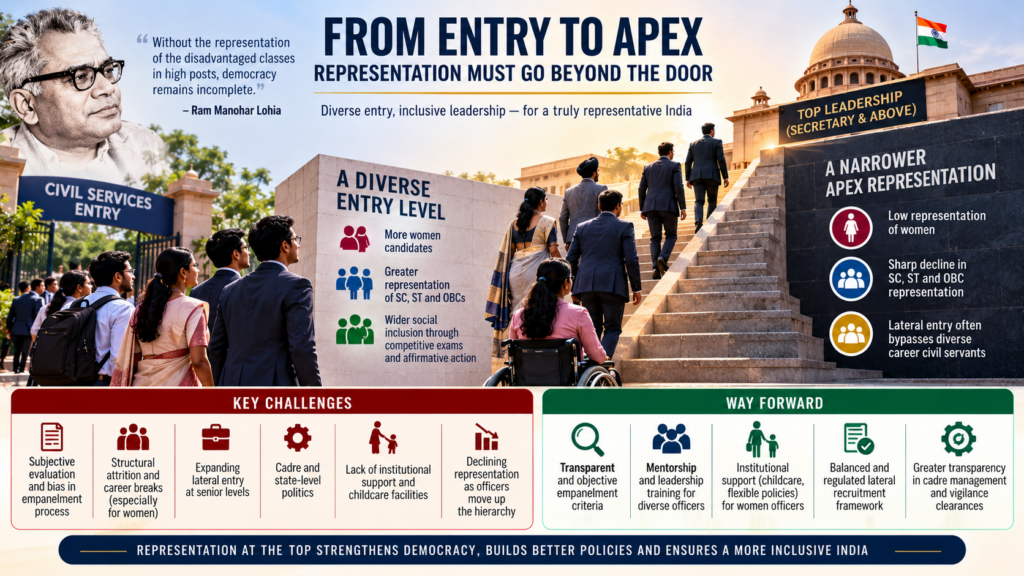
- Gender Disparity at Apex Levels: Although women’s participation at the entry level has reached historic milestones—such as touching nearly 41% in recent IAS batches—their presence thins out drastically at the senior and apex leadership tiers. Structural attrition, career breaks, and slower progression patterns mean that top-tier policy formulation remains male-dominated.
- The Social Hierarchy Drop (SC, ST, and OBCs): Government data presented in Parliament highlights a stark drop-off in senior bureaucratic echelons. While entry-level quotas ensure initial representation for Scheduled Castes (SCs), Scheduled Tribes (STs), and Other Backward Classes (OBCs), representation at the Secretary and Joint Secretary levels in central ministries lingers disproportionately low—often hovering around 4% to 5% for SC/ST officers against mandated quotas, declining sharply as officers move from Director levels up to Secretary roles.
2. Structural Bottlenecks Causing the Attrition
A. The Mechanics of Senior-Level Empanelment
- Central Staffing Scheme (CSS) Norms: Elevation to senior positions at the Centre (Joint Secretary and above) relies heavily on the empanelment process, which evaluates past Annual Performance Assessment Reports (APARs), departmental clearances, and rigorous multi-tier reviews.
- Subjective Evaluation Biases: The transition from objective, exam-based entry to subjective, appraisal-based progression introduces systemic biases, where officers from non-traditional or marginalized backgrounds may face institutional disadvantages.
B. Lateral Entry and Contractual Governance
- Bypassing Career Civil Servants: The increasing institutional reliance on lateral entry—recruiting private sector experts directly to mid and senior-level joint secretary and director posts—bypasses the career pipeline.
- Impact on Diversity: Because lateral entrants often draw from corporate or elite networks, this practice inadvertently shrinks the promotion avenues and apex representation of career civil servants who climbed through foundational entry-level quotas.
C. Institutional Attrition and Life-Stage Barriers
- Work-Life Conflict for Women: The grueling demands of district administration early in service, combined with inadequate institutional childcare support and socio-cultural expectations regarding domestic responsibilities, lead to disproportionate mid-career stagnation or voluntary retirements among women officers.
- Cadre and State-Level Politics: Disparities in state cadre management, arbitrary disciplinary proceedings, and political patronage at state levels can stall an officer’s career trajectory long before central empanelment windows open.
3. Policy Implications and Governance Consequences
- Deficit in Inclusive Policymaking: When apex decision-making bodies lack diverse representation, policies risk suffering from blind spots regarding the ground realities of marginalized populations, rural communities, and gender-specific vulnerabilities.
- Erosion of Substantive Equality: True social justice in governance requires moving beyond formal, entry-level inclusion (proportional representation at the door) to substantive empowerment (effective voice at the table).
4. Way Forward
- Transparent and Objective Empanelment: Streamline and demystify the Central Staffing Scheme empanelment criteria with transparent, objective performance metrics to eliminate discretionary bottlenecks.
- Institutional Support and Mentorship: Establish targeted mid-career leadership training, structured mentorship pipelines, and institutional flexibility (such as expanded childcare leave and creche facilities) to retain women and diverse officers through critical mid-career transitions.
- Balanced Lateral Recruitment Frameworks: Ensure that lateral entry mechanisms are transparent, statutorily regulated, and do not cannibalize the legitimate promotional pathways of career civil servants, particularly those from reserved categories.
- Cadre Management Transparency: Empower the Department of Personnel and Training (DoPT) to audit state-level cadre performance appraisals to prevent arbitrary delays in departmental clearances and vigilance clearances.
|
SOURCE: The Hindu epaper – Realising Lohia’s vision among top posts