
SYLLABUS: Environment General Studies – : III Conservation, environmental pollution and degradation, environmental impact assessment.
IN NEWS: Warming Himalayas demand a rethink on development
QUESTION: The Indian Himalayan Region requires a shift from infrastructure-led development to climate-resilient and ecosystem-based development.” Discuss(250 words)
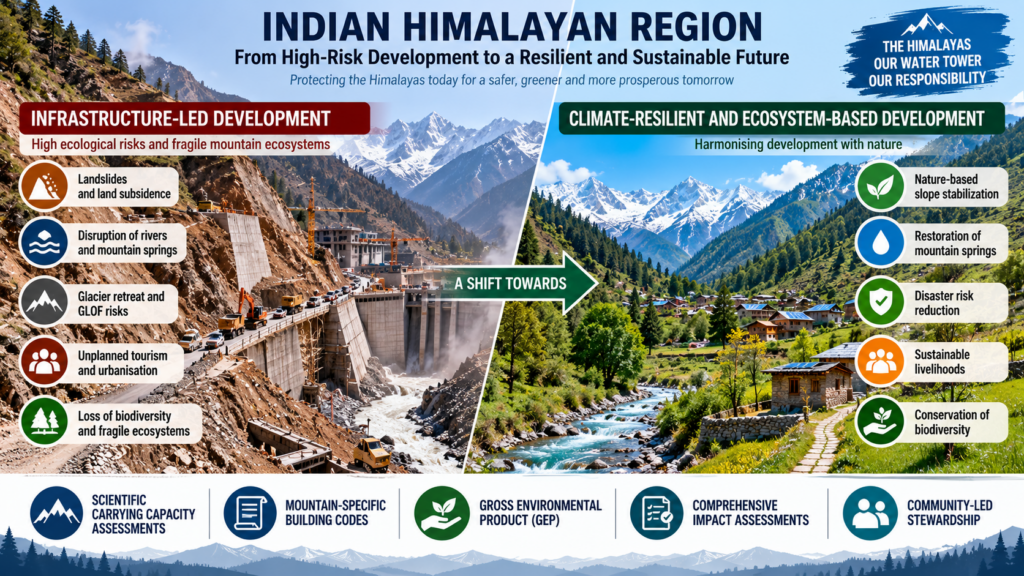
ANSWER: The Indian Himalayan Region (IHR)—spanning 13 states and Union Territories—acts as the “Water Tower of Asia” and a critical ecological security barrier for the Indian subcontinent. However, the paradigm of infrastructure-led development (heavy dam building, unscientific road expansion, and mass tourism urbanisation) has strained the young, geologically active fold mountains. Events such as the Joshimath land subsidence, recurring Glacial Lake Outburst Floods (GLOFs), and major hill-highway landslides highlight the limits of plains-centric construction in mountain ecosystems.
- Limitations of the Infrastructure-Led Development Paradigm
- Geological Instability and Landslides: High-intensity slope-cutting, heavy blasting, and tunnelling for multi-lane highways (e.g., Char Dham Highway expansion) disrupt sensitive toe-slopes, triggering rockslides and accelerating land subsidence.
- Hydro-Ecosystem Disruption: Large-scale hydropower projects rely on run-of-the-river tunnels that alter natural river discharge, drying up natural mountain springs (dharas) and disrupting endemic aquatic biodiversity.
- Cryospheric Degradation and GLOF Risks: Infrastructure expansion increases local black carbon deposition on glaciers. Combined with warming temperatures, this accelerates glacier retreat and creates expanding moraine-dammed glacial lakes vulnerable to outburst floods.
- Exceeding Social and Carrying Capacities: Rapid urbanisation without scientific drainage, sanitation, or solid waste management leads to untreated sewage polluting pristine mountain catchments and destabilising vulnerable slopes.
- Loss of Endemic Biodiversity: Linear infrastructure development fragments critical wildlife corridors, worsening human-wildlife conflict and damaging temperate and alpine biodiversity hotspots.
2. Rationale for Climate-Resilient and Ecosystem-Based Development (EbA)
- Nature-Based Slope Stabilization: Utilizing bio-engineering techniques—such as deep-rooting native vegetation (e.g., Oak, Deodar, Rhododendron) alongside geotextiles—stabilizes fragile slopes at a fraction of the cost of concrete retaining walls.
- Restoration of Mountain Springs (Springshed Management): Recharging natural aquifers through contour trenching and rainwater harvesting restores local drinking water security and base flows in Himalayan rivers.
- Disaster Mitigation and Risk Reduction: Preserving river floodplains, wetlands, and natural forest cover absorbs flash flood energy and buffers high-altitude communities against extreme weather events.
- Sustainable Livelihood Creation: Transitioning toward high-value, eco-sensitive sectors—such as organic farming (following the Sikkim model), agro-forestry, medicinal plant cultivation, and regulated eco-tourism—creates sustainable local livelihoods without damaging fragile topsoil.
3. Key Policy Initiatives & Institutional Frameworks
- National Mission for Sustaining the Himalayan Ecosystem (NMSHE): A key component under the National Action Plan on Climate Change (NAPCC) aimed at building capacity for monitoring mountain ecosystems and climate risks.
- SECURE Himalaya Project: Implemented by MoEFCC in collaboration with UNDP to conserve high-altitude biodiversity, protect endangered species (e.g., Snow Leopard), and secure local community livelihoods.
- Springshed Rejuvenation (Jal Shakti Abhiyan): Focuses on mapping and restoring drying mountain springs across IHR states using hydro-geological methodologies.
- NITI Aayog Guidelines on IHR: Recommends strict carrying-capacity assessments for hill towns, sustainable tourism frameworks, and a “Green Bonus” metric for states preserving critical ecosystem services.
4. Way Forward
- Mandate Scientific Carrying Capacity Assessments: Cap tourism, vehicular inflow, and urban construction permits based on the ecological carrying capacity and micro-hazard zoning of individual mountain valleys.
- Enforce Mountain-Specific Building Codes: Replace rigid plains-based engineering standards with scientific hill-cutting guidelines, mandatory micro-zonation, and light-footprint bio-architectural designs.
- Adopt Gross Environmental Product (GEP): Institutionalize GEP alongside GDP in financial devolution metrics to incentivize states to protect forests, rivers, and alpine meadows.
- Institutionalize Comprehensive Impact Assessments: Expand traditional Environmental Impact Assessments (EIAs) to evaluate the cumulative hydro-geological and climate risks of multiple projects across entire river basins.
- Community-Led Stewardship: Empower traditional local institutions (such as Van Panchayats) and integrate indigenous knowledge on slope behavior and water management into formal disaster mitigation planning.
|
SOURCE: The Hindu epaper – Warming Himalayas demand a rethink on development