
|
IN NEWS: India’s problem of overtreatment, overmedication
QUESTION: The coexistence of overtreatment and undertreatment reflects the structural inequalities in India’s health-care system. Discuss.(250 words)
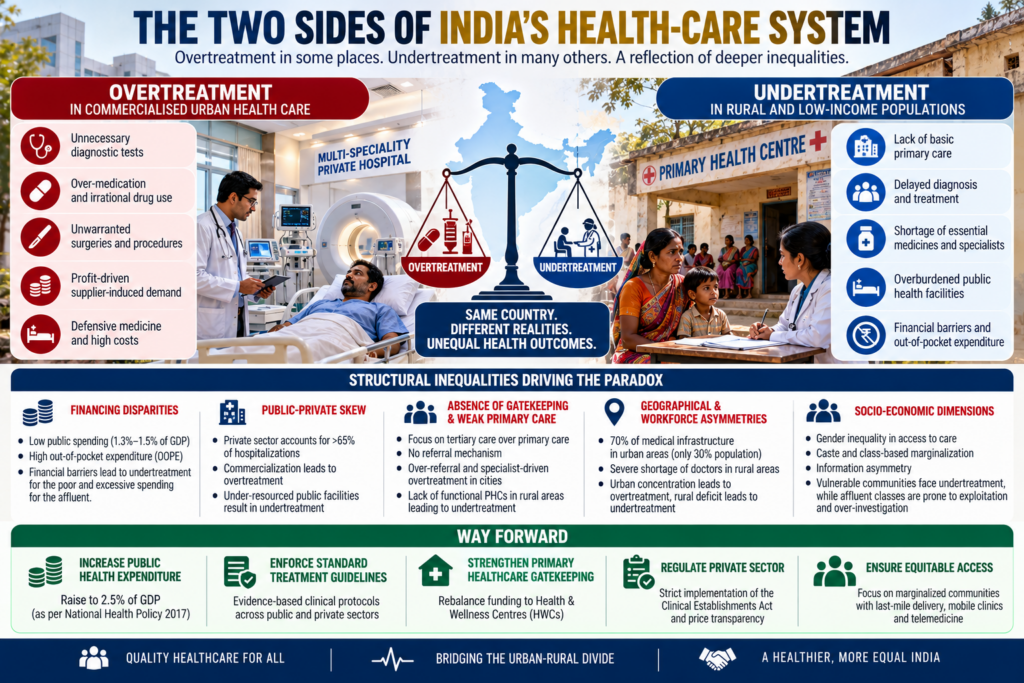
ANSWER: India’s healthcare system is characterized by a stark paradox: the simultaneous existence of overtreatment (unnecessary diagnostic tests, over-medication, unwarranted surgeries) in the commercialized urban sector and undertreatment (lack of basic primary care, delayed diagnoses, unaddressed mortality) among rural and low-income populations. This dual crisis is a direct reflection of structural inequalities embedded in health financing, governance, and infrastructure distribution across the country.
1. Structural Determinants Driving the Paradox
A. Financing & Expenditure Disparities
- Low Public Spending (1.3% to 1.5% of GDP): Inadequate budgetary allocation starves public health facilities of doctors, diagnostics, and essential drugs, leading to undertreatment for marginalized groups dependent on state care.
- Dominance of Out-of-Pocket Expenditure (OOPE): OOPE accounts for a significant portion of total health spending. High financial barriers force low-income households to delay care (undertreatment), while affluent classes spend excessively on non-essential healthcare (overtreatment).
B. Public-Private Sector Skew
- Commercialization of Private Care: With the private sector accounting for over $65\%$ of hospitalizations, profit-driven models lead to supplier-induced demand. This results in overtreatment.
- Underserved Public Sector: Overburdened public hospitals lack basic infrastructure and workforce, resulting in long waiting times, rationing of care, and early discharge of unstable patients (undertreatment).
C. Absence of Gatekeeping & Weak Primary Care
- Distorted System Architecture: India’s health infrastructure prioritizes tertiary care over primary care.
- Impact: The absence of a referral mechanism allows affluent urban patients to bypass primary levels for minor ailments, leading to specialist-driven overtreatment. Conversely, rural populations lack functional Primary Health Centres (PHCs), leading to unmanaged conditions (undertreatment).
D. Geographical and Workforce Asymmetries
- Urban-Rural Divide: Nearly 70 % of medical infrastructure and specialists are concentrated in urban areas where only 30 % of the population resides.
- Impact: Urban centers develop dense, competitive private setups practicing defensive medicine (overtreatment), while rural hinterlands face a severe deficit of medical professionals (undertreatment).
2. Socio-Economic Dimensions of the Health Divide
- Gender Inequalities: Women in low-income and rural households frequently suffer from undertreatment due to lower intra-household priority (e.g., unaddressed anemia and reproductive health issues). Conversely, high rates of elective hysterectomies in private setups reflect commercial overtreatment.
- Caste and Class Marginalization: Vulnerable communities (SC, ST, informal workers) face systemic barriers—geographical isolation, financial vulnerability, and discrimination—leading to high rates of treatable mortality (undertreatment).
- Information Asymmetry: Patients lack the technical awareness to judge necessity, leaving low-income groups vulnerable to under-servicing and middle-to-high-income groups vulnerable to exploitation and over-investigation.
3. Existing Government Initiatives & Limitations
| Initiative | Objective | Key Challenge / Gap |
| Ayushman Bharat – PM-JAY | Secondary & tertiary insurance for poor families | Focuses heavily on hospitalization rather than outpatient primary care |
| Health & Wellness Centres (HWCs) | Strengthen primary care and early detection | Personnel shortages and drug stock-outs persist in remote areas |
| National Health Mission (NHM) | Rural infrastructure and maternal health | Regional disparities in state-level implementation and funding |
| Clinical Establishments Act | Regulate standards in private facilities | Weak enforcement and low adoption rates across several states |
4. Way Forward
- Increase Public Allocation: Step up public health spending to $2.5\%$ of GDP (as recommended by the National Health Policy 2017) to ensure universal access to free essential diagnostics and medicines.
- Mandate Standard Treatment Guidelines (STGs): Enforce evidence-based clinical protocols across both public and private sectors to curb unnecessary procedures and over-prescribing.
- Strengthen Primary Healthcare Gatekeeping: Rebalance funding toward Health & Wellness Centres to detect chronic conditions early, preventing undertreatment in rural areas and over-referral to urban tertiary hospitals.
|
SOURCE: The Hindu epaper – India’s problem of overtreatment, overmedication