
|
IN NEWS: Terror’s changing face, India’s counter-terror strategy
QUESTION: “India’s counter-terrorism strategy has shifted from restraint to deterrence.” Discuss with reference to India’s new-age counter-terrorism policy framework. (15 Marks, 250 Words)
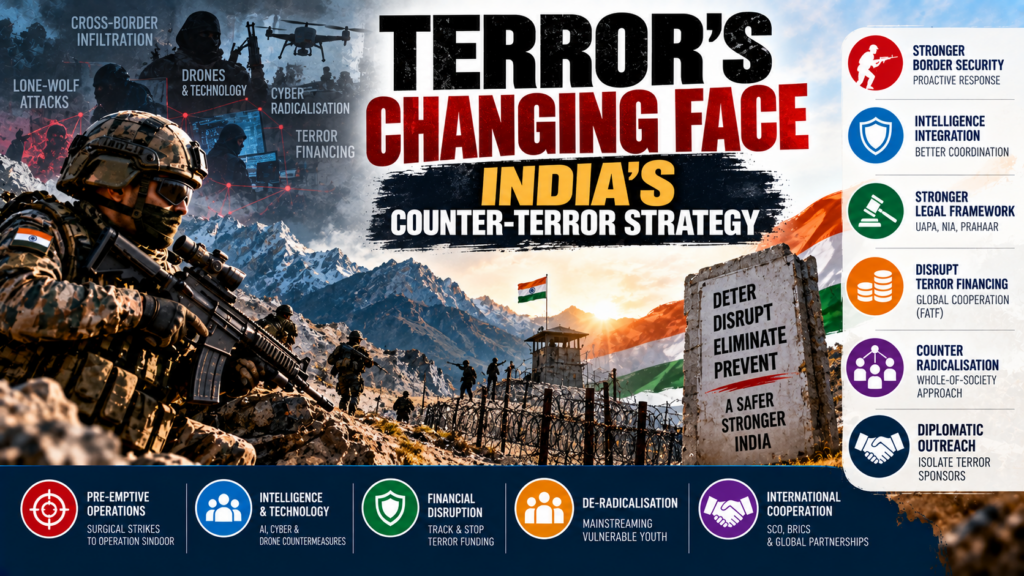
ANSWER: Terrorism in India has evolved from organised cross-border networks to decentralised cells, lone-wolf attacks and technologically-enabled threats drones, cyber capabilities, and radicalisation. In response, India’s counter-terrorism strategy, shaped largely by persistent cross-border terrorism rooted in Jammu & Kashmir since the early 1990s, has shifted from passive restraint to active deterrence, treating cross-border terror as an act of war.
- Evolution of India’s Counter-Terrorism Approach
Restraint-based Response: 1990s – 2008
- Defensive restraint:
- During the 1990s, India primarily treated terrorism as an internal security challenge, relying on intelligence, policing, counter-insurgency and diplomatic pressure.
- Major incidents included the 1993 Mumbai blasts, 1998 Coimbatore blasts and IC-814 hijacking (1999).
- Strategic restraint:
- The 2001 Parliament attack led to Operation Parakram (2001–02) and large-scale military mobilisation, but India stopped short of cross-border military action.
- The 26/11 Mumbai attacks (2008) further demonstrated India’s preference for diplomatic, intelligence and investigative responses despite evidence of external linkages.
Proactive Deterrence: 2016 – 2019
- Surgical strikes (2016): Following the Uri attack, India directly targeted terrorist launch pads across the LoC, signalling a shift towards imposing costs on terrorist infrastructure.
- Balakot air strikes (2019): Following Pulwama, India undertook a cross-border precision strike, demonstrating greater willingness to target terror infrastructure beyond the LoC.
Integrated Counter-Terrorism: 2019–2025
- India’s response increasingly combined military, intelligence, financial, diplomatic and technological instruments, moving beyond isolated kinetic operations.
- Counter-terrorism increasingly focused on terror financing, recruitment, radicalisation, intelligence fusion and disruption of terrorist networks, alongside conventional security operations.
Institutionalised Deterrence: 2026
- Operation Sindoor, following the Pahalgam attack, represents a further shift towards integrated deterrence, combining military action with intelligence, diplomatic and financial measures.
- PRAHAAR – National Counter-Terrorism Policy and Strategy, 2026 is seen as the culmination of this evolution, seeking to replace fragmented, agency-specific responses with a codified national framework.
Thus, India’s trajectory has moved from restraint → proactive retaliation → integrated response → institutionalised deterrence.
- New-Age Policy Architecture
PRAHAAR – National Counter-Terrorism Policy and Strategy
- PRAHAAR marks a shift from ad hoc, agency-driven responses to a comprehensive national doctrine, complementing existing instruments such as the UAPA and NIA framework.
- National Counter-Terrorism Policy and Strategy rests on two organising principles:
- The “whole-of-government” approach, synchronising MHA, Ministry of Defence, intelligence agencies (IB, R&AW), NIA, state police and financial regulators (ED, FIU-IND);
- The “whole-of-society” approach, extending counter-terrorism to civil society, education, and local communities.
- Therefore, it addresses both prevention (radicalisation, financing, recruitment) and response (operations, investigation, deterrence) as twin pillars.
The Four-Fold Operational Strategy for Residual Threats
- Continuous elimination of remaining terror infrastructure within Indian territory, particularly Kashmir.
- Pre-emptive cross-border military action against terror launch-pads along the LoC institutionalising what surgical strikes (2016) and Balakot (2019) began as one-off responses.
- Exhaustive de-radicalisation programme a preventive, non-kinetic pillar mainstreaming vulnerable youth and making terror affiliation socially and economically unattractive.
- Cutting off terror financing through coordinated international mechanisms (e.g., FATF).
Institutional Architecture Reinforcing the New Policy
- National Investigation Agency (NIA):
- India’s central counter-terrorism law-enforcement agency, responsible for investigation and prosecution of offences threatening national security, including terrorism.
- Multi-Agency Centre (MAC):
- An intelligence-sharing and coordination mechanism under the Intelligence Bureau (IB) that facilitates real-time sharing of actionable intelligence among central and State security agencies.
- National Security Guard (NSG):
- India’s specialised counter-terrorism force, trained for high-risk operations such as counter-terrorist intervention, hostage rescue and anti-sabotage operations.
- National Intelligence Grid (NATGRID):
- An integrated intelligence framework that enables authorised security and law-enforcement agencies to access and analyse information from multiple databases for intelligence-led investigation and threat assessment.
- Unlawful Activities (Prevention) Act, 1967 (UAPA):
- India’s principal anti-terror legal framework, enabling the government to proscribe terrorist organisations and designate individuals as terrorists, besides providing provisions for investigation and prosecution.
- National Counter-Terrorism Centre (NCTC):
- A proposed centralised counter-terrorism mechanism intended to integrate intelligence, investigation and operational capabilities; its establishment remains a matter of institutional and inter-governmental debate.
- Enforcement Directorate (ED):
- Investigates money-laundering and proceeds of crime that can include financial networks associated with terrorism and organised crime.
- Financial Intelligence Unit–India (FIU-IND):
- India’s central agency for receiving, processing and analysing suspicious financial transaction information, helping identify potential money-laundering and terror-financing networks.
- Ministry of Home Affairs (MHA):
- The nodal Union ministry for internal security and counter-terrorism coordination, overseeing the broader policy, legislative and institutional framework.
- National Security Council (NSC):
- The apex institutional framework for advising the government on national security matters, supporting strategic coordination and policy formulation.
- Financial Action Task Force (FATF):
- An inter-governmental body that sets global standards against money laundering and terrorist financing, strengthening international efforts to disrupt the financial ecosystem of terrorism
Responding to New-Age Threats
- Terrorism is increasingly shifting towards smaller autonomous cells and lone-wolf actors, reducing the effectiveness of traditional network-centric approaches.
- Drones facilitate surveillance, arms/drug smuggling and attacks, while cyber capabilities and AI create new avenues for recruitment,propaganda,reconnaissance and operational planning.
- Counter-terrorism therefore requires continuous technological upgradation, including AI-enabled intelligence, cyber capabilities, drone countermeasures and predictive threat assessment.
Diplomatic and Multilateral Reinforcement
- India has sought to strengthen the international counter-terrorism consensus through platforms such as the SCO and BRICS, while highlighting the problem of states using terrorism as an instrument of policy.
- Such diplomatic efforts complement kinetic deterrence by seeking the international isolation of terrorist organisations and their state sponsors.
India’s counter-terrorism strategy has consequently evolved from strategic restraint to calibrated deterrence and institutionalised counter-terrorism. Yet, military deterrence alone cannot address decentralised and technology-enabled terrorism. Sustainable security requires the simultaneous strengthening of intelligence coordination, de-radicalisation, financial disruption, technological preparedness, diplomatic isolation and societal resilience.
|
SOURCE: The Hindu e-paper – Terror’s changing face, India’s counter-terror strategy