
|
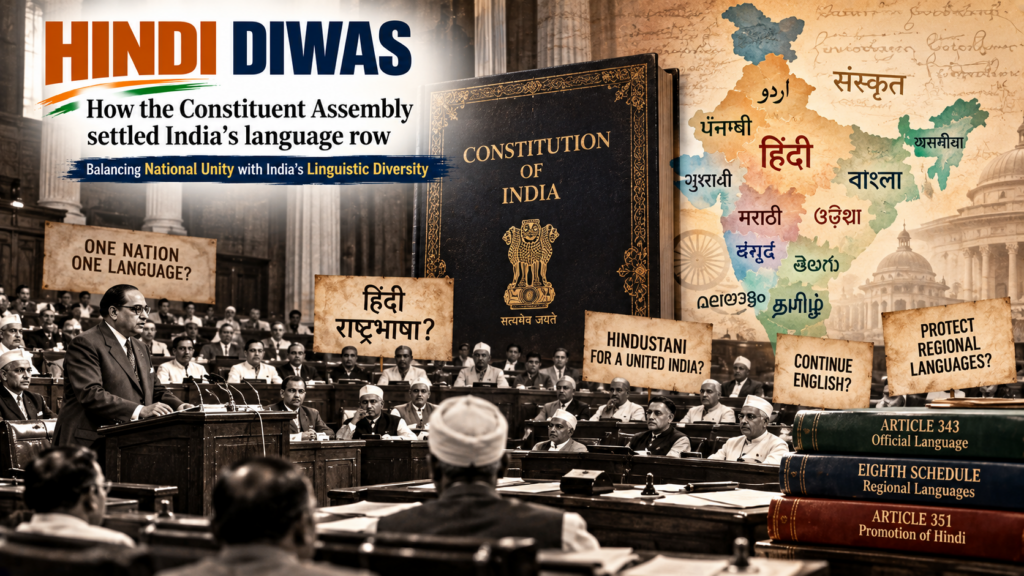
IN NEWS: Hindi Diwas: How the Constituent Assembly settled India’s language row
QUESTION: “The language debate in the Constituent Assembly reflected the larger challenge of balancing national unity with India’s linguistic diversity.” Discuss.250 WORDS
ANSWER: The central conflict lay between proponents of Hindi in the Devanagari script (who sought a single national language to solidify national identity) and representatives from non-Hindi-speaking regions, particularly South India and the Eastern provinces (who feared cultural domination, political marginalization, and disadvantage in public employment).
Key Dimensions of the Language Debate
- National Language vs. Official Language: Proponents of Hindi argued that a sovereign nation needed a single national language (Rashtrabhasha) to replace English, the language of colonial rule. Opponents emphasized that elevating one regional language above others would create first- and second-class citizens.
- Hindi vs. Hindustani: Mahatma Gandhi and several Assembly members originally advocated for Hindustani—a blend of Hindi and Urdu written in both Devanagari and Persian scripts—as an inclusive medium representing India’s composite culture. However, the Partition of India severely weakened support for Hindustani, shifting the focus primarily to Hindi versus English/Regional Languages.
- The Position of English: Non-Hindi members, led by figures like T.A. Ramalingam Chettiar and T.T. Krishnamachari, argued for the retention of English during a transition period. They viewed English not as a colonial remnant, but as a neutral medium that leveled the playing field among diverse linguistic groups.
The Compromise: The Munshi-Ayyangar Formula
- No “National Language”: The Constitution avoided declaring any language as the sole National Language of India.
- Official Language of the Union: Hindi in the Devanagari script was declared the Official Language of the Union (Article 343).
- Transition Period for English: English was allowed to continue as an official language for all Union purposes for a period of 15 years (until 1965), with Parliament granted the power to extend its use thereafter.
- Recognition of Regional Languages: The Eighth Schedule was created to recognize major regional languages, granting them constitutional status and protection.
- Directives for Hindi Development: Article 351 mandated the Union to promote the spread of Hindi while drawing upon Sanskrit and other Indian languages for its enrichment, ensuring its composite character.
Significance in Balancing Unity and Diversity
- Preservation of Federal Integrity: By resisting the imposition of a single national language, the Assembly prevented secessionist tendencies and paved the way for the linguistic reorganization of states in 1956.
- Pragmatic Nationalism: The settlement privileged unity through consensus over uniformity through mandate, recognizing that forced assimilation could fracture the nation.
- Institutional Adaptability: Granting Parliament the authority to extend the use of English allowed subsequent governments to navigate future linguistic friction, leading to the Official Languages Act of 1963.
The Constituent Assembly’s language debate demonstrated that Indian nationhood was conceived not as a monolithic identity, but as a framework capable of accommodating deep diversity. By opting for a flexible “Official Language” framework rather than an uncompromising “National Language,” the framers successfully laid the foundation for a stable, multi-linguistic federal democracy.
|
SOURCE: The Indian Express – Hindi Diwas: How the Constituent Assembly settled India’s language row