
SYLLABUS: Science and Technology General Studies – :III Awareness in the fields of IT, Space, Computers, robotics, nano-technology, bio-technology and issues relating to intellectual property rights.
IN NEWS: ISRO’s ‘privatisation’ move: What India’s space policy says
QUESTION: “The success of India’s space-sector reforms will depend not merely on privatisation, but on building a competitive and innovation-oriented space ecosystem.” Critically analyse.
(15 marks, 250 words)
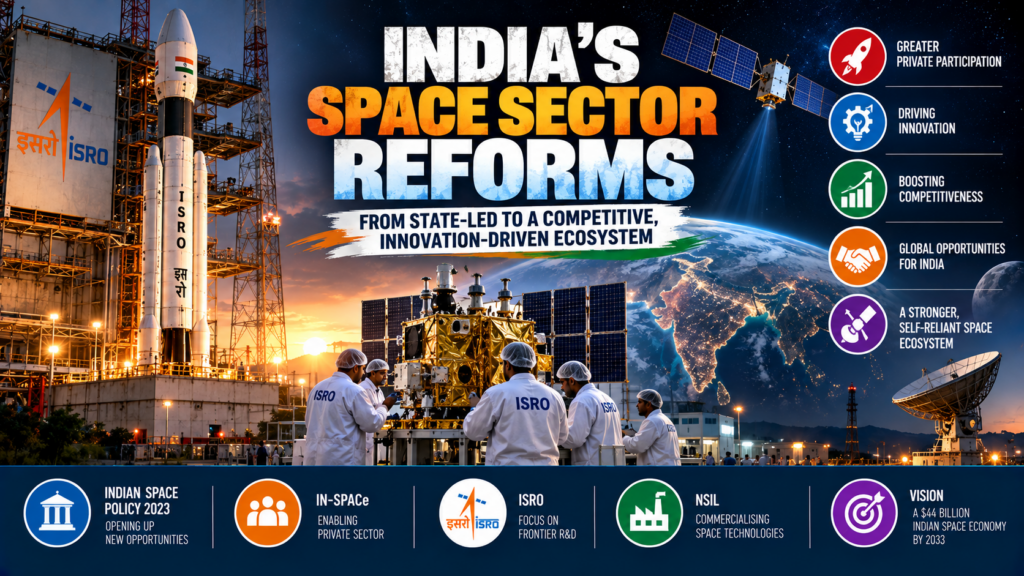
ANSWER: India’s space sector reforms, codified under the Indian Space Policy 2023, mark a structural shift from a state-monopolized, capability-driven model to a market-oriented ecosystem. While liberalizing entry for Non-Government Entities (NGEs) and allowing Foreign Direct Investment (FDI) are necessary first steps, mere privatization cannot guarantee global leadership. True success hinges on building an agile, competitive, and innovation-driven space ecosystem where public research and private enterprise work synergistically.
Limitations of Mere Privatization
- Risk of Low-Value Contract Manufacturing: Simply outsourcing assembly and routine component fabrication to domestic firms converts the private sector into mere vendors rather than creators of proprietary intellectual property (IP).
- Capital and Gestation Bottlenecks: Space technologies carry high capital intensity and long gestation periods. Without specialized risk capital, private firms risk getting stuck in the “valley of death” between laboratory prototypes and commercial scale.
- Monopoly Spillover: Transferring mature launch assets without broad-based market competition risks creating private monopolies, failing to lower launch costs or spark technological breakthroughs.
Core Pillars of a Competitive and Innovation-Oriented Ecosystem
- Institutional Specialization and Demarcation
- The tripartite framework dividing roles between ISRO (frontier R&D, deep-space missions, and human spaceflight), IN-SPACe (independent single-window regulator and facilitator), and NewSpace India Limited (NSIL, commercializing mature technologies) ensures that ISRO is unburdened from routine production. This allows public scientific talent to focus purely on high-risk innovation.
- Demand Aggregation and Government as an Anchor Customer
- Private space ventures rely heavily on predictable demand. Following global models like NASA’s commercial procurement programs, the Indian government and defense forces must act as primary anchor customers by issuing long-term commercial contracts for satellite imagery, earth observation data, and launch services.
- Infrastructure Sharing and Technology Transfer
- Lowering entry barriers requires providing startups access to state-owned critical facilities—such as ISRO’s integration facilities, test stands, and tracking telemetry networks. Transferring dual-use and mature technologies through NSIL enables private entities to build upon proven foundations.
- Financial Synergies and Risk Capital
- Enhancing market liquidity through liberalized automatic-route FDI (up to 74% in satellite activities and 49% in launch vehicles), alongside dedicated public initiatives like the ₹1,000-crore Space Venture Capital Fund, helps seed deep-tech ventures.
- Statutory Clarity and Legal Framework
- Beyond policy guidelines, enacting a comprehensive statutory Space Activities Act is essential to define third-party liability, space asset insurance, spectrum allocation, and intellectual property rights, giving long-term certainty to global and domestic investors.
Strategic Significance of an Ecosystem Approach
- Expanding Global Footprint: India currently holds roughly 2% of the ~$500 billion global space economy. A private-led ecosystem targeting small satellite launches, geospatial analytics, and ground-station-as-a-service can help scale India’s share toward its target of $44 billion by 2033.
- Indigenous Deep-Tech Upstream Capability: Fostering private launch operators (e.g., Skyroot, Agnikul) and satellite constellations (e.g., Pixxel) drives innovation in reusable rockets, 3D-printed engines, and hyperspectral imagery.
- Sovereign Security and Resilience: A broad ecosystem of private space suppliers creates a resilient supply chain for strategic capabilities, earth observation, and communication redundancy during national crises.
Privatization provides the entry gate, but a competitive ecosystem provides the momentum. India’s space reforms will succeed when policy support, public infrastructure sharing, private risk capital, and academic research coalesce. Transitioning from a state-led model to a whole-of-nation space enterprise will allow ISRO to push the frontiers of deep-space exploration while empowering private industry to capture the global commercial space market.
|
SOURCE: The Indian Express – ISRO’s ‘privatisation’ move: What India’s space policy says