
|
IN NEWS: Distorted power relations in the world make Security Council non-operational
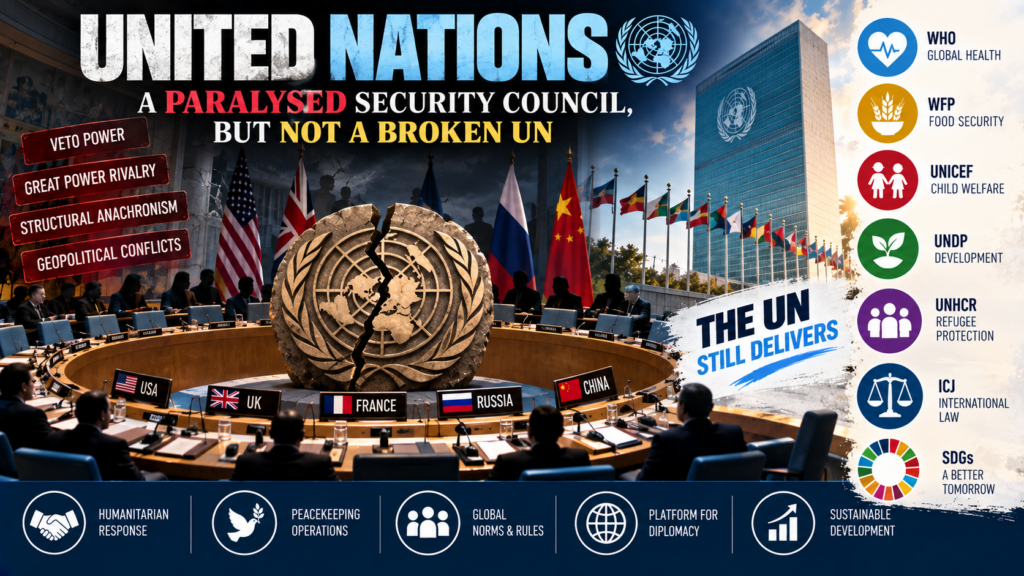
QUESTION: “The United Nations Security Council is paralysed but the UN is not broken”. Comment.
ANSWER: At the 18th BRICS Summit in New Delhi, UN Secretary-General António Guterres remarked that the Security Council is “paralysed,” but the United Nations itself is “not broken.” He attributed this paralysis to major powers failing to recognise the limits of their own power.
Security Council Being Paralysed :
- Veto Power and P5 Rivalry
The veto, held by the five permanent members (US, UK, France, Russia, China), was designed to ensure great-power consensus but has instead become a tool for protecting national or allied interests.
- Russia’s vetoes on resolutions concerning Ukraine
- US vetoes shielding actions related to Israel-Gaza
- China-Russia alignment blocking action on Syria and Myanmar
- Structural Anachronism
The UNSC’s permanent membership reflects the post-WWII power structure of 1945, not contemporary geopolitical realities – Africa, Latin America, and large democracies like India, Brazil, and Germany have no permanent seat despite their global weight. - Great-Power Competition Returning
With US-China rivalry and the Russia-West confrontation intensifying, the Council increasingly mirrors broader geopolitical fault lines rather than functioning as a neutral arbiter.
UN retaining relevance through its other organs, agencies, and normative functions : - General Assembly as a Democratic Counterweight
When the Council is deadlocked, the UNGA’s “Uniting for Peace” mechanism allows the wider membership to step in. Its resolutions on Ukraine, though non-binding, carried significant diplomatic and normative weight, signalling broad international opinion even without enforcement power.
- Specialised Agencies Operate Independently of Council Gridlock
WHO, UNHCR, WFP, UNICEF, and UNDP continue humanitarian, developmental, and health functions regardless of Council paralysis – their mandates don’t require Security Council authorization to function day-to-day.
- Continuity of Peacekeeping
Existing missions (DRC, South Sudan, Lebanon) continue operating even when the Council cannot agree on new mandates or interventions – demonstrating institutional inertia that isn’t wholly dependent on unanimous P5 consent.
- Normative and Legal Architecture
The UN’s enduring strength lies not just in crisis response but in its capacity to shape the rules, norms, and legal frameworks that govern international conduct over the long term
- a) International Court of Justice (ICJ)
- Continues adjudicating inter-state disputes and issuing advisory opinions independent of Council paralysis (e.g., advisory opinions on climate obligations, and rulings related to the Israel-Palestine conflict)
- b) Human Rights Architecture
- The UN Human Rights Council, OHCHR, and treaty-monitoring bodies continue investigating violations, issuing reports, and applying diplomatic pressure (e.g., fact-finding missions on Ukraine, Myanmar, Gaza)
- Universal Periodic Review mechanism keeps all member states under continuous human rights scrutiny, regardless of Council activity
- c) Global Agreements and Normative Frameworks
- Paris Climate Accord (2015) – negotiated and adopted under UN auspices, continues to structure global climate commitments and periodic review (COP process) despite Council-level disputes elsewhere
- Sustainable Development Goals (SDGs) – provide a globally accepted development framework guiding national policy, investment, and multilateral cooperation.
- d) Emerging Governance: Artificial Intelligence
- UNSG Guterres has highlighted the UN’s role in convening the first-ever global dialogue on AI governance, noting that prior to this initiative, over a hundred countries had never participated in any global forum addressing artificial intelligence
- Suggests a proactive, agenda-setting role for the UN distinct from its reactive crisis-response function
- Platform for Diplomacy
Even when action is blocked, the UN remains the principal forum where adversarial states continue to engage, negotiate, and communicate – arguably preventing worse escalation.
Child welfare in the digital age cannot rest solely on legacy protections against physical harm; it must evolve to address online exploitation and close regulatory gaps around technology in schools. A proactive, well-coordinated welfare architecture is essential to secure India’s children as much online as offline.
Way Forward
- UNSC Reform: Expansion of permanent/non-permanent membership (G4 proposals – India, Brazil, Germany, Japan); calls for a “veto restraint” code in mass atrocity situations
- Strengthening UNGA’s role: Greater reliance on Uniting for Peace-type mechanisms during deadlock
- Reinforcing agency-level multilateralism: Continued investment in WHO, UNHCR, UNDP, etc., as functioning pillars of global governance even amid Council dysfunction.
The Security Council’s paralysis reflects a crisis of great-power consensus, not a collapse of multilateralism itself. The United Nations, through its broader organs and agencies, continues to deliver humanitarian relief, uphold international law, and provide a platform for dialogue, proving that while one organ may be gridlocked, the institution as a whole retains functional relevance and legitimacy in global governance.
|
SOURCE: The Hindu e-paper – Distorted Power Relations in the World make Security Council non-operational