
| SYLLABUS: Disaster Management General Studies – : III Disaster and Disaster Management |
IN NEWS: Hunker down
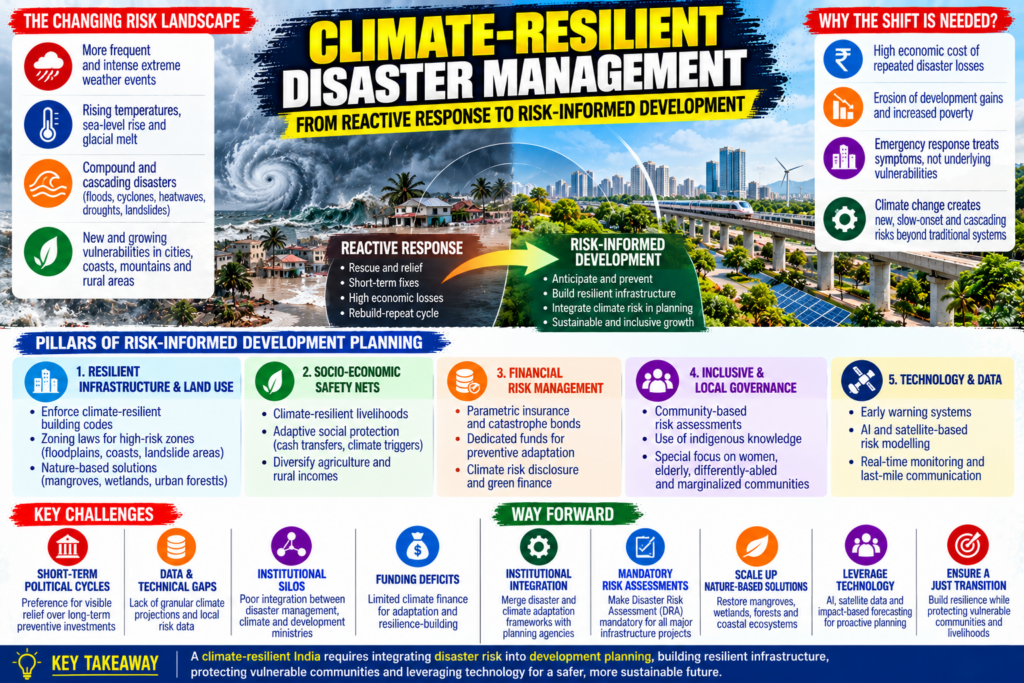
QUESTION: “Climate-resilient disaster management requires a shift from event-specific emergency response to risk-informed development planning.” Discuss
ANSWER: Historically, disaster management was predominantly reactive—focusing on post-event rescue, relief, and reconstruction. However, as climate change accelerates the frequency and intensity of extreme weather events, reactive approaches are becoming economically unsustainable and humanly catastrophic.
Shifting to risk-informed development planning means integrating climate and disaster risk assessments into every layer of social, economic, and physical planning before disasters strike.
1. The Need for the Shift: Limitations of Event-Specific Emergency Response
- Financial Unsustainability: The “disaster-rebuild-repeat” cycle strains public finances. Spending billions on post-disaster recovery drains resources from education, healthcare, and infrastructure.
- Maladaptation and Risk Creation: Unplanned urban expansion, deforestation, and non-resilient infrastructure create new risks. Emergency response treats the symptoms of a disaster, not the underlying vulnerabilities created by poor development choices.
- Erosion of Development Gains: A single severe storm or flood can set back decades of socio-economic progress in vulnerable communities, pushing millions back into poverty.
- The Changing Nature of Risks: Climate change introduces compound, cascading, and slow-onset risks (e.g., sea-level rise, prolonged droughts) that traditional emergency response frameworks are ill-equipped to handle.
2. Core Pillars of Risk-Informed Development Planning
| Pillar | Focus & Key Interventions |
| Resilient Infrastructure & Land Use | • Enforcing strict, climate-resilient building codes. • Zoning laws that prohibit construction in high-risk zones (floodplains, landslide-prone slopes). • Investing in nature-based solutions (e.g., coastal mangrove restoration, urban wetlands). |
| Socio-Economic Safety Nets | • Adaptive social protection programs (e.g., cash transfers triggered by climate thresholds). • Diversifying rural livelihoods away from climate-vulnerable agriculture. |
| Financial Risk Management | • Parametric insurance and catastrophe bonds to secure rapid liquidity. • Budgetary reserves specifically allocated for preventive adaptation. |
| Inclusive & Local Governance | • Leveraging indigenous knowledge for localized risk assessments. • Ensuring vulnerable groups (women, elderly, disabled) participate in planning. |
3. Key Challenges in Transitioning
- Short-Term Political Cycles: Political incentives often favor visible, immediate post-disaster relief over long-term, invisible preventive investments.
- Data & Technical Gaps: Granular climate projections and localized risk data are often lacking, particularly in developing nations.
- Institutional Silos: Disaster management agencies and development ministries (finance, urban planning, agriculture) often operate in isolation without unified risk-planning frameworks.
- Funding Deficits: International climate finance remains disproportionately skewed toward mitigation or immediate humanitarian response rather than proactive adaptation.
Way Forward
- Institutional Integration: Merging National Disaster Management Authorities (NDMAs) with climate adaptation bodies and central planning agencies.
- Mainstreaming Risk Assessments: Making Disaster Risk Assessment (DRA) a mandatory prerequisite for all public and private infrastructure investments (similar to Environmental Impact Assessments).
- Promoting Nature-Based Solutions (NbS): Integrating green infrastructure (e.g., reforestation, coral reef protection) alongside traditional grey infrastructure (sea walls, dams).
- Leveraging Technology: Utilizing early warning systems, AI-driven risk modeling, and satellite monitoring to inform spatial planning and proactive evacuation strategies.
|
SOURCE: The Hindu epaper – Hunker down