
|
IN NEWS: Disinvestment as key economic strategy
QUESTION: “Asset monetisation can unlock the productive potential of public assets, but it cannot substitute for sustainable revenue mobilisation and fiscal discipline.” Analyse. (150 words)
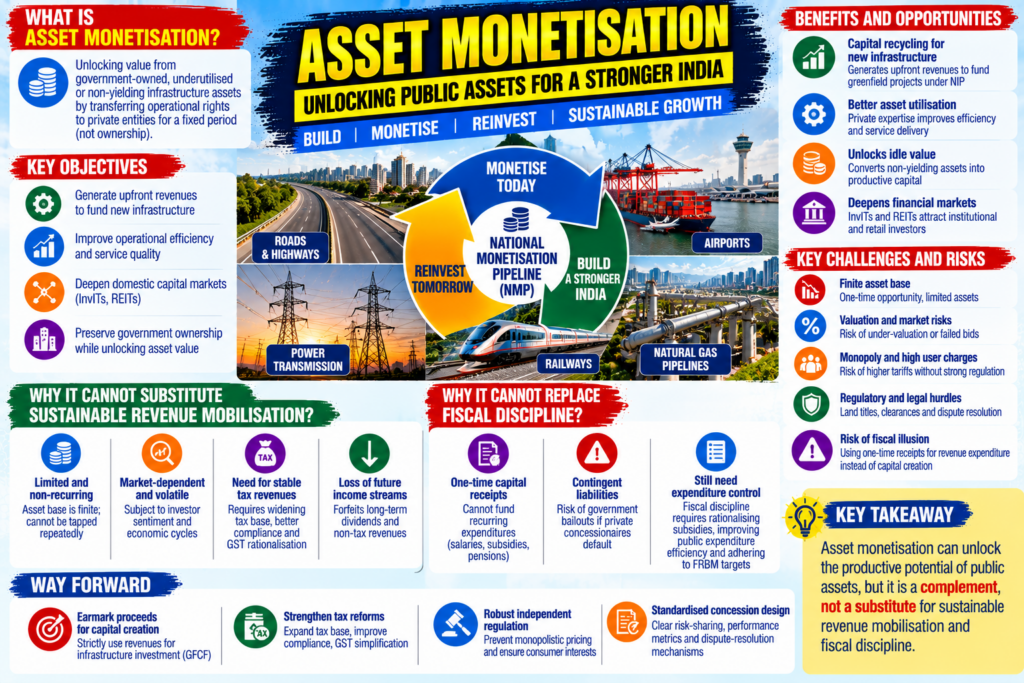
ANSWER: Asset monetisation—primarily operationalised in India through the National Monetisation Pipeline (NMP)—aims to unlock capital embedded in unutilised or underutilised public infrastructure by transferring operational rights (not ownership) to private entities.
1. Productive Potential of Asset Monetisation
- Capital Recycling for Infrastructure Creation: Yields upfront revenues and premium payments that can be reinvested into greenfield infrastructure under the National Infrastructure Pipeline (NIP), mitigating public debt expansion.
- Enhancing Operational & Asset Efficiency: Brownfield projects (e.g., toll roads, gas pipelines, power transmission lines) often suffer from suboptimal capacity utilization under public management. Private concessionaires bring technological upgrades and commercial management.
- Unlocking Idle Value: Converts non-yielding public capital into cash flows without transferring core ownership, preserving sovereign rights while maximizing returns.
- Deepening Capital Markets: Instruments like Infrastructure Investment Trusts (InvITs) and Real Estate Investment Trusts (REITs) allow institutional and retail investors to participate in infrastructure yield, deepening domestic financial markets.
2. Why Asset Monetisation Cannot Substitute for Sustainable Revenue Mobilisation
- Finite Asset Base: Public assets eligible for monetisation are limited. Once monetised under multi-decade concessions (e.g., 20–30 years), the revenue inflow cannot be repeatedly tapped.
- Volatile and Market-Dependent Revenues: Revenue generation depends heavily on market sentiment, interest rate cycles, regulatory clarity, and investor risk appetite. It lacks the stability and predictability of tax receipts.
- Non-Tax Revenue vs. Tax Base Expansion: Sustainable revenue mobilisation requires widening the direct tax base, improving tax compliance, rationalising tax slabs (e.g., GST simplification), and addressing structural leakages—none of which can be replaced by asset leases.
- Loss of Future Non-Tax Inflows: Monetising dividend-paying or profitable public assets yields immediate liquidity but forfeits long-term steady revenue streams (dividends/profits) that accrued to the exchequer.
3. Why Asset Monetisation Cannot Substitute for Fiscal Discipline
- Risk of Fiscal Illusion: Monetisation proceeds can artificially mask high revenue deficits. Using one-time capital receipts to fund recurring revenue expenditures (e.g., subsidies, salaries, pensions) violates sound fiscal management principles enshrined in the FRBM Framework.
- Sovereign Contingent Liabilities: Poorly drafted concession agreements or default risks by private concessionaires can force the government to step in, creating hidden or off-budget contingent liabilities.
- Cost of Regulatory and Market Failures: Monopoly risks in monetised public infrastructure (e.g., ports, airports, highways) can lead to user-fee inflation. If regulatory oversight fails, public welfare declines, prompting costly state interventions.
Key Challenges and Risks in Implementation
- Valuation and Market Risks: Accurately pricing long-term asset concessions is complex; under-valuation risks public loss, while over-valuation leads to failed auctions.
- Monopoly and User Cost Dynamics: Monopolistic tendencies in privatised infrastructure can result in high user tariffs, creating economic friction for the public.
- Regulatory Capacity: Weak independent sector regulators can lead to dispute-ridden concessions, delays, and litigation.
- Encroachment and Dispute Settlement: Disencumbering brownfield assets (land titles, environmental clearances, labor issues) before monetisation remains an administrative bottleneck.
Way Forward
- Adhere to FRBM Mandates: Earmark 100% of monetisation proceeds strictly for capital creation (GFCF) rather than bridging revenue deficits.
- Strengthen Structural Tax Reforms: Focus on direct tax rationalisation, expanding the tax base, and curbing tax evasion to ensure predictable, long-term revenue streams.
- Ensure Robust Independent Regulation: Establish transparent, autonomous regulatory frameworks across infrastructure sectors to prevent monopolistic pricing and protect consumer interests.
- Rigorous Concession Design: Standardise Model Concession Agreements (MCAs) with clear dispute-resolution mechanisms, balanced risk-sharing models, and strict performance metrics.
|
SOURCE: The Hindu epaper – Disinvestment as key economic strategy