
|
IN NEWS: India’s next investment cycle will shape its carbon future
QUESTION: How can India balance its developmental imperatives with the need to prevent carbon lock-in and stranded assets? Discuss with reference to long-lived infrastructure investments and emerging low-carbon technologies. (15 marks, 250 words)
ANSWER: India faces a unique dual imperative: expanding infrastructure to meet the socio-economic aspirations of its 1.4 billion population while committing to reach net-zero emissions by 2070.
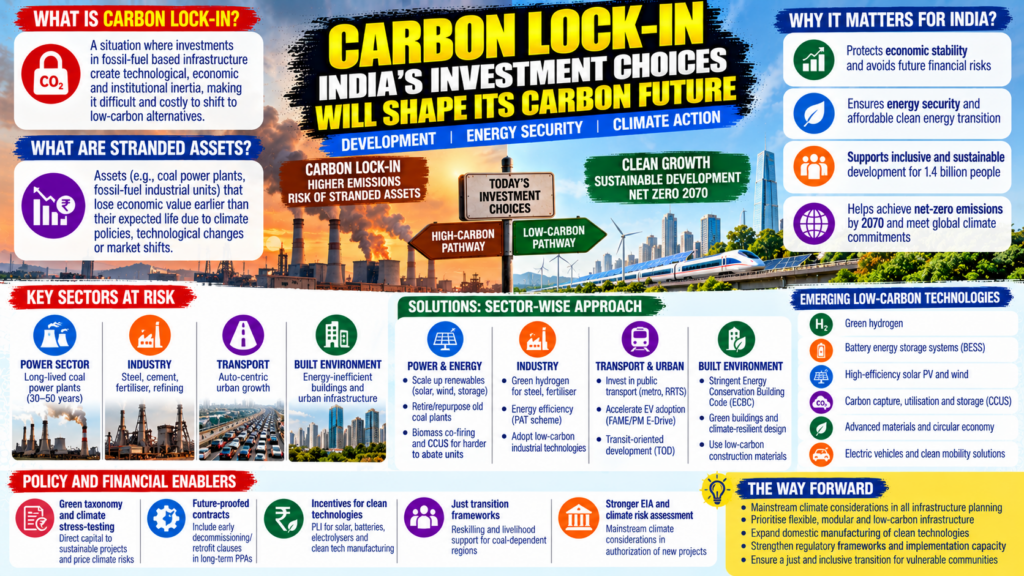
A central challenge in this transition is avoiding carbon lock-in (where fossil-fuel infrastructure creates technological, economic, and institutional inertia) and preventing stranded assets (infrastructure that suffers premature devaluation or write-downs due to climate policies and technological disruption).
The Twin Risks in Long-Lived Infrastructure Investments
- Carbon Lock-In: Investments in long-life assets (e.g., thermal power plants, traditional steel plants, urban road networks) lock the economy into carbon-intensive operational pathways for 30–50 years.
- Stranded Asset Vulnerability: As renewable energy costs plummet and global carbon border measures (e.g., EU’s CBAM) take effect, coal power plants, fossil-fuel industrial units, and inefficient real estate risk becoming non-viable long before their design life ends, exposing state-owned banks and utilities to bad loans.
Balancing Developmental Imperatives with Decarbonization
India can balance economic growth and climate goals through a structured approach targeting key capital-intensive sectors:
1. Power and Energy Sector Transition
- Flexible Operation & Retirement Pathways: Transition older, inefficient coal plants to operate as flexible “peaking” power sources rather than baseload capacity, while retrofitting young coal plants for co-firing with biomass or carbon capture, utilization, and storage (CCUS).
- Modular Infrastructure: Focus future capacity additions on modular, quickly scalable clean technologies (solar PV, battery energy storage systems, and pumped hydro storage) rather than long-lead thermal projects.
2. Industry & Hard-to-Abate Sectors
- Transition to Green Hydrogen: Leverage the National Green Hydrogen Mission to substitute fossil fuels in steelmaking, fertilizers, and refining, preventing carbon lock-in in new industrial units.
- Circular Economy & Resource Efficiency: Deploy the Perform, Achieve and Trade (PAT) scheme and material efficiency standards to ensure new industrial investments integrate low-carbon pathways from inception.
3. Sustainable Urbanization and Transport
- Modal Shift to Transit-Oriented Development (TOD): Avoid auto-centric urban lock-in by investing in high-capacity public transport (Metros, Regional Rapid Transit Systems) and dedicated freight corridors.
- Phased Electrification: Accelerate EV adoption through the FAME/PM E-Drive schemes, alongside deploying battery swapping networks and interoperable charging infrastructure.
4. Climate-Proofing Built Environment
- Green Building Codes: Enforce strict compliance with the Energy Conservation Building Code (ECBC) for commercial and residential developments to avoid decades of high energy consumption.
Policy and Financial Enablers
| Dimension | Key Enabler | Impact on Preventing Lock-in |
| Financial System | Green Taxonomy & Climate Stress-Testing | Directs capital toward sustainable projects and forces financial institutions to price stranded asset risks into thermal/fossil loans. |
| Technology Acceleration | Production Linked Incentives (PLI) | Subsidizes domestic manufacturing of low-carbon tech (advanced chemistry cells, high-efficiency solar modules, electrolyzers). |
| Policy Flexibility | “Future-Proofed” Contracting | Incorporates early-decommissioning or retrofit clauses into long-term Power Purchase Agreements (PPAs) to mitigate lock-in risks. |
| Just Transition | Regional Diversification Frameworks | Safeguards vulnerable local economies in coal-dependent regions (e.g., Jharkhand, Odisha) through retraining and reskilling programs. |
Aligning India’s development goals with low-carbon growth requires a shift from “build now, clean up later” to “climate-smart capital allocation.” By aligning long-lived infrastructure with flexible, modular designs and accelerating the deployment of emerging low-carbon technologies, India can simultaneously meet its growth aspirations, ensure energy security, and insulate its financial sector from stranded asset risks.
|
SOURCE: The Hindu epaper – India’s next investment cycle will shape its carbon future