
SYLLABUS: International Relations General Studies – : II Bilateral, regional and global groupings and agreements involving India and/or affecting India’s interests.
IN NEWS: New Delhi’s ‘balancing act’ risks eroding Russia’s trust
QUESTION: “BRICS and the SCO provide India with platforms to advance a multipolar world order, but their expanding membership also complicates consensus-building.” Discuss. (15 marks, 250 words)
ANSWER: The BRICS (Brazil, Russia, India, China, South Africa, and expanded members) and the Shanghai Cooperation Organisation (SCO) serve as foundational multilateral platforms in India’s multi-aligned foreign policy. They offer New Delhi significant strategic leverage to champion a multipolar world order, reform global governance mechanisms, and project the voice of the Global South.
Platforms to Advance a Multipolar World Order
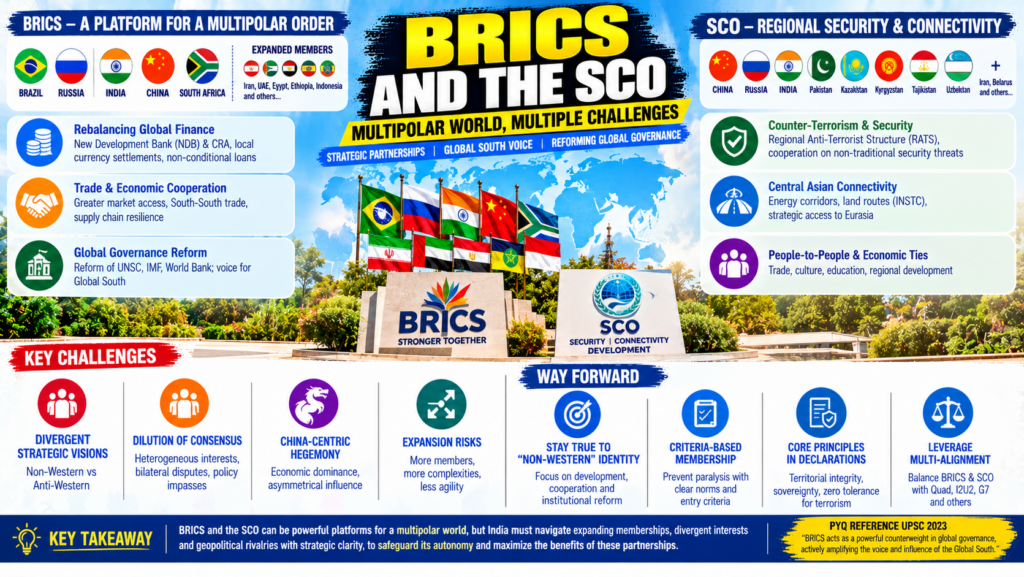
1. Rebalancing Global Financial Infrastructure (BRICS)
- Alternative Financing & De-Dollarization: Through the New Development Bank (NDB) and the Contingent Reserve Arrangement (CRA), BRICS provides developing nations with non-conditional infrastructure financing, bypassing the stringent conditionality’s of the IMF and World Bank.
- Local Currency Settlements: Promoting trade in local currencies reduces vulnerability to Western financial sanctions and unilateral sanctions, fostering economic multipolarity.
2. Eurasian Security and Counter-Terrorism Coordination (SCO)
- Regional Security Architecture: The SCO provides a structured platform to address non-traditional security threats in Eurasia through the Regional Anti-Terrorist Structure (RATS).
- Central Asian Connectivity: It allows India to maintain direct engagement with Central Asian republics, securing vital energy corridors, land transport routes (like INSTC), and strategic footprint without relying on Western routes.
3. Reform of Global Governance & Global South Leadership
- UNSC and IMF Reforms: Both forums consistently call for democratizing the United Nations Security Council (UNSC) and Bretton Woods institutions to reflect contemporary geopolitical realities.
- Vanguard of the Global South: India leverages these platforms alongside its G20 leadership to frame policies on climate finance, digital public infrastructure (DPI), and supply-chain resilience tailored to developing nations.
4. Direct Bilateral Engagement and Strategic Autonomy
- Diplomatic Cushioning: Membership ensures crucial strategic space to engage directly with China and Russia, preventing total isolation or single-bloc dominance. It allows India to practice “evasive balancing” and safeguard its strategic autonomy while simultaneously participating in Western-led forums like the Quad.
Challenges posed by Expanding Membership and Consensus-Building
| Dimension | Scope of Expansion | Primary Consensus-Building Challenges |
| BRICS Expansion | Addition of Iran, UAE, Egypt, Ethiopia, Indonesia, etc. | Ideological variance; risk of turning into an explicit “anti-West” coalition driven by China-Russia-Iran. |
| SCO Expansion | Inclusion of Pakistan, Iran, and Belarus | Importation of bilateral conflicts into multilateral agenda; focus diverted from consensus security goals. |
1. Divergent Strategic Visions: “Non-Western” vs. “Anti-Western”
- Ideological Friction: India views BRICS and the SCO as “non-Western” forums aimed at reforming multilateralism. Conversely, China, Russia, and Iran increasingly seek to weaponize these groupings into “anti-Western” geopolitical blocs targeting US hegemony.
- Loss of Strategic Neutrality: An explicitly anti-Western pivot risks alienating India’s key economic and strategic partners in the West (e.g., US, EU, Japan).
2. Dilution of Consensus and Institutional Efficacy
- Heterogeneity of Interests: Expanding from cohesive core groups to broad, diverse coalitions makes unanimity on key joint declarations increasingly difficult. Member states bring conflicting economic systems, foreign policy priorities, and security alignments.
- Bilateral Disputes Hijacking Agendas: The inclusion of rival states (e.g., India-Pakistan in SCO, Iran-Saudi dynamics in expanded formats) leads to structural impasses, blocking substantive joint initiatives in trade and counter-terrorism.
3. China-Centric Hegemony and Asymmetry
- Economic Overshadowing: China’s massive economic weight creates asymmetrical influence within the New Development Bank and Belt and Road Initiative (BRI) projects linked to the SCO.
- Countering Unipolarity within Multipolarity: India faces the challenge of preventing a transition from a Western-dominated unipolar world to an Asia/Eurasia order dominated by Beijing.
Way Forward
- Firm Stance on “Non-Western” Identity: Anchor both organizations around developmental agendas, economic cooperation, and institutional reform rather than anti-Western rhetoric.
- Criteria-Based Membership Norms: Advocate for strict, institutionalized criteria for further expansion or dialogue-partner additions to prevent systemic paralysis.
- Core Principles in Joint Declarations: Mandate explicit recognition of territorial integrity, sovereignty, and zero tolerance for state-sponsored cross-border terrorism in all joint SCO/BRICS communiqués.
- Leveraging Multi-Alignment: Continue balancing BRICS and SCO engagements with active participation in Western/Indo-Pacific platforms (Quad, I2U2, G7 invitee status) to maintain maximum strategic flexibility.
|
SOURCE: The Hindu epaper – New Delhi’s ‘balancing act’ risks eroding Russia’s trust