
|
IN NEWS: Why are social media takedowns in focus?
QUESTION: Examine the constitutional and legal framework governing the blocking of online content in India. How can the State balance public order with freedom of speech and expression under Article 19?(15 Marks, 250 words)
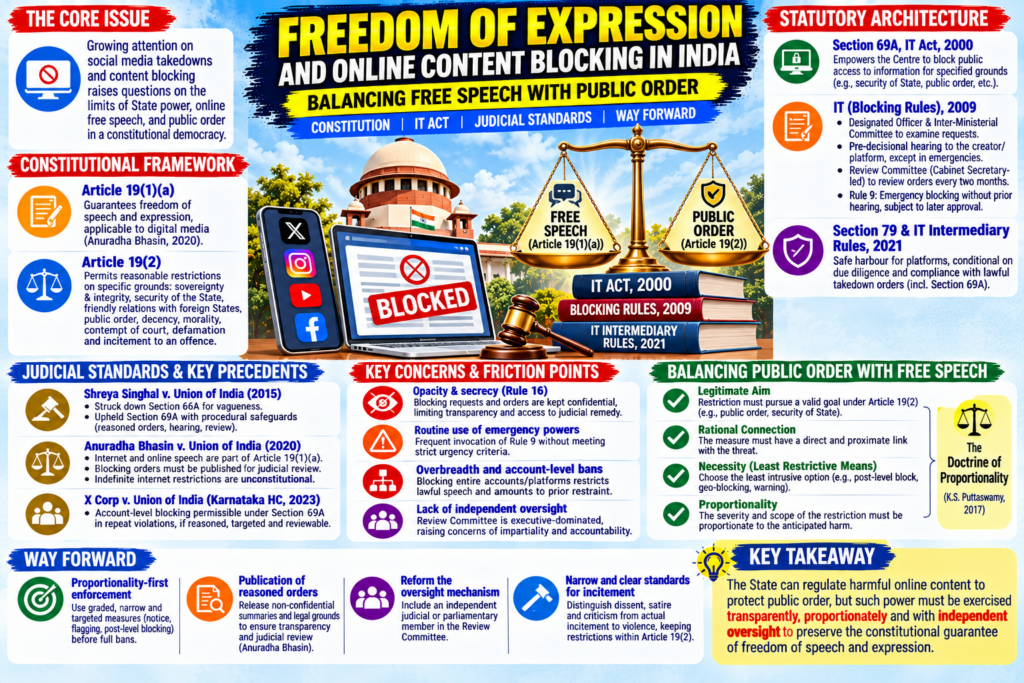
ANSWER: The regulation of online content in India sits at the intersection of state sovereignty, public order, and fundamental civil liberties. While Article 19(1)(a) of the Indian Constitution guarantees the Freedom of Speech and Expression to all citizens, this right is not absolute and is subject to “reasonable restrictions” under Article 19(2).
Constitutional Basis: Article 19(1)(a) vs. Article 19(2)
- Scope of Online Free Speech: Article 19(1)(a) guarantees the freedom of speech and expression, which extends to digital media and internet access (Anuradha Bhasin v. Union of India, 2020). Speech cannot be restricted on grounds outside the eight exhaustive heads under Article 19(2).
- The High Threshold of “Public Order”: In Ram Manohar Lohia v. State of Bihar (1966), the Supreme Court distinguished “law and order,” “public order,” and “security of the State.” To restrict speech under “public order,” there must be a direct, proximate, and immediate threat to public tranquility—satisfying the “spark in a powder keg” test rather than hypothetical or remote harm.
- The Doctrine of Proportionality: As affirmed in K.S. Puttaswamy (2017) and Anuradha Bhasin (2020), state restrictions on free speech must satisfy four tests: legitimate goal, rational connection, necessity (least restrictive means), and proportionality strictu sensu (balancing severity against outcome).
Statutory Architecture Governing Blocking
- Section 69A of the IT Act, 2000: Empowers the Central Government (or delegated officers) to issue directions to block public access to information on specific grounds: sovereignty/integrity of India, defense, security of State, friendly relations with foreign States, or public order.
- IT (Blocking Rules) 2009 — Operational Controls:
- Designated Officer & Inter-Ministerial Committee: Screening mechanism to examine blocking requests.
- Pre-Decisional Hearing: Requirement to issue notice and grant a hearing to the creator or platform before blocking.
- Review Committee: Executive oversight committee headed by the Cabinet Secretary to review blocking orders every two months.
- Rule 9 (Emergency Blocking): Allows temporary blocking without a prior hearing in urgent situations, subject to post-facto committee approval.
- Section 79 & IT Intermediary Rules, 2021: Intermediaries enjoy “safe harbour” immunity from third-party content liability only if they exercise due diligence and act upon actual knowledge (court orders or authorized government directions under Section 69A).
Judicial Jurisprudence & Standards of Review
- Shreya Singhal v. Union of India (2015): The Supreme Court struck down Section 66A for vagueness and overbreadth, but upheld Section 69A. The Court ruled that Section 69A is constitutional because it contains built-in procedural safeguards: reasoned written orders, mandatory hearings, and Review Committee scrutiny.
- Anuradha Bhasin v. Union of India (2020): Laid down that indefinite digital bans or access restrictions are unconstitutional. Mandatory publication of blocking orders was established as a prerequisite for judicial review under Article 32/226.
- X Corp v. Union of India (Karnataka High Court, 2023): Confirmed that account-level blocking (instead of post-level blocking) is permissible under Section 69A in repeat offender cases, provided individual orders remain reasoned, targeted, and subject to judicial scrutiny.
Critical Friction Points & Constitutional Concerns
- Rule 16 Confidentiality & Opaque Executive Orders: Rule 16 of the 2009 Blocking Rules mandates strict secrecy of all blocking requests and actions. This prevents content creators and citizens from knowing why content was removed, directly impairing the right to judicial remedy under Article 226/32.
- Bypassing Regular Procedure via Emergency Powers: Standard procedural requirements (reasoned orders and pre-decisional hearings) are frequently bypassed by routinely invoking Rule 9 emergency powers for standard public order administration.
- Overbreadth & Account-Level Censorship: Blocking entire accounts rather than specific illegal posts leads to prior restraint and overbreadth, censoring future lawful speech alongside targeted unlawful posts.
- Institutional Conflict in Oversight: The Review Committee under the 2009 Rules comprises executive officials reviewing executive actions, creating a structural absence of independent oversight.
Way Forward: Rebalancing Public Order and Speech
- Proportionality-First Enforcement: Executive authorities must exhaust less restrictive measures—such as warning notices, content flags, or post-level geo-blocking—before resorting to full account bans or domain blocking.
- Publication of Reasoned Orders: To comply with Anuradha Bhasin, non-confidential summaries and legal grounds of blocking orders must be made public to preserve accountability and enable judicial review.
- Reforming the Oversight Structure: Introduce an independent judicial or parliamentary member into the Section 69A Review Committee to break single-branch executive review.
- Narrow Interpretation of Incitement: Administrative machinery must strictly separate sharp political criticism, satire, and dissent from imminent incitement to violence, keeping state intervention anchored to the strict boundaries of Article 19(2).
|
SOURCE: The Hindu epaper – Why are social media takedowns in focus?