
|
IN NEWS: JOBS FOR LOCALS How feasible is the idea?
QUESTION: “Reservation of employment opportunities for local residents raises a constitutional dilemma between regional aspirations and the fundamental right to equality and freedom of movement.” Examine. (15 Marks)
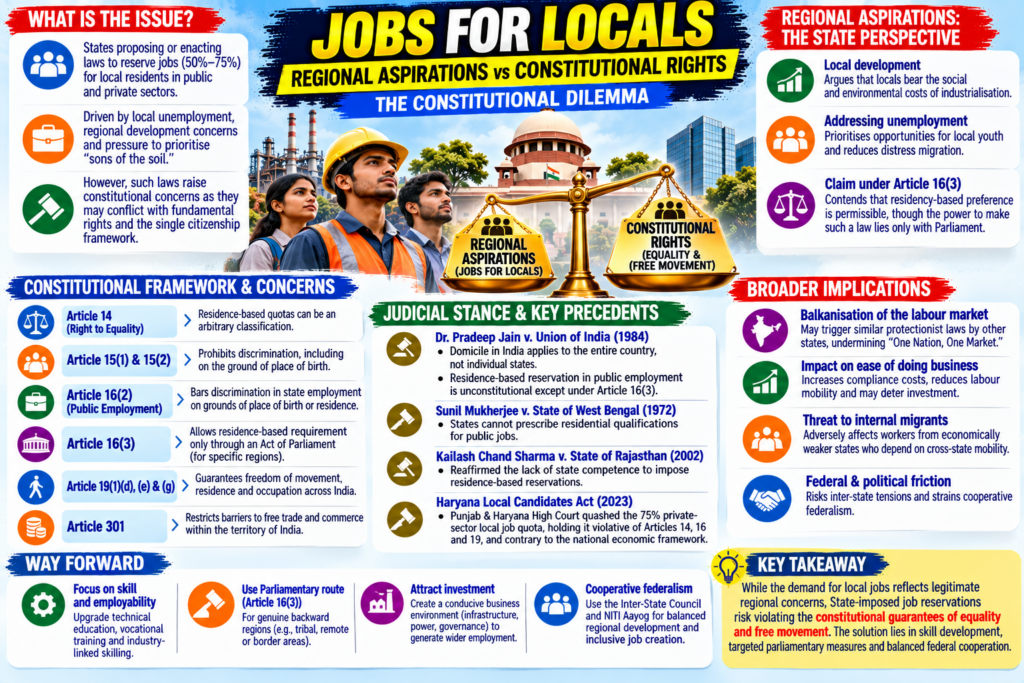
ANSWER: In recent years, multiple state legislatures have passed or proposed legislation mandating local quotas (ranging from 50% to 75%) in both public and private sectors for lower-tier jobs. These measures reflect intensifying regional political pressure triggered by local youth unemployment, rural distress, and perceived displacement by migrant labor. However, these state-level statutes directly conflict with the constitutional architecture intended to preserve a single Indian citizenship (single domicile concept).
The Constitutional Dilemma: Dual Framework
A. Regional Aspirations & State Perspectives
- Socio-Economic Development: State governments argue that local populations bear the direct social and environmental costs of industrial land acquisition and regional development, entitling them to preferential employment.
- Mitigating Rural-Urban Migration Pressures: Proponents contend that securing local jobs reduces distress migration and lightens the infrastructure burden on urban civic resources.
- Constitutional Exception under Article 16(3): The Constitution acknowledges that certain socio-economic conditions may warrant residence-based employment conditions. However, the power to make such laws is explicitly conferred upon Parliament alone, not state legislatures, to prevent balkanization.
B. Constitutional Rights & Federal Principles
- Violation of Article 14 (Right to Equality): Arbitrary classifications based solely on residence fail the test of reasonable classification, as residence within a state does not automatically equate to socio-economic backwardness.
- Violation of Article 15(1) & 15(2): Article 15 explicitly prohibits discrimination against any citizen on grounds only of religion, race, caste, sex, or place of birth. While “residence” is distinct from “place of birth”, using permanent residence as a proxy for birth violates the spirit of non-discrimination.
- Violation of Article 16(2) (Public Employment): Article 16(2) bars discrimination in state employment on grounds of place of birth or residence. Exceptions can only be framed under Article 16(3) through an Act of Parliament to address specific backward regions (e.g., Article 371J for the Kalyana-Karnataka region).
- Violation of Article 19(1)(d), (e), & (g): Guaranteed freedoms to move freely throughout India, reside anywhere, and practice any trade, business, or occupation are severely restricted when states impose local hiring mandates on private enterprises.
- Undermining Article 301 (Free Trade & Commerce): Restricting workforce recruitment in private establishments hampers the free flow of trade and business operations, creating internal protectionist barriers within the Union.
Judicial Stance and Precedents
- Dr. Pradeep Jain v. Union of India (1984): The Supreme Court held that the concept of “domicile” in India applies to the country as a whole, not individual states. It explicitly ruled that residence-based reservations in public employment are unconstitutional unless framed under Article 16(3) by Parliament.
- Sunil Mukherjee v. State of West Bengal (1972) & Kailash Chand Sharma v. State of Rajasthan (2002): The Apex Court reaffirmed that state governments lack legislative competence to prescribe residential qualifications for public jobs.
- Quashing of the Haryana Local Candidates Act (2023): The Punjab & Haryana High Court quashed the 75% private-sector local job quota, ruling that state intervention in private hiring violates fundamental rights under Article 19 and creates artificial barriers within the national economy.
Socio-Economic & Strategic Implications
- Balkanization of the Labour Market: Local reservation laws risk triggering retaliatory legislation by other states, threatening the “One Nation, One Market” paradigm.
- Impact on Ease of Doing Business: Forcing private enterprises to hire based on geography rather than merit or skill limits productivity, disincentivizes foreign and domestic investment, and increases compliance friction.
- Threat to Internal Migrants: Migrant workers from economically weaker states rely on cross-state mobility for livelihood. Restricting entry exacerbates inter-state economic disparities.
Way Forward
- Focus on Skill Alignment over Quotas: States should address youth unemployment by upgrading local technical education, vocational training, and industry-aligned skill development rather than relying on legal mandates.
- Utilizing Parliamentary Mechanisms (Article 16(3)): Where genuine backwardness exists (e.g., remote, tribal, or border regions), states must approach Parliament to enact targeted, legally sound legislation rather than passing unconstitutional state laws.
- Fostering Industrial Investment: States should compete on infrastructure quality, power supply, governance transparency, and ease of doing business to naturally generate surplus employment for all.
- Preserving Federal Balance: The Inter-State Council and NITI Aayog should serve as platforms to dialogue on balanced regional development, ensuring state aspirations do not fracture the constitutional vision of single citizenship and free mobility.
|
SOURCE: The Hindu epaper – JOBS FOR LOCALS How feasible is the idea?