
|
IN NEWS:Can India and China coexist peacefully?
QUESTION: “Peace and tranquillity along the Line of Actual Control (LAC) are essential for the normalisation of India-China relations.” Examine
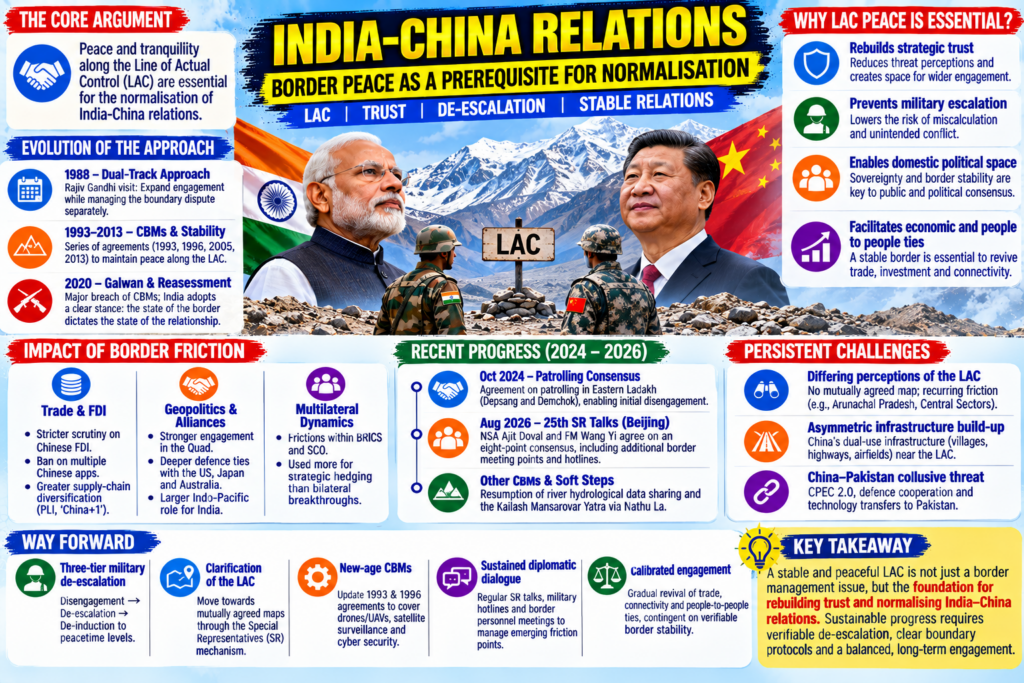
ANSWER: The strategic postulate that border peace is a prerequisite—not a parallel track—to bilateral normalization represents the cornerstone of India’s updated foreign policy posture toward China. Following the 2020 border standoffs in Eastern Ladakh (notably the Galwan Valley clash), India abandoned its three-decade-old modus vivendi, asserting that normal diplomatic, trade, and cultural relations cannot co-exist with a militarized and volatile Line of Actual Control (LAC).
1. The Shift from Dual-Track Diplomacy to Post-2020 Realities
- The 1988 Consensus: Initiated during Prime Minister Rajiv Gandhi’s visit to Beijing, this framework allowed both nations to expand economic, diplomatic, and multilateral cooperation while delegating border dispute resolution to quiet diplomatic tracks.
- Post-Galwan Paradigm Shift: Unilateral attempts to alter the status quo along the LAC breached existing Confidence-Building Measures (CBMs) (1993, 1996, 2005, 2013 agreements). This led India to adopt an explicit posture: state of the border dictates the state of the relationship.
2. Why Peace along the LAC is Essential for Normalization
a) Rebuilding Strategic Trust
- Trust is the bedrock of diplomatic engagement. Repeated tactical face-offs and infrastructure build-ups on the Tibetan Plateau create a profound trust deficit, rendering strategic partnerships or compromises untenable.
b) Preventing Unintended Military Escalation
- Dense troop deployments in high-altitude environments (Ladakh, Arunachal Pradesh) run an operational risk of miscalculation. Verifiable disengagement, de-escalation, and de-induction are vital to eliminate threat perceptions.
c) Domestic Political Alignment & Sovereign Imperatives
- Sovereign integrity is non-negotiable in Indian foreign policy. High-intensity border friction alienates domestic public sentiment, limiting political leeway to pursue trade relaxations or diplomatic accommodations with Beijing.
3. Impact of Border Friction on Key Dimensions
| Sphere | Operational Impact of LAC Instability |
| Trade & FDI | Increased scrutiny on Chinese Foreign Direct Investment (FDI), stringent beneficial-ownership criteria, banning of foreign digital applications, and supply-chain diversification. |
| Geopolitics & Alliances | Accelerated India’s involvement in the Quad (US, Japan, Australia, India) and reinforced security partnerships in the Indo-Pacific to balance Chinese power. |
| Multilateral Dynamics | Heightened friction within groupings like BRICS and the Shanghai Cooperation Organisation (SCO), turning regional venues into platforms for strategic hedging rather than bilateral breakthroughs. |
4. Progress & Recent De-escalation Pathways (2024–2026)
- 2024 Patrolling Consensus: In October 2024, India and China reached an agreement on patrolling rights in Eastern Ladakh (e.g., Depsang and Demchok sectors), paving the way for initial disengagement.
- 25th Special Representatives (SR) Talks (Beijing, August 2026): National Security Advisor Ajit Doval and Foreign Minister Wang Yi agreed on an eight-point consensus, establishing additional border meeting points and hotlines across the Eastern and Middle sectors to enhance crisis communication.
- Confidence-Building & Soft Diplomacy: Modest revivals of border mechanisms—such as river hydrological data sharing and the resumption of the Kailash Mansarovar Yatra via Nathu La—signal incremental steps toward reducing friction.
5. Persistent Strategic Challenges
- Differing Perceptions of the LAC: Absence of a mutually agreed-upon map leads to recurring friction in sectors such as Upper Subansiri (Arunachal Pradesh) and Central Sectors.
- Asymmetric Infrastructure Development: Chinese dual-use border infrastructure (“Xiaokang” villages, highways, airfields) continues to test India’s border management capabilities.
- Collusive Threat (China-Pakistan Axis): Continued development of CPEC 2.0 and defence hardware transfers to Islamabad sustain India’s concern regarding a two-front security matrix.
Way Forward
- Three-Tier Military De-escalation: Follow a strict sequence: complete disengagement at friction points de-escalation (retreat of standoff artillery/armour) de-induction (returning division-level deployments back to peacetime bases).
- Clarification & Demarcation of the LAC: Leverage the Special Representatives mechanism to move from basic patrolling agreements to formal, shared maps of the LAC to avoid tactical overlap.
- New-Age Confidence-Building Measures (CBMs): Update legacy treaties (1993, 1996) with protocols addressing modern aerial threats (drones/UAVs), satellite surveillance, and cyber intelligence along the border.
|
SOURCE: The Hindu epaper – Can India and China coexist peacefully?