
|
IN NEWS: Concerns over the collegium system
QUESTION: Judicial independence and executive accountability are complementary requirements of a constitutional democracy, but balancing the two in judicial appointments remains a challenge. Discuss.
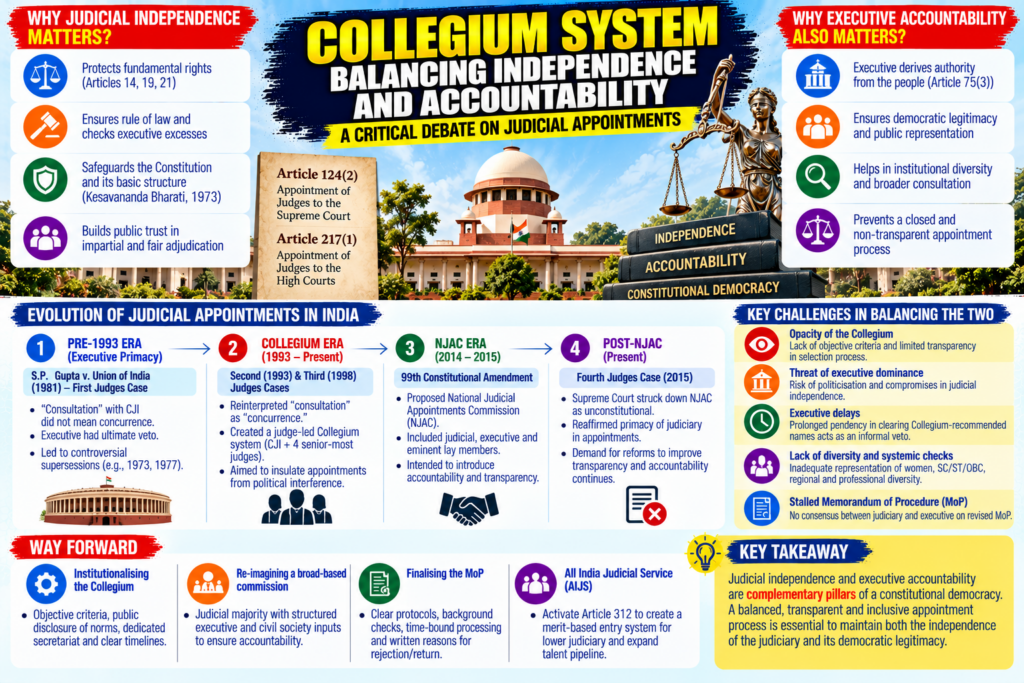
ANSWER: The relationship between judicial independence and executive accountability represents a core structural tension in constitutional democracies. In India, this tension is most visible in the debate over judicial appointments—specifically the shift from executive supremacy to judicial self-selection through the Collegium system, and the ongoing search for a balanced mechanism.
1. Complementary Requirements of Constitutional Democracy
- Judicial Independence as a Shield:
- Rule of Law & Rights Protection: An independent judiciary ensures that citizen rights under Articles 14, 19, and 21 are defended against state overreach without fear or favor.
- Basic Structure Safeguard: Declared a core feature of the Constitution in Kesavananda Bharati (1973), independence ensures the judiciary remains an uncoerced arbiter of legislative and executive action.
- Executive Accountability as a Democratic Mandate:
- Popular Sovereignty: The executive derives authority from the electorate and is directly accountable to Parliament (Article 75(3)).
- Institutional Checks: Broad public appointments—including higher judiciary nominations—traditionally involve the executive to ensure institutional diversity, public representation, and democratic legitimacy.
- Mutual Reinforcement:
- Independence without accountability runs the risk of opacity and insularity, while accountability without independence threatens the Rule of Law.
2. The Evolution of Appointments: A Tilted Balance
The mechanism for appointing judges to the Supreme Court and High Courts under Articles 124(2) and 217(1) has undergone significant shifts:
| Epoch / Phase | Mechanism | Primary Focus & Impact |
| Pre-1993 Era | Executive primacy (S.P. Gupta, 1981 / First Judges Case) | “Consultation” with the Chief Justice of India (CJI) did not mean concurrence. Gave the executive ultimate veto, leading to controversial supersessions (e.g., 1973 and 1977). |
| Collegium Era (1993–Present) | Judicial primacy (Second & Third Judges Cases) | Reinterpreted “consultation” as “concurrence.” Created a judge-led Collegium system to shield appointments from political interference. |
| 99th Amendment & NJAC (2014–2015) | Hybrid Commission (Fourth Judges Case, 2015) | Proposed the National Judicial Appointments Commission (NJAC) combining judicial, executive, and eminent lay members. Struck down by the SC for violating judicial independence. |
3. Core Challenges in Balancing Independence and Accountability
- The Opacity of Judicial Self-Selection:
- The Collegium system remains unique globally, as judges appoint judges without formal legislative or executive concurrence.
- Concerns linger regarding a lack of objective criteria, undisclosed evaluation metrics, and limited transparency in candidate selection.
- The Threat of Executive Dominance:
- Reverting to executive-led selection risks politicizing the bench, undermining public trust in judicial impartiality when assessing government actions.
- Executive delays in clearing Collegium-recommended names have emerged as an informal veto, leading to prolonged judicial vacancies.
- Stalled Memorandum of Procedure (MoP):
- Despite the Supreme Court agreeing to finalize a revised MoP post-NJAC verdict to improve transparency and set eligibility standards, consensus between the judiciary and the executive remains unresolved.
- Lack of Institutional Checks on Merit & Diversity:
- Neither pure Collegium selection nor executive preference guarantees broad social representation, regional balance, or systematic vetting of competence.
4. Way Forward
- Institutionalizing the Collegium (Short-Term):
- Introduce objective evaluation criteria, public disclosure of selection criteria, a dedicated secretariat, and clear timelines for both Collegium recommendations and executive clearances.
- Re-imagining a Broad-Based Commission (Long-Term):
- Formulate a re-designed Judicial Appointments Commission that preserves judicial dominance (e.g., majority judicial composition) while providing structured executive and civil society inputs, addressing the constitutional flaws identified in the NJAC verdict.
- Finalizing the Memorandum of Procedure (MoP):
- Establish clear protocols for background checks, time-bound processing of files, and written justifications when candidate names are returned or rejected.
- Establishing an All India Judicial Service (AIJS):
- Activate Article 312 to create a standardized, merit-based entry system for the lower judiciary, expanding the talent pipeline for future elevation to High Courts and the Supreme Court.
|
SOURCE: The Hindu epaper – Concerns over the collegium system