
|
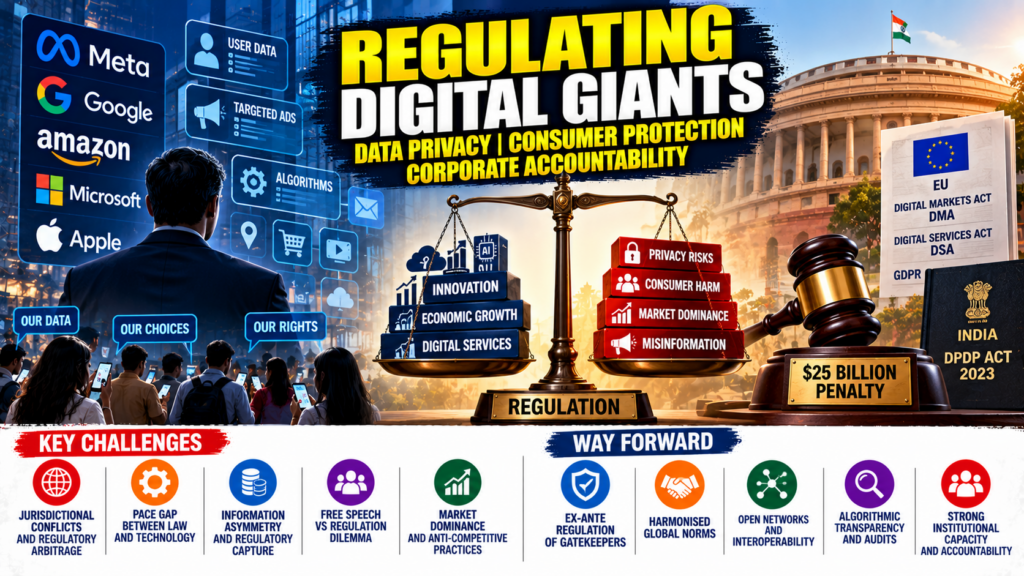
IN NEWS: Why does Meta have to pay a $25 billion penalty?
QUESTION: The growing power of digital platforms has raised concerns regarding data privacy, consumer protection and corporate accountability. Examine the challenges involved in regulating global technology companies.
ANSWER: The unprecedented scale and systemic influence of global technology platforms—often referred to as Big Tech—have transformed digital public infrastructure, commerce, and communication. However, their data-driven business models rely heavily on network effects, surveillance capitalism, and market dominance. This has led to growing threats to individual privacy, consumer choice, and democratic accountability, creating a urgent regulatory challenge for governments worldwide.
Key Regulatory Concerns
- Data Privacy and Surveillance: Platforms monetize user attention through extensive data collection, profiling, and targeted advertising without meaningful informed consent.
- Consumer Protection: Dominant platforms frequently use dark patterns (deceptive user interface design), anti-competitive bundling, ecosystem lock-ins, and self-preferencing (favoring their own products over third-party sellers on e-commerce sites).
- Corporate and Algorithmic Accountability: Opaque algorithms prioritized for user engagement can amplify hate speech, radicalization, and misinformation. Additionally, platforms have historically used safe-harbor immunity laws to avoid direct legal responsibility for third-party content.
Challenges in Regulating Global Technology Companies
1. Jurisdictional Conflicts and Regulatory Arbitrage
- Borderlines vs. Cyberspace: Tech platforms operate seamlessly across international borders, whereas national regulatory authorities operate within strict territorial limits.
- Safe-Haven Arbitrage: Companies frequently route data through or base their headquarters in low-regulation jurisdictions, making enforcement and cross-border investigation difficult.
2. Pacing Problem (Law vs. Technology)
- Algorithmic Opacity: Modern machine learning architectures operate as “black boxes.” Regulatory bodies often lack the technical capacity to audit predictive models or algorithmically enforced bias in real time.
- Outdated Frameworks: Legislative cycles are slow, while digital products iterate rapidly. Regulatory frameworks framed for legacy industries struggle to address dynamic, zero-price digital business models.
3. Asymmetry of Information and Resources
- Big Tech firms hold unmatched information advantages over public enforcement bodies. They can deploy significant legal, financial, and lobbying resources, leading to regulatory capture or long, drawn-out legal challenges that delay compliance.
4. Tensions Between Free Speech, Censorship, and Security
- Determining platform liability for user-generated content presents a dilemma: strict intermediary liability risks incentivizing private platforms to pre-emptively censor speech, while absolute immunity allows harmful content to spread unchecked.
5. Economic Dominance and Anti-Competitive Gatekeeping
- High switching costs and network effects create winner-take-all markets. Tech platforms act as both market operators and market participants (gatekeepers), making traditional ex-post antitrust actions (which take years to litigate) largely ineffective at restoring market contestability.
Comparative Global Regulatory Approaches
| Framework / Region | Key Focus / Mechanism | Primary Challenge |
| European Union (GDPR, DMA, DSA) | Ex-Ante Regulation & Strict Privacy: Identifies gatekeepers (SIDIs), bans self-preferencing, mandates consent for cross-service tracking, and enforces data protection penalties. | High compliance burden for small startups; potential stifling of domestic AI innovation. |
| United States | Litigation-Driven Antitrust: Focuses on post-facto judicial enforcement by the FTC and DOJ targeting monopoly abuses. | Lengthy legal battles; lack of a single comprehensive federal privacy law. |
| India (DPDP Act 2023, Consumer Protection Rules, proposed Digital Competition Bill) | Data Sovereignty & Open Networks: Combines statutory data fiduciaries, e-commerce regulations, and public digital goods (like ONDC) to break platform monopolies. | Balancing user privacy with broad executive exemptions; enforcing cross-border compliance. |
Way Forward
- Shift to Ex-Ante Regulation: Move away from slow ex-post antitrust investigations toward ex-ante frameworks (e.g., classifying Systemically Important Digital Intermediaries) to prevent anti-competitive behavior before market consolidation occurs.
- Harmonized International Norms: Develop multilateral treaties on cross-border data transfer, digital taxation, and internet governance under bodies like the G20 or UN, minimizing regulatory fragmentation.
- Open Architecture & Interoperability: Promote interoperable digital public infrastructure (e.g., India’s Open Network for Digital Commerce – ONDC) to lower entry barriers for smaller businesses and end ecosystem lock-ins.
- Independent Algorithmic Audits: Require platform gatekeepers to submit critical algorithms to independent technical audits for safety, transparency, and bias checks.
| PYQ REFERENCE UPSC 2023 Q. “Right to Privacy is protected as an intrinsic part of Right to Life and Personal Liberty under Article 21 of the Constitution of India. In the light of this statement, critically examine the impact of mass data collection by digital corporations on the fundamental rights of citizens.” |
SOURCE: The Hindu epaper – Why does Meta have to pay a $25 billion penalty?