
|
IN NEWS: Wicked surprise
QUESTION: “The northeast monsoon is characterised by greater unpredictability and significant regional variations in rainfall.” Examine the factors responsible for this phenomenon and its implications for peninsular India.
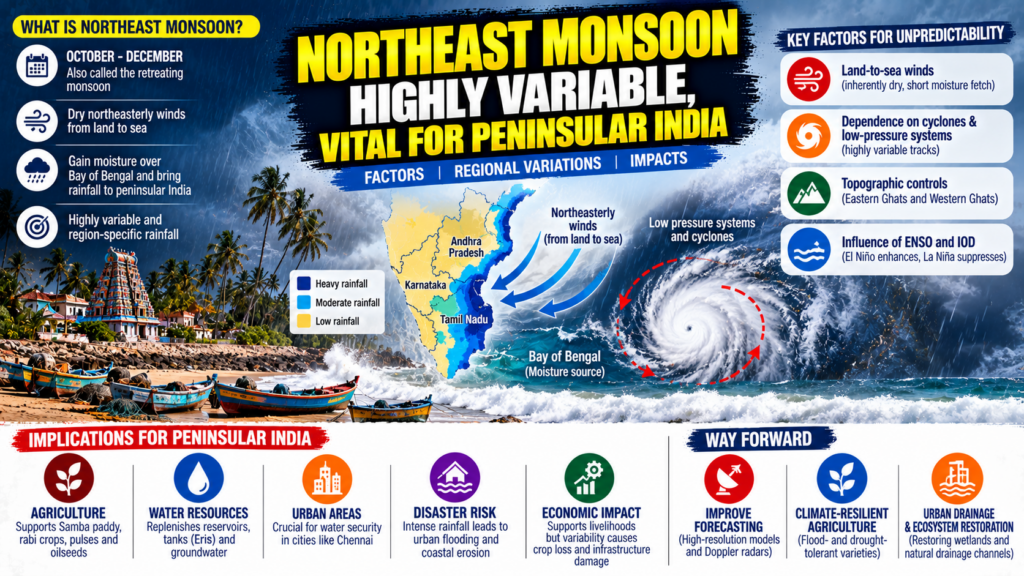
ANSWER: The Northeast Monsoon (NEM), often referred to as the retreating monsoon, occurs between October and December. Unlike the Southwest Monsoon, which provides uniform and widespread precipitation across the majority of the subcontinent, the Northeast Monsoon exhibits high spatiotemporal unpredictability and intense regional variations.
Factors Responsible for Unpredictability and Regional Variations
1. Reversal Mechanism & Short Fetch over the Bay of Bengal
- Land-to-Sea Winds: NEM winds originate over the dry, continental high-pressure zones of Central Asia and Northern India. Because they blow from land to sea, they are inherently dry.
- Limited Moisture Source: The winds pick up moisture only during their short fetch across the Bay of Bengal. Any slight shift in the lower-tropospheric wind direction alters the moisture loading, making precipitation erratic.
2. High Dependence on Tropical Cyclones & Low-Pressure Systems
- Pulse-Driven Rainfall: Rather than steady continuous rainfall, a significant portion of NEM precipitation is driven by synoptic systems—such as depressions, deep depressions, and tropical cyclones—forming in the southern Bay of Bengal.
- Tracks & Path Variability: The trajectory of these low-pressure systems is highly variable. If a cyclone makes landfall in northern Tamil Nadu or southern Andhra Pradesh, it causes localized torrential rainfall, leaving surrounding regions dry.
3. Topographic Controls & Relief Variations
- Rain-Shadow and Orographic Reversal: As moisture-laden northeasterly winds approach the east coast, the Eastern Ghats and the topography of Tamil Nadu force the air to ascend, causing heavy rainfall along coastal strips.
- Western Ghats Barrier: The Western Ghats block these winds from penetrating deep into the interior, creating sharp regional contrasts between coastal regions (e.g., Coastal Tamil Nadu) and interior rain-shadow areas (e.g., North Interior Karnataka and Telangana).
4. Ocean-Atmosphere Drivers (ENSO & IOD)
- El Niño–Southern Oscillation (ENSO): Unlike the Southwest Monsoon, where El Niño causes droughts, El Niño generally enhances Northeast Monsoon rainfall, whereas La Niña suppresses it.
- Indian Ocean Dipole (IOD): A positive IOD phase reinforces low-pressure activity over the Bay of Bengal, whereas a negative phase reduces convective activity, inducing inter-annual volatility.
Implications for Peninsular India
| Sector / Aspect | Positive / Beneficial Impacts | Negative / Critical Challenges |
| Agriculture & Cropping | • Primary water source for Samba paddy in Tamil Nadu and Rabi crops across South India. • Supports rain-fed pulses and oilseeds. | • Delay or deficiency leads to severe crop failure. • Unseasonal or cyclonic downpours cause crop submergence and post-harvest damage. |
| Water Resources | • Replenishes reservoirs, traditional tanks (Eris), and aquifers in rain-deficient eastern peninsular belts. | • Unpredictable spells make long-term reservoir management and municipal planning difficult. |
| Socio-Economic & Infrastructure | • Vital for urban water security in major metros (e.g., Chennai). | • High frequency of extreme localized rainfall events triggers urban flooding (e.g., Chennai 2015, 2023) and coastal erosion. |
Way Forward
- Precision Forecasting: Enhancing High-Resolution Weather Prediction Models (NWPs) and Doppler Weather Radar (DWR) networks along the eastern coast to accurately track localized low-pressure systems.
- Climate-Resilient Agriculture: Promoting flood- and drought-tolerant crop varieties alongside shifting sowing windows based on extended-range forecasts.
- Urban Drainage & Wetland Restoration: Restoring natural drainage channels and urban wetlands in coastal metropolises to manage sudden, high-intensity precipitation events.
|