
UPSC Syllabus: GS Paper II – Polity & Governance: Structure, organisation and functioning of the Executive and Judiciary; Ministries and Departments of the Government; pressure groups and formal/informal associations and their role in polity.
Why in News?
The Vanashakti verdict has been described as a balanced and pragmatic approach to environmental governance. The Supreme Court’s judgment revisited the legality of post-facto environmental clearances and sought to reconcile environmental protection with developmental requirements.
In Vanashakti v. Union of India, decided on 29 July 2026, the Supreme Court adopted an “eco-centric proportionality” approach, balancing the right to a pollution-free environment with legitimate developmental needs.
What is Environmental Clearance?
Environmental clearance is a regulatory mechanism intended to assess the likely environmental consequences of specified projects before they commence.
The EIA Notification, 2006 mandates prior environmental clearance for specified projects. This requirement reflects the precautionary principle, under which environmental risks should be assessed before potentially irreversible damage occurs.
Precautionary Principle
The precautionary principle is an important component of sustainable development.
In Vellore Citizens’ Welfare Forum v. Union of India (1996), the Supreme Court recognised the precautionary principle and polluter-pays principle as essential components of sustainable development.
The Vanashakti judgment reaffirmed that prior environmental clearance remains the mandatory rule and that post-facto clearance cannot become the normal regulatory route.
Rule of Law and Executive Discretion
The judgment also strengthens the principle that environmental governance must operate within the framework of law.
The Court quashed the 2021 Office Memorandum permitting post-facto environmental clearance because an executive instruction cannot amend, dilute or override a statutory environmental framework.
The Court emphasised that administrative instructions may supplement statutory rules but cannot contradict them.
This prevents the emergence of a “violate first, regularise later” culture, which could disadvantage compliant enterprises and weaken environmental deterrence.
Developmental Imperatives and Proportionality
The judgment did not adopt an absolute prohibition against every form of regularisation.
The Court upheld the 2017 Notification as a narrowly tailored and time-bound mechanism for addressing certain past violations.
However, such regularisation requires:
- Environmental damage assessment
- Remediation
- Resource augmentation
- Compliance with environmental requirements
Thus, regularisation cannot become an unconditional amnesty for environmental violations.
The Court also allowed existing clearances under the 2017 Notification and 2021 Office Memorandum to remain valid, subject to individual challenge, partly because immediate invalidation could adversely affect public projects and create significant public consequences.
This reflects a proportionality-based approach rather than an absolute prohibition.
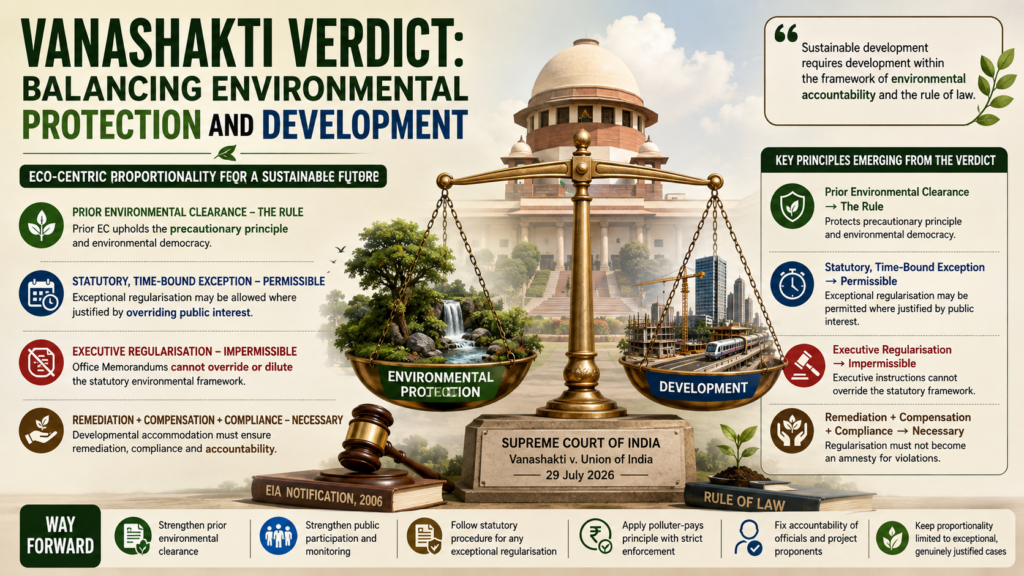
Key Principles Emerging from the Verdict
The judgment establishes a hierarchy of principles:
Prior Environmental Clearance → The Rule
Prior EC protects the precautionary principle and environmental democracy.
Statutory, Time-Bound Exception → Permissible
Exceptional regularisation may be permitted where justified by overriding public interest.
Executive Regularisation through an Office Memorandum → Impermissible
Executive instructions cannot override the statutory environmental framework.
Remediation + Compensation + Compliance → Necessary
Developmental accommodation should not reward environmental violations.
Significance of the Verdict
The judgment is significant because it avoids treating sustainable development as either:
- Unrestricted development, or
- Absolute environmentalism.
Instead, it seeks to balance environmental accountability, rule of law and legitimate developmental requirements through proportionality.
Way Forward
1. Strengthen prior environmental clearance
Improve EIA capacity and scientific appraisal so that environmental assessments are meaningful and effective.
2. Strengthen public participation
Enhance public consultation and environmental monitoring.
3. Follow statutory procedure
Any exceptional regularisation should be created only through proper statutory procedures.
4. Apply the polluter-pays principle
Environmental restoration, compensation and deterrent penalties should be effectively implemented.
5. Fix accountability
Officials and project proponents responsible for violations should be held accountable.
6. Restrict proportionality to exceptional cases
Proportionality should not become a routine mechanism for escaping environmental regulations.
Conclusion
The Vanashakti verdict demonstrates that environmental governance must combine precaution, legality and proportionality. Developmental requirements cannot be ignored, but they also cannot justify bypassing statutory environmental safeguards.
The judgment therefore reinforces the principle that sustainable development requires development within the framework of environmental accountability and the rule of law.
UPSC Relevance
PYQ Reference – UPSC CSE 2018
“How far is the Integrated Coastal Zone Management approach adopted by India to manage its coastal resources and environment?”
Source: The Hindu e-paper, The Vanashakti verdict is balanced and pragmatic
Key Takeaway
The Vanashakti verdict seeks to achieve a balance between environmental protection and development: prior environmental clearance remains the norm, executive shortcuts cannot override statutory law, and exceptional regularisation must be legally grounded, time-bound and accompanied by remediation and accountability.