
|
IN NEWS: Ensuring equity amid India’s educational progress
QUESTION:
Discuss the major regional and social disparities that persist in India’s school education system despite significant improvements in educational indicators. (15 Marks)
ANSWER:
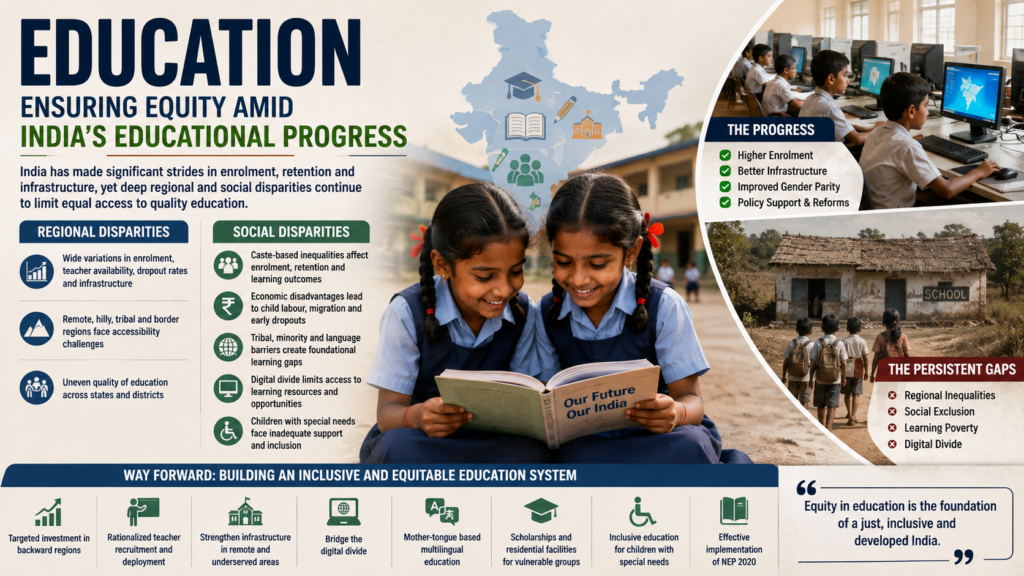
India’s school education system, covering nearly 1.47 million schools, 240 million students, and 10.2 million teachers (UDISE+ 2025-26), has witnessed significant progress in enrolment, retention, gender parity, and infrastructure. However, the gains remain uneven, reflecting a “paradox of progress” where deep regional and social inequalities continue to affect access, quality, and learning outcomes.
Major Regional Disparities in School Education
1. Variations in Gross Enrolment Ratio (GER)
- Significant inter-state differences persist across educational stages.
- Meghalaya records the highest Foundational GER (131%), whereas Bihar records the lowest (24%).
- At the Secondary level, GER ranges from 109% in Chandigarh to 48% in Bihar.
2. Uneven Teacher Availability
- Large disparities exist in Pupil-Teacher Ratio (PTR) across states.
- Jharkhand records a Secondary PTR of 43, indicating teacher shortages and workload pressures.
- Sikkim and Ladakh have comparatively lower PTRs, enabling better teacher attention.
3. Regional Differences in Dropout Rates
- Educationally backward states continue to report high dropout rates.
- Bihar has the highest preparatory and middle-school dropout rates.
- Ladakh records one of the highest secondary-level dropout rates due to geographical constraints.
4. Infrastructure Gaps
- While access to electricity, drinking water, and toilets has improved nationally, disparities persist.
- Remote, tribal, hilly, and border regions continue to face inadequate school infrastructure and connectivity.
5. Accessibility Challenges
- Children in districts such as Kandhamal (Odisha), Bageshwar (Uttarakhand), Palghar (Maharashtra) and border regions face difficulties in reaching schools regularly due to terrain and transport constraints.
Major Social Disparities in School Education
1. Caste-Based Educational Inequalities
- Students from SC and ST communities continue to face barriers in enrolment, retention, and completion.
- Educational attainment declines significantly at higher levels due to socio-economic vulnerabilities.
2. Economic Disadvantages
- Children from economically weaker households often experience:
- Early entry into the workforce,
- Seasonal migration,
- Inability to afford supplementary learning resources.
3. Tribal and Minority Exclusion
- Tribal and minority students often study in languages different from their mother tongue.
- This creates learning gaps at the foundational stage and increases dropout risks.
4. Digital Divide
- Urban schools have greater access to computers, internet connectivity, and digital learning tools.
- Rural and disadvantaged regions lag behind, widening learning inequalities.
5. Inclusion of Children with Special Needs (CWSN)
- Many schools lack accessible classrooms, assistive devices, and trained special educators.
- This limits meaningful participation of differently-abled children.
Way Forward
1. Targeted Investment in Educationally Backward Regions
2. Rationalized Teacher Recruitment and Deployment
3. Strengthening School Infrastructure in Remote Areas
4. Bridging the Digital Divide
5. Mother-Tongue Based Multilingual Education
6. Expanded Scholarships and Residential School Facilities
7. Inclusive Education for Children with Special Needs
8. Effective Implementation of NEP 2020
Despite substantial progress in educational access and participation, regional and social inequalities continue to shape educational opportunities in India. Achieving the constitutional vision of equality (Article 14), social justice (Article 46), and the Right to Education (Article 21A) requires a balanced approach that combines quality, equity, and accessibility. Bridging these gaps is essential for realizing the goals of NEP 2020 and building an inclusive knowledge society.
|
SOURCE: The Hindu e-paper Ensuring equity amid India’s educational progress