
|
IN NEWS: India has to act on its ‘sugar’ problem
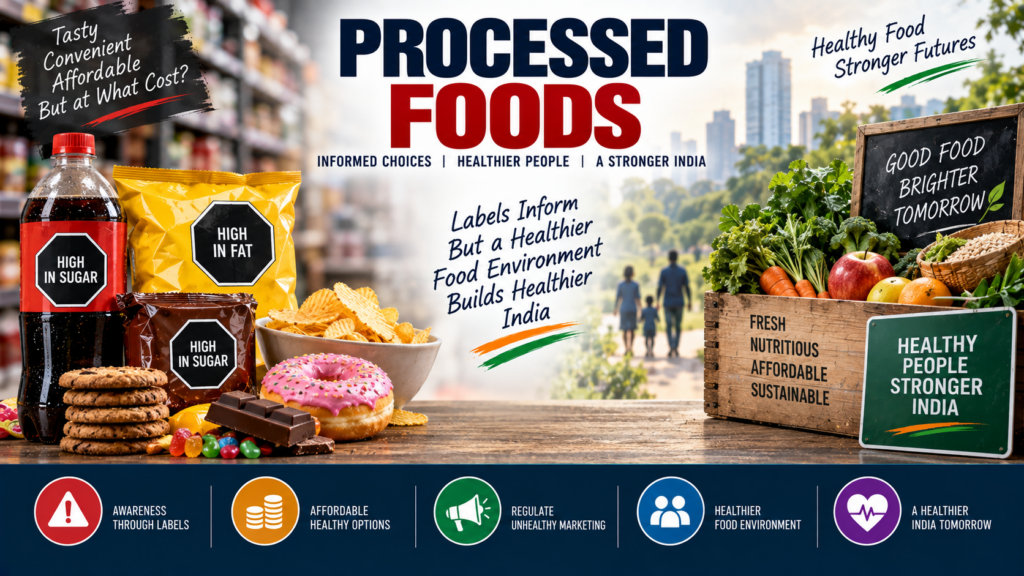
QUESTION: “A front-of-pack warning label can inform consumers, but cannot by itself transform an unhealthy food environment.” Discuss the limitations of food labelling as a public-health intervention in India.
ANSWER: Front-of-Pack Warning Labels (FOPWL)—such as the red hexagonal labels proposed by the Food Safety and Standards Authority of India (FSSAI) for products high in fat, sugar, and salt (HFSS)—aim to make nutritional risks immediately clear to consumers. However, while labelling addresses information asymmetry at the point of sale, public health research demonstrates that informational interventions alone cannot overhaul an inherently unhealthy food system.
Information vs. Environment: Core Structural Limitations of Labelling
- Exclusion of the Unorganized Food Sector: Front-of-pack labelling applies strictly to processed, packaged goods. In India, over 80% of daily food consumption occurs through the informal food economy—street vendors, roadside eateries, local bakeries, and fresh markets. These unorganized sources remain completely outside the purview of FOPWL, leaving a vast portion of high-fat, high-sodium diets unmonitored.
- Socio-Economic and Educational Barriers: Labels rely on consumer literacy, nutrition awareness, and visual cognition. In a country with significant rural-urban disparities, varying literacy levels, and multilingual diversity, symbolic warnings may fail to alter purchasing behavior without sustained, localized public education campaigns.
- The “Food Desert” and Affordability Crisis: For millions of low-income households, dietary choices are dictated by price, shelf-life, and caloric density rather than health warnings. Ultra-processed foods are often cheaper and more accessible than fresh produce, whole grains, and lean proteins. A warning label informs a consumer that a product is unhealthy, but it does not make healthier alternatives affordable or physically accessible.
- Corporate Marketing and Hyper-Palatability: FOPWL competes against billion-dollar advertising budgets, aggressive digital marketing aimed at children, celebrity endorsements, and deliberate chemical formulation (the “bliss point” of sugar, salt, and fat) designed to induce craving and habit formation. A static warning label rarely counteracts these persuasive marketing tactics.
Regulatory and Policy Deficiencies in India’s Labelling Framework
- Watered-Down Thresholds and Phased Dilutions: Industry pressure often leads to weakened regulatory thresholds. Requiring a product to trigger multiple nutrient thresholds (e.g., high in both sugar and fat) before displaying a mandatory red warning—rather than a single-nutrient trigger—allows many unhealthy ultra-processed items to evade strict warnings in initial regulatory phases.
- Nutrient Substitution and the “Health Halo” Loophole: Manufacturers frequently bypass specific nutrient warnings by reformulating products with artificial sweeteners, refined starches, or hidden additives that maintain hyper-palatability without triggering “high added sugar” or “high fat” thresholds, leading to a false sense of security among buyers.
- Weak Enforcement and Penalty Structures: Statutory penalties under the Food Safety and Standards Act (2006) for non-compliance or misbranding remain modest compared to the commercial revenues generated by multinational food brands. Without stringent monitoring, mislabeling and deceptive packaging claims persist.
Key Components of a Comprehensive Public Health Policy
To transform an unhealthy food environment, front-of-pack warning labels must serve as one element within a broader, multi-pronged structural intervention:
- Fiscal Policies and Strategic Taxation: Implement health taxes (similar to “soda taxes”) on ultra-processed and HFSS foods to artificially raise their prices while utilizing generated tax revenues to subsidize fresh, locally produced fruits, vegetables, and coarse grains (millets).
- Restrictions on Marketing and Commercial Practices: Mandate strict legal bans on child-targeted advertising, cartoon endorsements, and promotional giveaways for HFSS products across television, social media, and digital platforms.
- Institutional Procurement and “Healthy Zones”: Enforce strict nutritional standards in public institutions—banning HFSS foods in school canteens, university campuses, government offices, and public hospitals, while integrating bio-fortified foods into the PM-POSHAN (Mid-Day Meal) and Anganwadi systems.
- Promoting Reformulation and Local Food Systems: Establish binding targets for food manufacturers to progressively lower sodium, trans-fats, and added sugars across product lines, supported by public investment in local cold-chain logistics to keep fresh food affordable.
Front-of-pack labelling is a necessary first step to ensure transparency, but it remains a passive, individual-centric measure. Curbing India’s growing burden of non-communicable diseases (NCDs) like diabetes and cardiovascular disorders requires shifting the policy focus from merely informing the consumer to actively restructuring the economic and physical accessibility of healthy food.
|
SOURCE: The Hindu e-paper – India has to act on its ‘sugar’ problem