
|
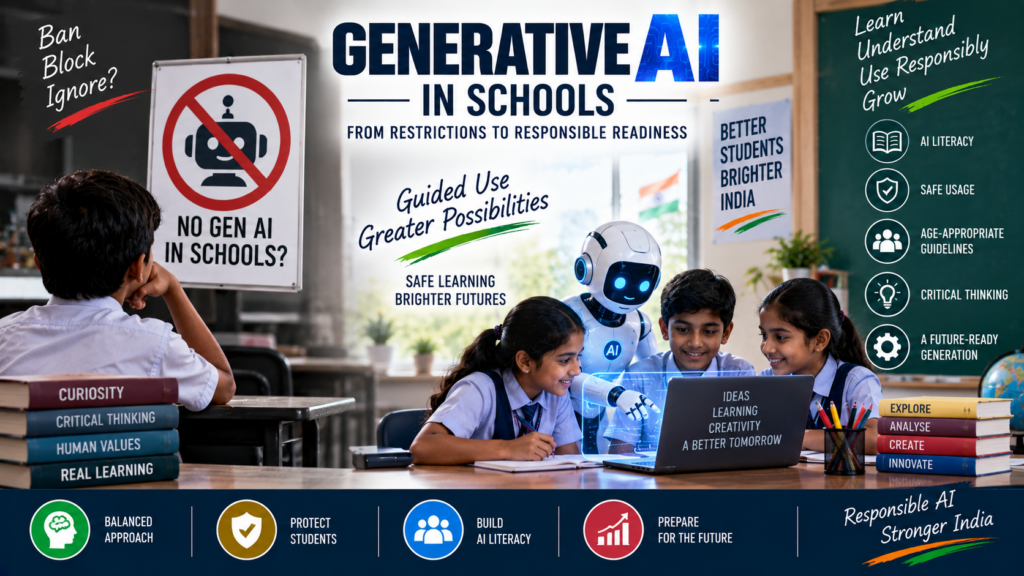
IN NEWS: Should the use of Gen AI be banned among younger students in schools?
QUESTION: “A complete ban on Generative AI in schools may be less effective than establishing age-appropriate guardrails for its responsible use.” Discuss.
ANSWER: A complete ban on Generative AI (GenAI) in schools offers short-term control over concerns like plagiarism and privacy, but it fails to address the reality of a technology integrated into daily life and future workplaces. Implementing age-appropriate guardrails shifts the paradigm from prohibition to structured literacy, balancing cognitive development with essential technological skills.
Inefficacy of Complete Bans
- Enforcement Challenges & Digital Equity Gaps: Bans push AI usage underground rather than eliminating it. Students access these tools outside school networks via personal devices. Blanket bans widen the digital divide, denying underprivileged students guided access and training at school, while peers with home resources gain an advantage.
- Missed AI Literacy Opportunities: Banning tools prevents educators from teaching essential digital citizenship skills. Students miss out on learning critical evaluation, prompt design, and how to identify algorithmic bias or hallucinated information.
- Outdated Assessment Paradigms: Blanket bans treat AI purely as a cheating tool rather than encouraging schools to modernize learning models. They preserve rote-memorization tasks that are easily automated, delaying a necessary shift toward critical thinking, oral defenses, and process-oriented assessments.
Age-Appropriate Guardrails by Educational Tier
- Primary School (Ages 5–10): Teacher-Led Discovery
- Focus: Building foundational literacy, numeracy, and social skills without cognitive shortcuts.
- Guardrails: Direct student interaction with GenAI is restricted. AI serves behind the scenes as an assistant for teachers to create differentiated lesson materials or visual aids. Classroom use is limited to guided, group-based activities that foster inquiry.
- Middle School (Ages 11–14): Scaffolded Exploration
- Focus: Understanding how AI operates, developing critical thinking, and exploring subjects safely.
- Guardrails: Closed-loop, privacy-compliant AI environments (e.g., dedicated educational LLMs) are used instead of open web tools. AI acts as an interactive tutor that provides hints and prompts rather than direct answers. Mandatory citation protocols and transparency requirements are introduced for all AI-assisted assignments.
- High School (Ages 15–18): Co-Pilot Integration & Ethics
- Focus: Advanced research, workflow optimization, and ethical analysis.
- Guardrails: Students use standard GenAI models under clear academic integrity frameworks. Evaluation shifts toward reflection essays, peer reviews, and oral examinations where students explain their process. Formal coursework includes ethical considerations, data privacy, and detecting bias.
Core Institutional Frameworks
- Technical & Privacy Protocols: Schools must deploy enterprise-grade AI environments that sanitize inputs, block harmful outputs, and comply with child data protection laws (e.g., COPPA, GDPR) to ensure student data is never used to train public models.
- Pedagogical Reframing: Assignments must prioritize higher-order thinking (evaluating, analyzing, synthesizing) over lower-order recall. Process becomes as valuable as the final product.
- Teacher Professional Development: Educators require structured training to integrate GenAI safely, recognize authentic student work, and use AI to reduce administrative loads.
Prohibition prepares students for a world that no longer exists. Structured, age-tiered guardrails ensure AI acts as a scaffold for cognitive development rather than a substitute for learning, equipping students to navigate an AI-driven future responsibly.
|
SOURCE: The Hindu e-paper – Should the use of Gen AI be banned among younger students in schools?