
SYLLABUS: International relations General Studies – : II Effect of policies and politics of developed and developing countries on India’s interests, Indian diaspora.
IN NEWS: India’s stakes in the Global Pandemic Agreement
QUESTION: India can play a bridging role between the Global North and Global South in shaping an equitable global pandemic preparedness regime. Discuss(250 Words)
ANSWER: India’s position at the intersection of the Global North and Global South equips it with a unique diplomatic, industrial, and strategic foundation to build a consensus on an equitable global pandemic preparedness framework. By bridging historical divides over intellectual property, supply chain centralisation, and resource allocation, India can help establish a resilient, inclusive global health architecture.
Strategic Advantages Positioning India as a Global Bridge
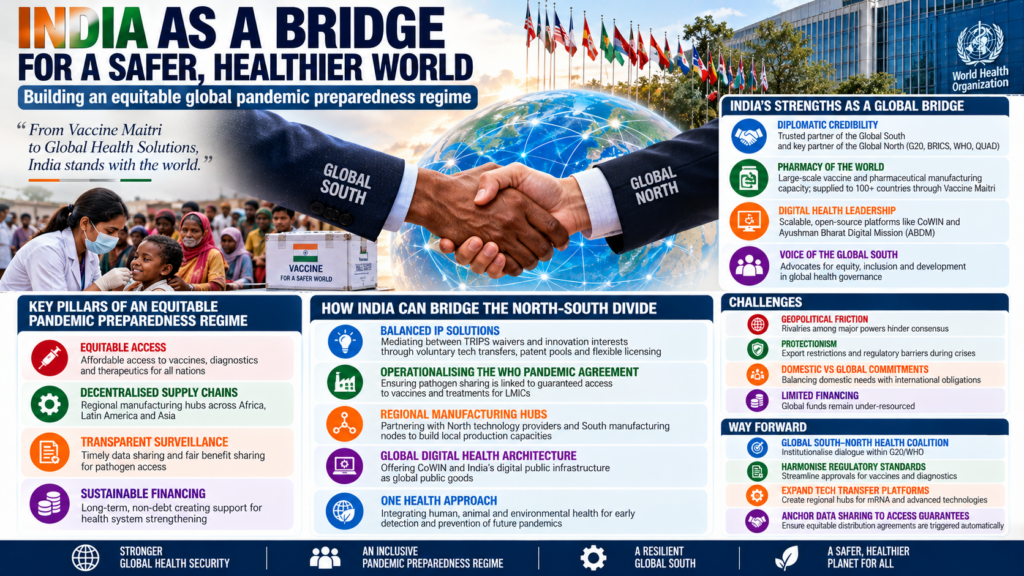
- Diplomatic Capital and Multilateral Credibility: India’s advocacy during its G20 Presidency and its active leadership in forums like BRICS, the Voice of Global South Summit, and the WHO have established its role as a representative of developing nations while maintaining strong strategic partnerships with Global North economies (e.g., G7, EU, QUAD).
- “Pharmacy of the World” Capacity: With massive vaccine and pharmaceutical manufacturing capacities, India demonstrated its ability to scale production rapidly during COVID-19, supplying essential therapeutics and vaccines to over 100 countries through initiatives like Vaccine Maitri.
- Digital Health Public Infrastructure: India’s success in building scalable, open-source digital public infrastructure—such as the CoWIN platform and the Ayushman Bharat Digital Mission (ABDM)—provides an adaptable framework for global health surveillance, tracking, and equitable distribution systems.
Key Demands of an Equitable Global Pandemic Preparedness Regime
- Equitable Access and IP Solutions: Preventing vaccine nationalism and ensuring affordable access to Medical Countermeasures (MCMs) like vaccines, diagnostics, and therapeutics for Low- and Middle-Income Countries (LMICs).
- Decentralised Supply Chains: Shifting manufacturing capabilities away from exclusive clusters in the Global North toward regional hubs across Africa, Latin America, and Asia to ensure supply security during crises.
- Transparent Surveillance and Data Sharing: Establishing transparent, rapid pathogen data-sharing protocols coupled with fair Benefit Sharing (FBS) frameworks so that nations sharing genetic data receive guaranteed, fair access to the resulting medical treatments.
- Sustainable Financing Mechanisms: Securing long-term, non-debt-creating financing for health system strengthening in vulnerable nations, beyond reactive emergency funds.
How India Can Bridge the Global North-South Divide
- Reconciling Intellectual Property (TRIPS Waiver vs. Innovation Incentives): While the Global South demands broad TRIPS waivers and the Global North seeks to protect intellectual property rights, India can mediate a balanced middle ground. It can advocate for voluntary tech transfers, patent pools (such as the Medicines Patent Pool), and compulsory licensing frameworks that protect innovation incentives while enabling rapid local production during declared health emergencies.
- Operationalising the WHO Pandemic Agreement: India can lead negotiations on the WHO Pandemic Agreement (Pandemic Treaty) by bridging differences over pathogen access and benefit-sharing (PABS). India can propose binding commitments where Global North pharmaceutical companies gain access to pathogen sequence data in exchange for reserving a fixed percentage of real-time production for LMICs at cost.
- Creating Distributed Regional Manufacturing Hubs: By partnering with North technology providers and South manufacturing nodes, India can transfer technology and standard operating procedures to establish regional biomanufacturing facilities across Africa and Latin America, mitigating the vulnerabilities of centralised supply chains.
- Standardising Digital Health Architecture: India can offer its open-source CoWIN and digital health stack as global public goods. This provides Global South nations with affordable, scalable tools for vaccination and resource allocation, while aligning with Global North data security and interoperability standards.
- Championing the One Health Approach: Integrating human, animal, and environmental health monitoring is essential for early zookeeper and zoonotic outbreak detection. India can bridge North-funded scientific research with Global South field-level epidemiology, improving global early-warning systems.
Major Challenges to Executing This Bridging Role
- Geopolitical Friction and Blocs: Escalating rivalries between major powers complicate consensus-building within multilateral bodies like the WHO and the UN Security Council.
- Protectionism and Trade Barriers: Export restrictions, regulatory divergence, and raw material hoarding by advanced economies during crises undermine multilateral agreements.
- Domestic vs. Global Commitments: Balancing domestic healthcare demands and population needs during a crisis with international supply obligations creates political and operational pressure.
- Financial Constraints: Global initiatives like the Pandemic Fund remain underfunded, limiting the capacity to build long-term structural preparedness in LMICs.
Way Forward
- Institutionalise a Global South-North Health Coalition: Establish a dedicated dialogue mechanism within the G20 or WHO to continuously align Global South access needs with Global North financing and technology.
- Harmonise Global Regulatory Standards: Work with the WHO and International Council for Harmonisation (ICH) to streamline regulatory approvals for vaccines and diagnostics during emergencies, shortening time-to-market worldwide.
- Expand Tech Transfer Platforms: Leverage public-private partnerships to create regional hubs for mRNA and platform-based technologies, supported by blended finance from multilateral development banks.
- Anchor Pathogen Sharing to Access Guarantees: Ensure that global surveillance protocols automatically trigger equitable distribution agreements for therapeutics and vaccines to participating countries.
|
SOURCE: The Hindu e-paper – India’s stakes in the Global Pandemic Agreement