
|
IN NEWS: India’s cement footprint stands in its way to net-zero emissions
QUESTION: Carbon capture is likely to remain important for achieving deep decarbonisation in the cement sector. Examine
ANSWER: Carbon Capture, Utilisation, and Storage (CCUS) is increasingly recognised as an indispensable technological pathway for achieving deep decarbonisation in the cement industry. Unlike other manufacturing sectors where emissions stem primarily from energy consumption, the cement sector faces severe structural decarbonisation hurdles due to the chemical nature of its core production process.
Chemical and Structural Imperatives for CCUS in Cement
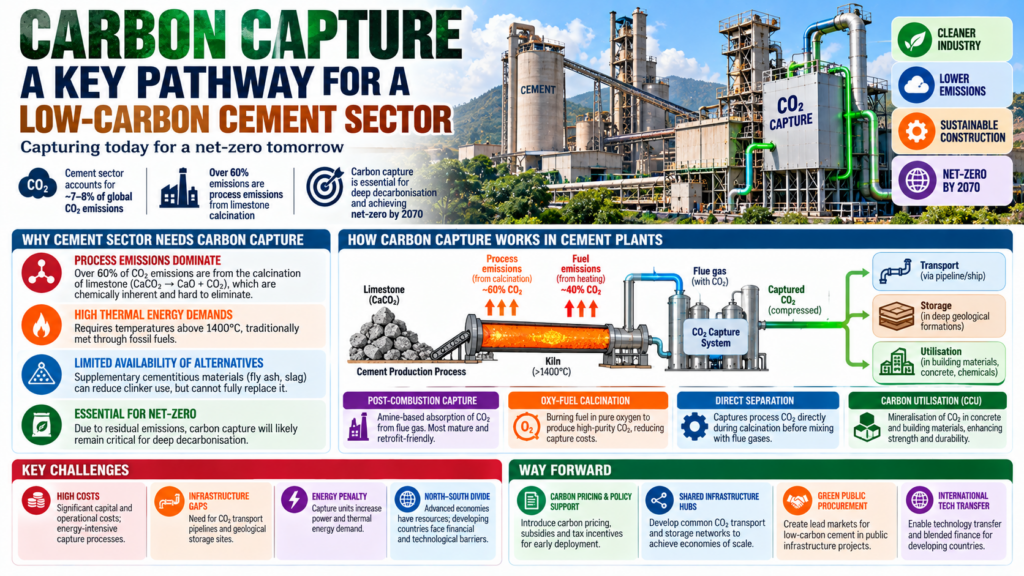
- Dominance of Process Emissions: Over 60% of total CO2 emissions in cement manufacturing are “process emissions” generated by the calcination of limestone (CaCO3CaO+CO2) inside the kiln. Because these emissions are chemically inherent to the production of clinker, they cannot be eliminated through energy efficiency improvements or a complete transition to renewable energy.
- Thermal Energy Demands: The remaining 35% to 40% of emissions originate from burning fossil fuels to heat kilns above 1400°C. While alternative fuels like biomass, municipal waste, and green hydrogen can mitigate fuel combustion emissions, they leave the primary process emissions untouched.
- Absence of Near-Term Chemical Substitutes: Although alternative binding materials and supplementary cementitious materials (SCMs) like fly ash and slag are used to reduce the clinker-to-cement ratio, their global availability is limited, and they cannot completely replace limestone-based clinker without compromising structural engineering standards.
Strategic Mechanisms and Technological Pathways
- Post-Combustion Chemical Absorption: Amine-based solvent scrubbing captures CO2 directly from flue gas after combustion. This is the most commercially mature approach and can be retrofitted onto existing operational cement plants without requiring fundamental kiln redesigns.
- Oxy-Fuel Calcination: By burning fuel in pure oxygen rather than ambient air, the resulting exhaust gas consists almost entirely of high-purity CO2 and water vapor. This significantly lowers the energy and capital cost required for subsequent carbon capture and isolation.
- Direct Separation Technologies: Innovative kiln architectures heat limestone indirectly, capturing pure process CO2 directly as it is released from the rock before it mixes with fuel combustion gases.
- Carbon Utilisation in Building Materials (CCU): Captured CO2 can be permanently sequestered by injecting it into recycled concrete aggregate or concrete mixing processes. This mineralisation process permanently traps CO2 while enhancing the compressive strength of the final concrete product.
Key Barriers to Scale and Global Deployment
- High Capital and Operational Costs: Implementing CCUS can increase the capital expenditure of a cement facility significantly and substantially raise operating costs, primarily due to the intense energy requirements of solvent regeneration.
- Cross-Border Transport and Storage Infrastructure: Transporting captured carbon requires extensive pipeline networks and access to verified geological storage formations (such as depleted oil fields or deep saline aquifers), which are unevenly distributed globally.
- Energy Penalty: Running capture units increases the internal power and thermal energy demand of cement plants, potentially diluting overall decarbonisation efficiency if supplied by carbon-intensive power grids.
- Global North-South Disparities: Advanced economies in the Global North possess the financial subsidies, carbon pricing mechanisms, and technical infrastructure necessary to deploy CCUS. Conversely, developing nations in the Global South face high capital costs and immediate domestic infrastructure demands, threatening to create a global green premium divide.
Way Forward
- Policy and Carbon Pricing Frameworks: Implement robust carbon border adjustment mechanisms, predictable carbon pricing, and targeted production tax credits to bridge the cost gap for early adopters of CCUS technologies.
- Development of Shared Infrastructure Hubs: Establish industrial carbon management hubs and open-access pipeline networks, allowing multiple industrial plants to share transport and geological storage infrastructure to achieve economies of scale.
- Mandating Green Public Procurement: Governments can leverage public works projects by specifying low-carbon or CCUS-enabled cement in public construction contracts to create guaranteed lead markets.
- International Technology and Financial Transfer: Multilateral development banks and Global North partners must facilitate technology transfers and blended financing to help developing nations scale CCUS without compromising economic growth.
|
SOURCE: The Hindu e-paper – India’s cement footprint stands in its way to net-zero emissions