
|
IN NEWS: The high cost of India’s private health-care boom
QUESTION: Affordable healthcare requires regulation of not merely individual prices but the incentives governing the entire healthcare delivery system. Discuss.
(15 marks, 250 words)
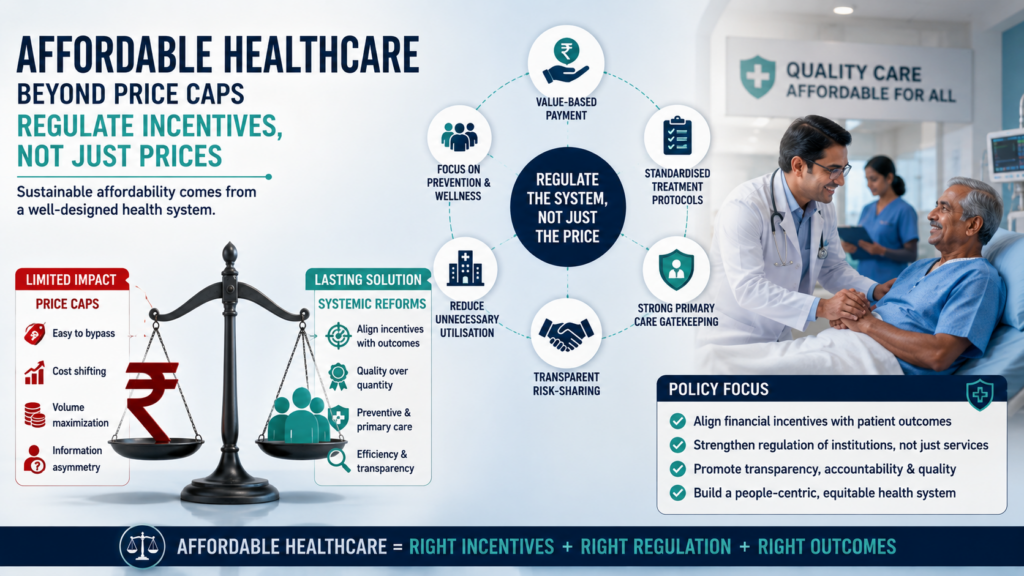
ANSWER: Regulating individual price tags in healthcare—such as capping the cost of a specific drug, an MRI scan, or a hospital bed—remedies a single symptom rather than the underlying illness. While price caps offer short-term relief, they are easily bypassed through unbundling, upcoding, or shifting volume toward non-regulated procedures. Truly affordable healthcare requires structural regulation of the financial, structural, and operational incentives that dictate how care is delivered.
Limitations of Fee-for-Service & Price Controls
Traditional healthcare systems operate predominantly on a Fee-for-Service (FFS) model, which inherently incentivizes volume over value.
- Volume Maximization: Under FFS, providers generate revenue by performing more tests, procedures, and consultations. Regulating the price of an individual service simply prompts providers to increase the quantity or complexity of services rendered to preserve profit margins.
- Cost Shifting: Capping prices in one domain often leads healthcare institutions to inflate costs in non-regulated areas (e.g., charging exorbitant fees for basic consumables or administrative services).
- Asymmetry of Information: Patients rarely possess the medical knowledge required to determine whether an ordered diagnostic test or surgical procedure is strictly necessary, leaving them vulnerable to provider-driven demand.
Realigning Systemic Delivery Incentives
Achieving long-term affordability necessitates shifting regulations away from line-item price fixing toward systemic delivery models that reward efficiency and preventive care.
- Transition to Value-Based Payment Models: Replacing FFS with bundled payments, capitation, or Accountable Care Organization (ACO) models aligns financial survival with patient health outcomes. In capitated models, providers receive a fixed fee per patient per year, incentivizing them to keep patients healthy and avoid costly hospitalizations.
- Standardization of Clinical Pathways: Establishing evidence-based clinical protocols reduces defensive medicine—where doctors order unnecessary tests purely to shield themselves from legal liability.
- Strengthening Primary Healthcare Gatekeeping: Mandating strong primary care networks prevents over-utilization of expensive tertiary and quaternary hospitals for conditions that could be effectively managed at the clinic level.
- Promoting Transparent Risk-Sharing: Regulating insurance reimbursement structures to ensure that both providers and insurers share financial risk encourages leaner management and eliminates redundant administrative bloat.
Affordability cannot be engineered by policing price tags while leaving the engine of profit-driven utilization untouched. Regulation must redefine what makes a healthcare delivery system financially successful: keeping populations healthy rather than treating them after they fall ill.
|