
|
IN NEWS: Towards recognising women farmers
QUESTION: The feminisation of agriculture has not been accompanied by a corresponding increase in the recognition and empowerment of women farmers.” Examine. (15 marks, 250 words)
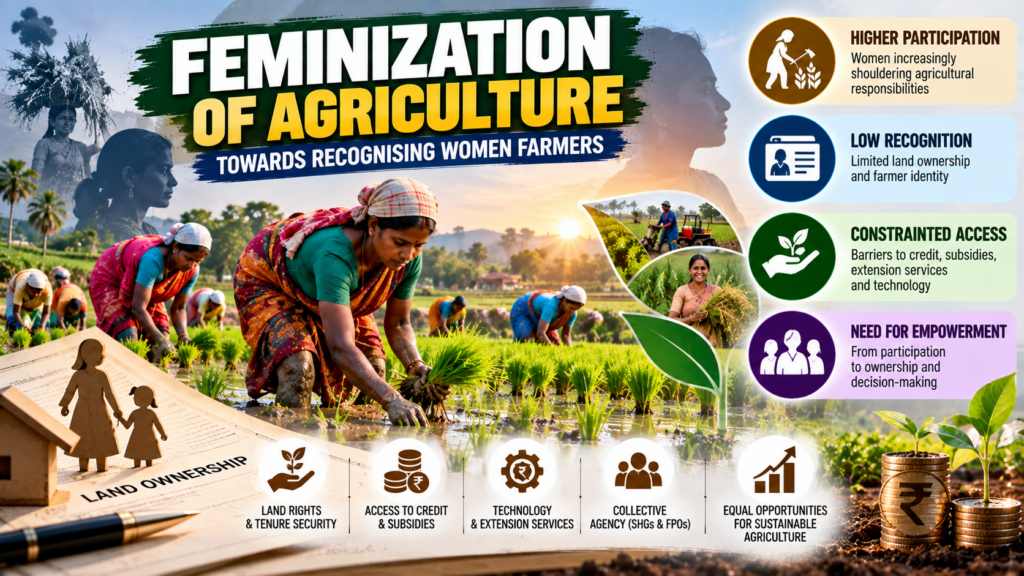
ANSWER: The feminisation of agriculture refers to the increasing participation and responsibility of women in farm and allied activities, particularly as men increasingly move towards non-farm employment. However, this has created a worker–owner dichotomy: women are increasingly responsible for agricultural production, while land ownership, farmer identity and control over productive resources remain predominantly with men.
Evidence of the recognition gap:
- In 2025, agriculture employed around 110 million women and 127 million men, bringing the agricultural workforce close to gender parity. Nearly three-fourths of rural women workers are engaged in agriculture, compared with less than half of rural men.
- Yet, the nature of employment remains highly gendered. 41.5% of women agricultural workers are unpaid family workers, compared with 19.6% of men. Conversely, only 38.5% of women are self-employed, compared with 62.9% of men.
- The Agriculture Census 2015 -16 shows that women account for only about 12–14% of operational agricultural holdings, despite their substantial contribution to farm work.
- In Maharashtra, the gap is particularly striking: 82% of rural female workers are engaged in agriculture, while women hold only 15.5% of operational farmland.
Measures for substantive women empowerment:
Land-linked eligibility can consequently limit women’s access to credit, crop insurance, subsidies, procurement, extension services and technology. The gender gap is also visible in PM-KISAN coverage, where women constitute only about 23% of beneficiaries, with substantial inter-State variation.
- Delink farmer identity from land ownership:
Maharashtra’s Women Farmers Empowerment Act, 2026 provides a Woman Farmer Certificate independent of land ownership and enables recognition through local institutions. It also provides for 30% reservation for women across State agricultural programmes. - Move from recognition to ownership:
Promote joint titling, inheritance rights and gender-responsive land records. Uttarakhand’s mandatory co-ownership of ancestral land provides a useful precedent. A certificate can establish farmer identity, but a title provides tenure security, collateral and bargaining power. - Build institutional visibility:
Create a standardised Women Farmer Database, integrate it with Farmer IDs/AgriStack, and include tenant farmers, landless cultivators and women engaged in allied activities. - Expand access to productive resources:
Ensure access to KCC, crop insurance, subsidies, extension, mechanisation and markets, without making individual land ownership an absolute precondition. - Strengthen collective agency:
Promote SHGs and women-led FPOs for aggregation, value addition, market access and bargaining power. As of February 2026, 1,175 FPOs had 100% women shareholders. - Promote women-centric technology:
Scale up Namo Drone Didi, Krishi Sakhis and drudgery-reducing technologies. Under DAY-NRLM, 2.58 crore women farmers received training during 2022–23 to 2024–25, while 800 women-led producer companies were promoted under the FPO framework.
The challenge is not merely to increase women’s participation in agriculture, but to convert participation into recognition, recognition into access, and access into ownership and agency.
Participation → Recognition → Access → Ownership → Economic agency
Maharashtra’s reform can therefore be viewed as an important institutional entry point, but genuine empowerment requires moving from legal visibility to tenure security, productive assets and decision-making power. As the recognition–ownership distinction demonstrates, recognition changes who the State sees; ownership determines who controls and decides
|
SOURCE: The Hindu e-paper – Towards recognising women farmers
SOURCE: Down to Earth – India’s women farmers are finally being recognised. Will they ever own the land?