
|
IN NEWS: Haifa – a century-old battle, the politics of memory
QUESTION: The Battle of Haifa is significant not only for India’s military history but also for understanding the colonial reordering of West Asia after the First World War. Discuss. (10 marks, 150 words)
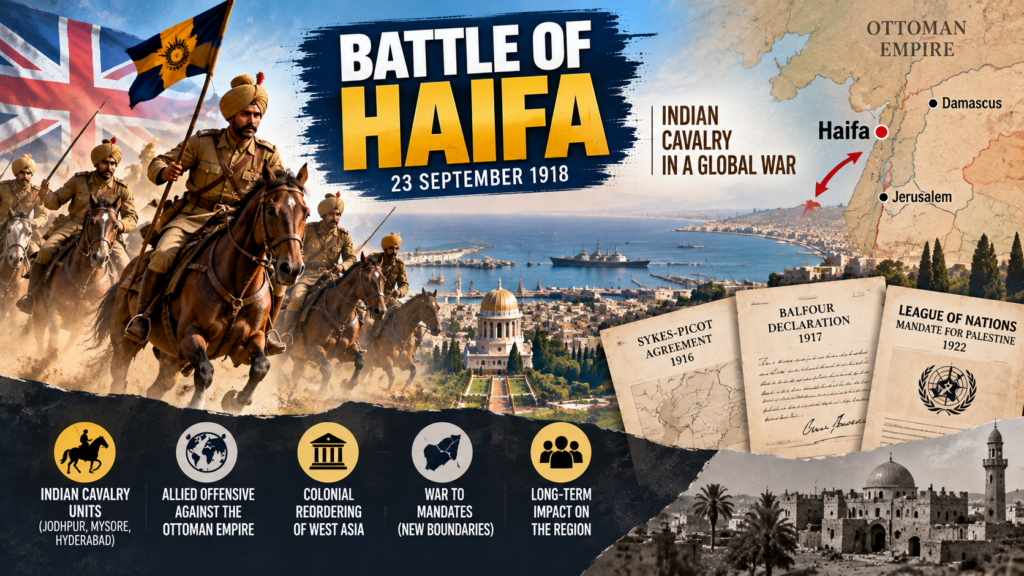
ANSWER: The Battle of Haifa, fought on 23 September 1918, was part of the Allied offensive against the Ottoman Empire during the final phase of the First World War. Indian cavalry units from Jodhpur, Mysore and Hyderabad played a prominent role in the capture of Haifa.
Battle of Haifa: Significance in Indian military history
- Indian contribution to a global war: The participation of Indian troops illustrates the extensive role of Indian soldiers in theatres beyond the Indian subcontinent during the First World War.
- Role of princely states: The Jodhpur, Mysore and Hyderabad Lancers were part of the Imperial Service Troops, reflecting the contribution of princely states to the British war effort.
- Military capability of Indian cavalry: The successful cavalry action at Haifa demonstrated the ability of Indian troops to operate effectively in difficult overseas theatres.
- Continuing military memory: The battle occupies a place in India’s military heritage and is commemorated through Haifa Day; its centenary was marked in 2018 with participation of personnel from India’s 61st Cavalry.
- Colonial paradox: The episode also reveals a larger contradiction that Indian soldiers demonstrated considerable military agency and courage, but did so within an imperial military structure and a war in which India was represented by the British Empire.
Battle of Haifa in the wider colonial transformation of West Asia
The importance of Battle Haifa becomes clearer when it is placed within the sequence of events surrounding the collapse of the Ottoman Empire.
- First, wartime agreements began anticipating a new political order.
- The Sykes–Picot Agreement of 1916 reflected British and French plans concerning territories of the Ottoman Empire in West Asia.
- At the same time, Britain made commitments relating to Arab aspirations and, through the Balfour Declaration of 1917, expressed support for establishing a national home for the Jewish people in Palestine.
- Second, military victories altered control on the ground.
- The British-led Allied campaign progressively displaced Ottoman authority from Palestine and neighbouring areas.
- The Battle of Haifa on 23 September 1918 was one episode within this wider military advance.
- The capture of Damascus soon afterwards further demonstrated the collapse of Ottoman control in the region.
- Third, the post-war settlement converted military occupation into a new system of political administration.
- The San Remo Conference of 1920 assigned the Mandate for Palestine to Britain and the mandates for Syria and Lebanon to France.
- Thus, territories that had been under Ottoman rule were reorganised under European mandatory authority.
- Fourth, the mandate system gave this arrangement an international-legal framework.
- The League of Nations formally approved the British Mandate for Palestine on 24 July 1922.
- Its terms incorporated Britain’s commitment to the establishment of a Jewish national home while explicitly stating that the civil and religious rights of existing non-Jewish communities should not be prejudiced.
- Finally, the Mandate formally came into force on 29 September 1923.
- The League of Nations recorded that the mandates for Palestine and Syria entered into force simultaneously after the necessary Franco-Italian agreement.
This mandate system, superimposing European drawn borders and competing promises onto Ottoman successor territories, is a root cause of persistent West Asian instability including the Israel-Palestine conflict, Syria-Lebanon tensions and fragile Iraqi statehood.
Thus, military victories such as Haifa were embedded in a larger process of imperial transition, territorial restructuring and competing national aspirations in West Asia.
Historical significance of the transformation
The post-war restructuring had consequences extending far beyond the battlefield:
Imperial transition: Ottoman sovereignty was replaced by British and French control through the mandate system.
New political geography: Former Ottoman territories were reorganised into new administrative and territorial units under European supervision.
Competing political aspirations: British wartime commitments and the interests of different communities increasingly intersected within Palestine.
Long-term consequences: The political arrangements of the mandate period became an important part of the historical background to the subsequent conflicts and competing national claims in the region.
The Battle of Haifa therefore connects India’s participation in the First World War with the much larger political transformation of West Asia. Its importance lies not merely in the military success of Indian cavalry, but in how that victory formed part of the collapse of Ottoman rule, the establishment of European mandates and the emergence of a new and contested political order in the region.
|
SOURCE: The Hindu e-paper – Haifa — a century-old battle, the politics of memory