
|
IN NEWS: India’s return to its Central Asian neighbourhood
QUESTION: India’s engagement with Central Asia is shaped as much by civilisational linkages as by contemporary geopolitical and economic interests. Discuss.
(10 marks, 150 words)
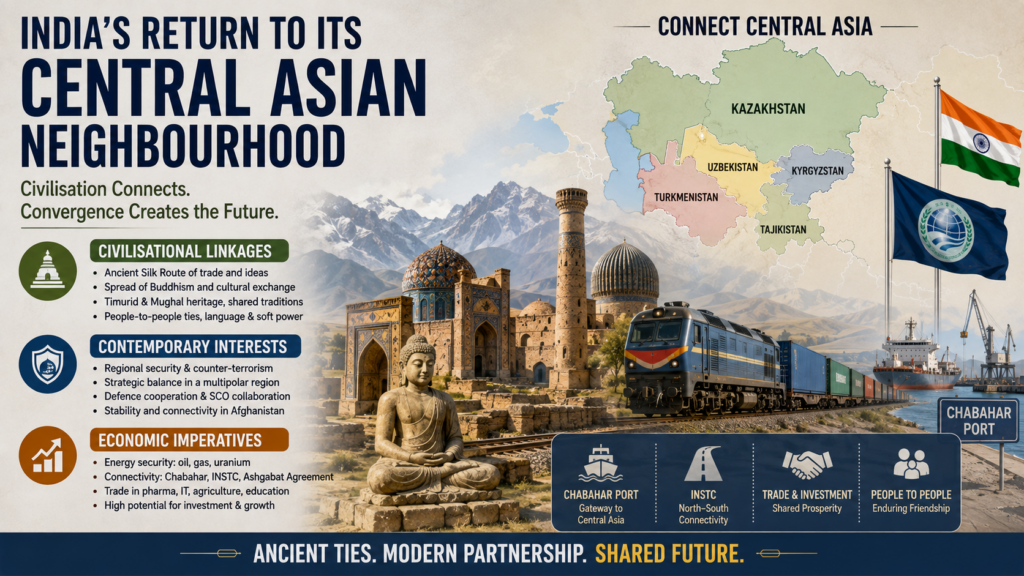
ANSWER: India’s engagement with Central Asia forms a core pillar of its extended neighborhood policy, anchoring its diplomatic push through the “Connect Central Asia” strategy. The relationship sits at the intersection of shared historic heritage and hard-nosed contemporary realpolitik.
Civilisational and Cultural Linkages
- Historical Silk Route Traditions: Trade, philosophical ideas, and people flowed along the ancient Silk Road connecting the Indian subcontinent with Silk City oases like Samarkand and Bukhara for millennia.
- Spread of Buddhism: Monks and scholars carried Buddhist philosophy through Central Asian hubs into East Asia, leaving enduring architectural and spiritual footprints across cities like Termez.
- Shared Architectural and Linguistic Exchange: The Timurid era brought mutual influences in architecture, music, and language, significantly shaping North Indian Mughal structures and enriching Persian-Sanskrit linguistic overlays.
- Modern Soft Power: Contemporary Indian cinema, yoga, and medical tourism foster deep goodwill and people-to-people ties across all five Central Asian republics (Kazakhstan, Kyrgyzstan, Tajikistan, Turkmenistan, Uzbekistan).
Contemporary Geopolitical Drivers
- Regional Security & Counter-Terrorism: Preventing regional instability, religious extremism, and drug trafficking emanating from Afghanistan remains a mutual strategic priority managed through regional mechanisms like the SCO (Shanghai Cooperation Organisation).
- Strategic Counterbalance: Active involvement acts as a vital counterbalance to China’s expanding influence via the Belt and Road Initiative (BRI), while supporting Russia’s traditional footprint to ensure a multipolar Eurasia.
- Geographic Proximity & Defense Ties: Defense exercises (such as KAZIND and DUSTLIK) and intelligence sharing, alongside strategic outposts like the Farkhor Air Base in Tajikistan, secure India’s northern strategic perimeter.
Economic and Energy Imperatives
- Energy Security: Central Asia holds massive reserves of uranium, oil, and natural gas. Kazakhstan serves as a vital supplier of uranium for India’s domestic civil nuclear energy needs.
- Multimodal Connectivity: Lacking direct overland access through Pakistan, India relies on key connectivity routes like Chabahar Port in Iran, the Ashgabat Agreement, and the International North-South Transport Corridor (INSTC) to bridge the logistics gap.
- Trade Potential: High-growth operational sectors include pharmaceuticals, information technology, higher education, agriculture, and mining, supported by structured summits through the India-Central Asia Dialogue framework.
The civilisational affinity provides deep trust, but institutionalizing transit infrastructure like Chabahar and INSTC remains essential to translate strategic interest into tangible economic volume.
|