
|
IN NEWS: End the culture of secrecy in judicial appointments
QUESTION: The collegium system was evolved to protect judicial independence, but its lack of transparency has raised concerns regarding accountability and equal opportunity. Critically examine. (15 marks, 250 words)
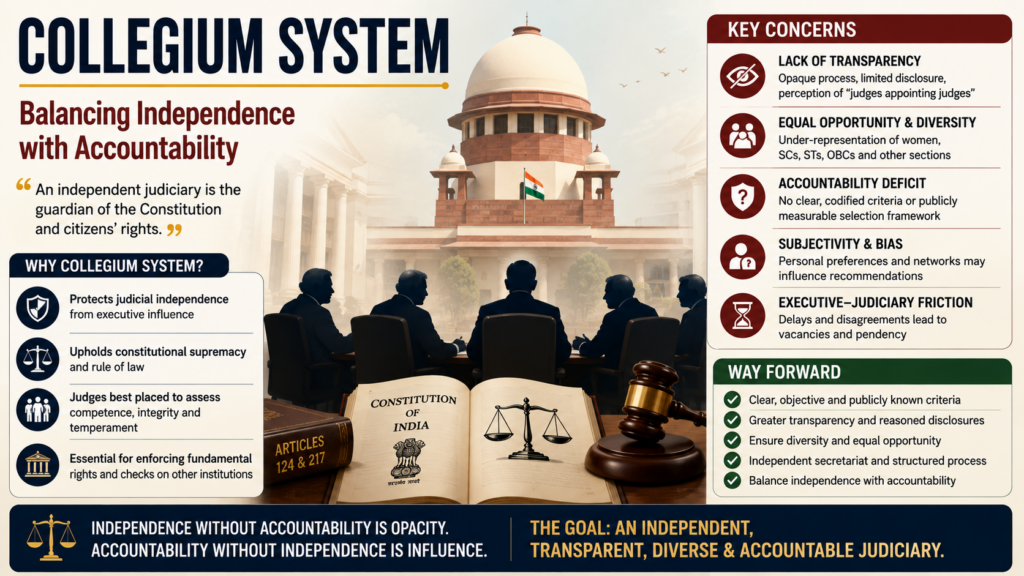
ANSWER: The collegium system, evolved through the Second Judges Case (1993) and Third Judges Case (1998), places the primacy of judicial opinion in appointments and transfers of higher judiciary. It seeks to insulate judges from executive influence and thereby protect judicial independence, a basic feature of the Constitution. However, its functioning has also raised concerns regarding transparency, accountability and representational diversity.
Why the Collegium was evolved
- Protection from executive dominance: The experience of the pre-collegium system raised concerns that excessive executive discretion could influence judicial appointments.
- Judicial independence: Articles 124 and 217, read with the judicial interpretation of “consultation”, established judicial primacy in appointments.
- Constitutional supremacy: An independent judiciary is essential for enforcing Fundamental Rights and reviewing executive and legislative action.
- Institutional self-protection: Judges are better placed to assess the professional competence, integrity and judicial temperament required for higher judicial office.
Concerns regarding the present system
- Lack of transparency
- The criteria for selecting candidates, reasons for rejection and internal deliberations are generally not available in a systematic manner.
- Although the Supreme Court has begun publishing collegium resolutions, the overall process remains largely opaque.
- This creates a perception of “judges appointing judges” without adequate public accountability.
- Concerns regarding equal opportunity
- Limited visibility of the selection process can disadvantage deserving candidates who lack access to informal professional networks.
- Concerns have been raised regarding the representation of women, Scheduled Castes, Scheduled Tribes, OBCs and other under-represented sections in the higher judiciary.
- Diversity is not merely representational; it can enhance public confidence in the judiciary.
- Accountability deficit
- Judicial independence cannot mean complete institutional insulation from scrutiny.
- Unlike the executive, the collegium does not operate through a formally codified and publicly measurable selection framework.
- Absence of clear performance and selection benchmarks can generate questions regarding consistency and fairness.
- Possibility of subjectivity
- Personal assessments, professional familiarity and institutional preferences can potentially influence recommendations.
- The absence of a transparent comparative evaluation mechanism makes it difficult to determine why one candidate is preferred over another.
- Executive–judiciary friction
- Delays in processing collegium recommendations and disagreements between the Union Government and judiciary have periodically affected appointments.
- This can aggravate vacancies and consequently contribute to the judicial pendency problem.
Why replacing the collegium is not a simple solution
- Political influence: Judicial appointments could become vulnerable to partisan considerations.
- Threat to checks and balances: A judiciary dependent on the political executive may be less effective in reviewing governmental action.
- Constitutional experience: The 99th Constitutional Amendment and NJAC Act, 2014, which sought to replace the collegium, were struck down by the Supreme Court in Supreme Court Advocates-on-Record Association v. Union of India (2015) because judicial independence was considered part of the basic structure.
Thus, the challenge is not simply “collegium versus executive”, but how to reconcile independence with institutional accountability.
Critical assessment
The collegium’s greatest strength is that it protects the judiciary from direct political control; its greatest weakness is that it can appear insufficiently transparent and accountable. Excessive opacity may undermine the very public confidence that judicial independence is intended to protect.
Therefore, judicial independence and accountability should be treated as complementary, not competing, constitutional values. The solution lies in reforming the collegium rather than weakening judicial primacy.
The constitutional objective should be an independent, transparent, diverse and accountable judiciary. A reformed collegium—with objective criteria, institutionalised procedures, greater diversity, reasoned disclosures and a professional secretariat—can preserve the judiciary’s independence while addressing concerns over opacity and equal opportunity. In essence, independence should protect judges from political pressure, not from legitimate institutional accountability.
|