
|
IN NEWS: Beyond Kudankulam’s fence, a cybersecurity challenge
QUESTION: “In an interconnected digital economy, the weakest link in a critical infrastructure’s supply chain can become a national security vulnerability.” Analyse
ANSWER: For India, where digital transformation intersects with complex geopolitical challenges, this analysis is crucial. India’s critical sectors—such as power grids, telecommunications, banking, transport, space, and defense production—increasingly rely on global and domestic third-party software, hardware, and cloud providers.
1. Structural Vulnerabilities in India’s Digital Supply Chain
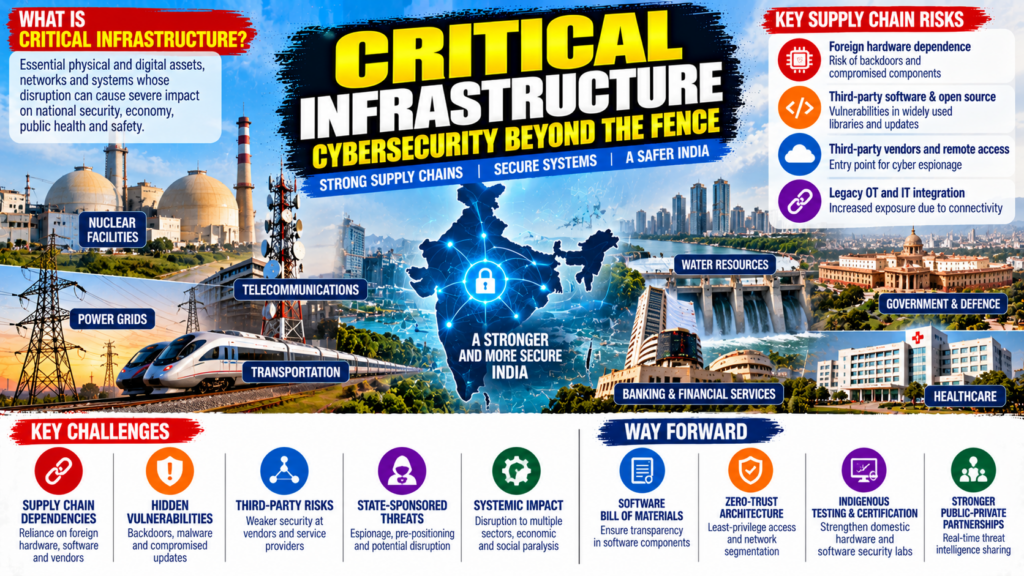
- Dependence on Foreign Hardware and Embedded Systems: India remains heavily dependent on imported hardware, semiconductors, and telecommunications equipment (primarily from East Asia and Western nations). Hidden backdoors, unverified microprocessors, or compromised firmware in critical assets (such as power grid transformers or telecom towers) create single points of national vulnerability.
- The Software and Open-Source Ecosystem: Modern IT/OT software deployed across Indian Critical Information Infrastructure (CII) utilizes open-source libraries and external APIs. Vulnerabilities in widely used libraries (e.g., Log4j) or compromised software updates can expose hundreds of public and private sector enterprises simultaneously.
- Legacy OT Systems and Modern IT Integration: Operational Technology (OT) driving India’s physical infrastructure—like power generation, nuclear facilities, and railways—was traditionally air-gapped. As these systems digitize and integrate with cloud platforms and enterprise IT networks for real-time monitoring, third-party remote access channels become prime targets for cyber exploitation.
2. High-Profile Indian Context & National Security Risks
- Cyber Espionage and Pre-positioning: State-sponsored advanced persistent threat (APT) groups frequently target secondary vendors, IT service providers, and contractors rather than attacking heavily fortified military or administrative networks directly. Gaining access via a vendor allows adversaries to map networks, exfiltrate sensitive data, or pre-position disruptive malware.
- Systemic Economic and Social Paralysis: An attack on a single critical vendor can cascade across multiple sectors. For example, a ransomware attack on a centralized payment gateway, cloud hosting provider, or power dispatch system can freeze commercial banking, paralyze transport logistics, and destabilize public order.
- Geopolitical Coercion: In times of border tensions or regional conflicts, foreign supply chain dependencies can be weaponized through remote shutdowns, withheld critical software patches, or covert data exfiltration.
3. India’s Policy, Legal, and Regulatory Response
- National Critical Information Infrastructure Protection Centre (NCIIPC): Designated under Section 70A of the Information Technology Act (2000), NCIIPC acts as the nodal agency for protecting India’s CII across six core sectors: Energy, Transport, Banking/Financial, Telecom, Strategic/Government, and Healthcare/Insurance. NCIIPC mandates stringent third-party risk assessments, audit trails, and vendor due diligence.
- Trusted Telecom Portal & National Security Directive on Telecommunication Sector (NSDTS): To mitigate hardware supply chain risks in 5G and core networks, India mandates that telecom service providers import equipment only from “Trusted Sources” using “Trusted Products,” effectively restricting high-risk foreign vendors.
- CERT-In Directives and 6-Hour Reporting: The Indian Computer Emergency Response Team (CERT-In) enforces strict compliance guidelines, including mandatory reporting of cyber incidents within six hours and strict data retention norms for service providers and cloud vendors.
- Public Procurement (Preference to Make in India) and Atmanirbhar Bharat: To reduce foreign hardware/software dependencies, the Indian government actively prioritizes domestically designed and manufactured electronic items and cybersecurity tools for critical government procurement.
Strategic Imperatives for India Moving Forward
- Mandatory Software Bill of Materials (SBOM): Requiring commercial vendors supplying Indian CII operators to provide a clear, detailed inventory of all software components, third-party libraries, and code origins.
- Implementation of Zero-Trust Architecture (ZTA): Assuming external vendors and internal networks are inherently untrusted. Enforcing continuous authentication, least-privilege access, and strict network segmentation between corporate IT and critical OT environments.
- Robust Indigenous Testing Infrastructure: Expanding domestic security testing, code audits, and hardware certification labs (e.g., STQC) to rigorously test foreign and domestic components before deployment in sensitive sectors.
- Enhanced Public-Private Partnerships: Fostering real-time threat intelligence sharing between intelligence agencies, regulatory bodies, and private sector vendors who own or maintain a large portion of the nation’s digital ecosystem.
|
SOURCE: The Hindu epaper – Beyond Kudankulam’s fence, a cybersecurity challenge