
SYLLABUS: Indian Polity General Studies – : II Indian Constitution—historical underpinnings, evolution, features, amendments, significant provisions and basic structure.
IN NEWS: Lessons on the right to assembly
QUESTION: “The right to dissent and protest is integral to a liberal democracy, but it remains subject to constitutionally permissible restrictions.” Examine
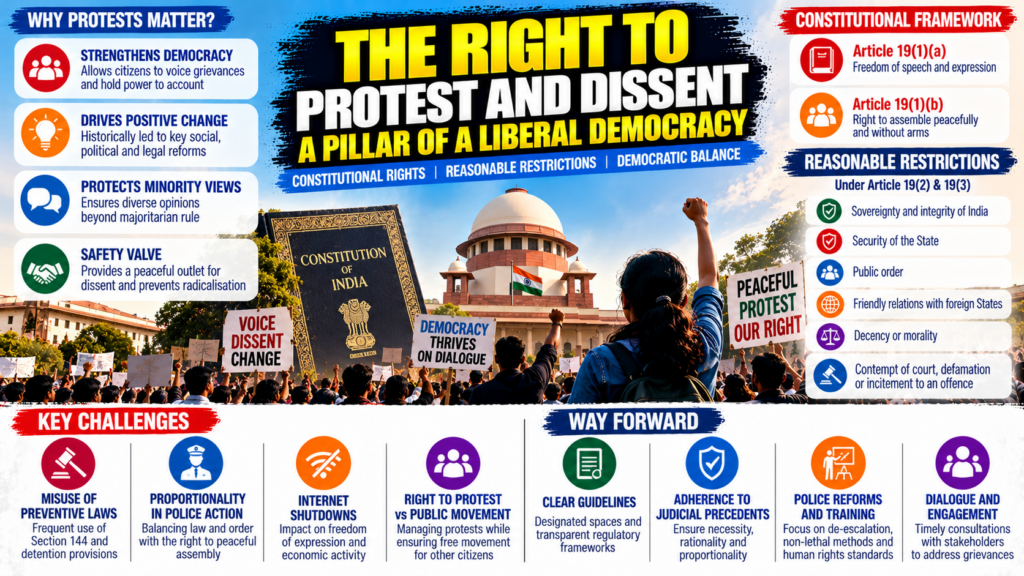
ANSWER: The right to dissent and protest is the cornerstone of a vibrant, liberal democracy, acting as a crucial check on state power and ensuring public accountability. Under the Constitution of India, this right is deeply rooted in Article 19(1)(a) (Freedom of Speech and Expression) and Article 19(1)(b) (Right to Assemble Peacefully and Without Arms). However, the Constitution balances these liberties with collective order, subjecting them to permissible restrictions under Articles 19(2) and 19(3).
The Right to Dissent & Protest as Integral to Liberal Democracy
- Substantive Democracy Beyond Elections: True democracy requires continuous dialogue, non-violent opposition, and the expression of minority or non-conforming viewpoints, ensuring that governance goes beyond majoritarian rule.
- Judicial Endorsement: The Supreme Court in Ramlila Maidan Incident (2012) held that peaceful protest is a fundamental right and an essential feature of a democratic state. Similarly, in Mazdoor Kisan Shakti Sangathan v. Union of India (2018), the Court affirmed that peaceful assembly is vital for citizens to convey their grievances to the government.
- Catalyst for Rights and Legal Reform: Historical protests—such as the Indian Freedom Movement and modern civil rights campaigns—demonstrate that peaceful dissent drives progressive socio-political change and legislative accountability.
- Safety Valve Function: Providing institutional and constitutionally protected avenues for non-violent protest prevents underground radicalization and civil unrest, maintaining social stability.
Constitutional Framework & Permissible Restrictions
The right to protest is neither absolute nor unbridled. The Constitution explicitly outlines specific grounds under which the state can impose reasonable restrictions:
- Grounds Under Article 19(2) & 19(3):
- Sovereignty and integrity of India
- Security of the State
- Friendly relations with foreign States
- Public order
- Decency or morality
- Contempt of court, defamation, or incitement to an offence
- Test of Reasonableness and Proportionality: Any state restriction on assembly or speech must pass the test of proportionality (K.S. Puttaswamy v. Union of India, 2017). The restriction must be prescribed by law, serve a legitimate state goal, and be the least restrictive measure necessary.
- Clear and Present Danger Standard: In Babulal Parate v. State of Maharashtra (1961), the Supreme Court ruled that restrictions imposed to prevent public disorder must be backed by a clear, non-speculative threat to peace.
Striking the Balance: Key Judicial Jurisprudence
- Right to Use Public Spaces vs. Right to Free Movement: In Himmat Lal K. Shah v. Commissioner of Police (1973), the Supreme Court clarified that while citizens have a right to hold meetings on public streets, it is subject to regulation aimed at preserving smooth traffic flow and public order.
- Indefinite Occupation of Public Ways Unlawful: In Himat Lal and subsequently reinforced in Anita Thakur v. State of J&K (2016) and Himachal Pradesh State Electricity Board v. Shiv K. Sharma (2006), the judiciary underscored that peaceful assembly cannot extend to obstructing public utilities or blockading transportation corridors indefinitely.
- Prohibition on Destruction of Property: The Court in In Re: Destruction of Public and Private Properties (2009) mandated strict accountability and financial compensation from groups engaging in vandalism or violence during protests.
Key Challenges in Implementation
- Misuse of Preventative and Penal Provisions: Frequent invocation of Section 144 of the Code of Criminal Procedure (CrPC) / Section 187 of the Bharatiya Nagarik Suraksha Sanhita (BNSS) and preventive detention laws often leads to pre-emptive suppression of legitimate peaceful protests.
- Proportionality in Law Enforcement: Striking a balance between police action (e.g., tear gas, water cannons) and maintaining public order remains a critical administrative challenge, requiring strict adherence to standard operating procedures.
- Digital Assembly and Internet Shutdowns: Blanket internet shutdowns used to curb protests impede overall freedom of expression and economic activity, violating the principles laid down in Anuradha Bhasin v. Union of India (2020).
Way Forward
- Standardized Regulatory Frameworks: Establish clear municipal and police guidelines designating specific spaces for public demonstration while preserving the right to free movement for non-protesting citizens.
- Adherence to Judicial Precedents: Ensure that executive orders under preventive laws strictly satisfy the criteria of necessity, rationality, and proportionality before restricting public gatherings.
- Police Reforms and Training: Train law enforcement agencies in de-escalation tactics, non-lethal crowd management, and human rights standards during demonstrations.
- Strengthening Alternative Dispute Mechanisms: Encourage timely state engagement and dialogue with aggrieved groups to address concerns before protests escalate into public disruptions.
The right to dissent is an indispensable pillar of constitutional democracy, giving voice to public grievances and holding authority accountable. However, liberty cannot exist without order. By ensuring that restrictions on peaceful assembly remain strictly reasonable, proportionate, and constitutionally sound, India can preserve both public order and democratic freedom.
|