
SYLLABUS: International Relations General Studies – : II Important International institutions, agencies and fora- their structure, mandate.
IN NEWS: We need to recreate the UN – 81 years show why it’s worth the effort
QUESTION: In an increasingly fragmented world order, critically examine the continuing relevance of the United Nations in promoting international peace, cooperation and effective global governance. (15 Marks, 250 words)
ANSWER: Established in 1945, the United Nations (UN) remains the cornerstone of multilateralism. However, growing geopolitical rivalries, unilateralism, regional conflicts and minilateral groupings have challenged its authority. Despite these developments, its universal legitimacy, norm-setting role and capacity for collective action sustain its relevance.
- Continuing Relevance of the United Nations
- Promoting International Peace and Security
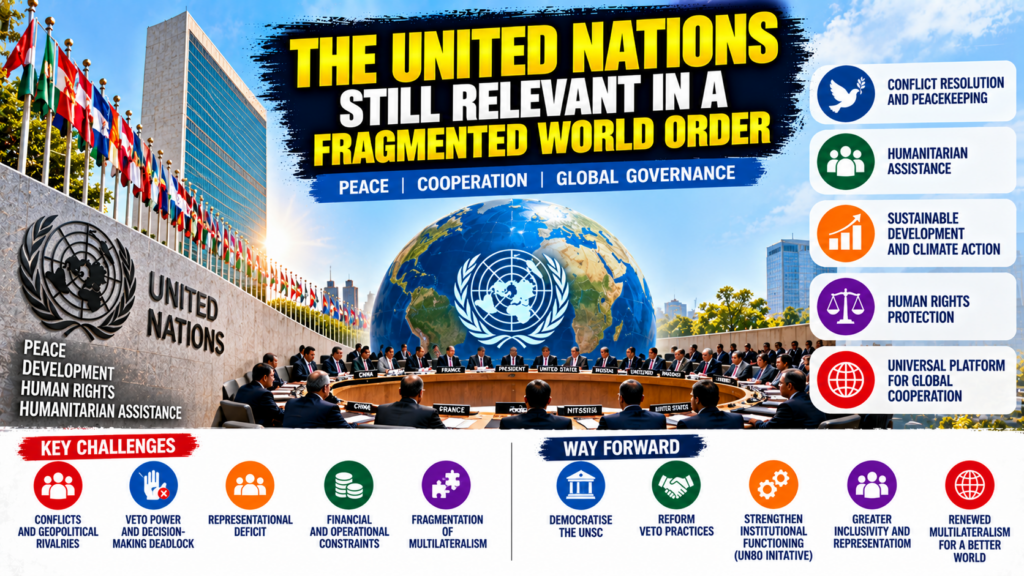
- Conflict resolution and peacekeeping: UN peacekeeping and mediation have facilitated conflict resolution and political transitions in countries such as Namibia, Timor-Leste and Mozambique.
- Preventive diplomacy: The UN provides a permanent institutional platform for dialogue between adversarial nations, helping prevent escalation and encouraging negotiated settlements.
- Collective security: Under Chapter VII of the UN Charter, the UNSC can authorise sanctions and enforcement measures to address threats to international peace.
- Strengthening International Cooperation
- Humanitarian assistance: UNHCR, UNICEF and WFP provide critical support to refugees and conflict-affected populations. Eg. Humanitarian relief during the Gaza and Sudan crises.
- Global health cooperation: WHO and UNICEF have supported polio eradication efforts, immunisation programmes and coordinated responses to Ebola and COVID-19.
- Sustainable development and climate action: The MDGs and SDGs established common development priorities, while the UN framework facilitated the Montreal Protocol and Paris Agreement.
- Human rights protection: The Universal Declaration of Human Rights and international human rights conventions have established common standards for dignity, equality and fundamental freedoms.
- Ensuring Effective Global Governance
- Inclusive representation: The 193-member UN General Assembly provides developing countries and smaller nations a voice in international decision-making, unlike limited-membership groupings.
- International legal framework: The UN Charter establishes principles of sovereign equality, peaceful dispute settlement and prohibition of the unlawful use of force.
- Governance of emerging challenges: The 2024 Pact for the Future and Global Digital Compact reflect the UN’s efforts to address digital inequality, artificial intelligence and emerging global risks.
- Institutional Limitations: A Critical Examination
Despite its contributions, the UN faces a widening gap between its normative authority and operational effectiveness.
- Inability to prevent conflicts: Prolonged conflicts in Ukraine, Gaza and Yemen expose the limitations of collective security when major powers have competing strategic interests.
- Deadlock due to Veto Power: The P5’s veto powers frequently obstruct timely decisions, weakening the UNSC’s ability to respond to humanitarian emergencies.
- Representational deficit: UNSC permanent membership reflects the geopolitical realities of 1945, excluding emerging powers such as India and permanent representation from Africa and Latin America.
- Selective enforcement of international law: Inconsistent responses to violations of sovereignty and humanitarian law undermine institutional credibility.
- Financial and operational constraints: Funding shortages, bureaucratic duplication and dependence on voluntary contributions affect humanitarian and developmental programmes.
- Fragmentation of multilateralism: The increasing reliance on regional and minilateral arrangements reflects dissatisfaction with the UN’s decision-making mechanisms.
Critical Assessment: The UN’s limitations arise partly from the conflicting interests of its member States rather than institutional design alone. While groupings such as the G20 and BRICS can complement multilateral cooperation, they cannot fully substitute for the UN’s universal membership, comprehensive mandate and international legal authority.
- Way Forward: Towards Reformed Multilateralism
- Democratise the UNSC: Expand permanent and non-permanent representation, particularly for Africa, Latin America and emerging powers such as India.
- Reform veto practices: Encourage voluntary veto restraint during mass atrocities and strengthen accountability through UNGA Resolution 76/262.
- Strengthen institutional functioning: Implement the UN80 Initiative to streamline administrative structures, reduce duplication and improve resource utilisation.
- Balance competing reform priorities: Reconcile the Global North’s emphasis on institutional efficiency with the Global South’s demands for equitable representation and participation.
- Build political consensus: Pursue reforms that enhance legitimacy while ensuring continued cooperation from major powers, essential for effective collective security.
The UN’s record reflects a paradox: substantial achievements in development, humanitarian assistance and global norm-setting, alongside persistent limitations in maintaining international peace. However, these shortcomings strengthen the case for reform rather than replacement. A more representative, accountable and effective UN remains essential for sustaining multilateralism in a fragmented world order.
|