
|
IN NEWS: How to break the ration shop monopoly
QUESTION: Examine the role of the One Nation One Ration Card scheme in addressing the structural limitations of the Public Distribution System in India. (10 Marks, 150 Words)
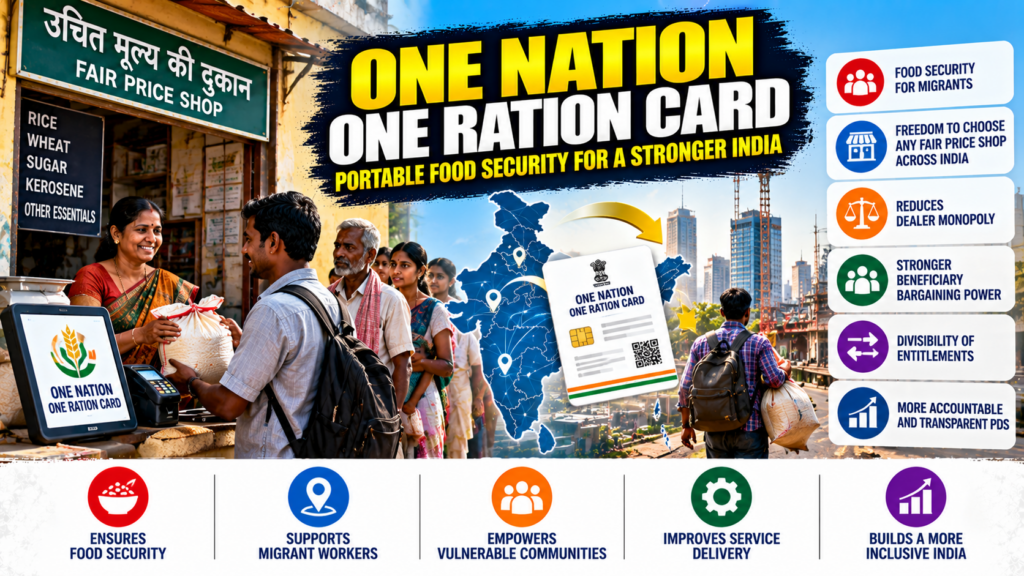
ANSWER: The One Nation One Ration Card (ONORC) scheme, introduced in 2019 under the National Food Security Act (NFSA), 2013, enables beneficiaries to access foodgrain entitlements from any Fair Price Shop (FPS) across India. Beyond ensuring food security for migrants, it seeks to address the structural problems of geographical restrictions, dealer monopoly and unequal bargaining power within the PDS.
- Role of ONORC in Addressing Structural Limitations
- Overcoming geographical restrictions: Earlier, ration entitlements were tied to the beneficiary’s registered location. ONORC enables migrant workers to access foodgrains at their destination, reducing vulnerabilities exposed during the COVID-19 lockdown.
- Breaking the FPS dealer monopoly: Traditionally, beneficiaries depended on a single assigned ration shop, limiting their ability to challenge short-weighing, poor-quality grains or irregular distribution. Portability allows them to switch dealers.
- Strengthening beneficiary bargaining power: Since FPS dealer commissions depend on the quantity of foodgrains distributed, the possibility of losing beneficiaries creates incentives for better service and accountability.
- Empowering vulnerable communities: Greater freedom of choice can reduce the dependence of women-headed households, Scheduled Castes and other marginalised groups on individual dealers, strengthening their agency in accessing food entitlements.
- Divisibility of entitlements: Migrant households can split their monthly foodgrain allocation between family members residing in different locations, ensuring continuity of food security.
2. Evidence of Structural Transformation: Bihar PDS Study
An analysis of 891 million PDS transactions in Bihar since April 2022 highlights that ONORC’s benefits extend beyond interstate migration.
- 55% of transactions occurred at a different FPS within the same block.
- Only 1% involved interstate portability.
- The share of portable transactions increased by approximately six percentage points annually.
These findings suggest that ONORC is used predominantly to exercise local dealer choice rather than long-distance portability, potentially shifting bargaining power towards beneficiaries.
- Continuing Structural Challenges
- Technological exclusion: Aadhaar authentication failures, worn fingerprints and poor internet connectivity can prevent beneficiaries from accessing foodgrains.
- Inadequate dealer incentives: Low commission margins may encourage short-weighing, diversion or resistance to portability.
- Limited awareness: Beneficiaries may remain unaware of their right to switch FPS dealers or split entitlements.
- Coverage gaps: NFSA beneficiary ceilings based on Census 2011 population figures leave some eligible households outside the system.
- Uneven effectiveness: The extent of beneficiary choice depends on the availability of alternative FPS outlets and effective implementation across States.
- Way Forward
- Strengthen beneficiary awareness: Publicise portability rights, entitlement divisibility and grievance redressal mechanisms at every FPS.
- Reform dealer incentives: Rationalise commissions and monitor service quality to discourage malpractices.
- Prevent exclusion: Introduce reliable alternative authentication mechanisms and update beneficiary coverage using current demographic data.
ONORC signifies a shift from a location-bound, dealer-centric PDS towards a portable, beneficiary-centric food security system. However, portability alone cannot eliminate structural weaknesses. Its transformative potential depends on greater beneficiary choice, fair dealer incentives and universal accessibility.
|