
|
IN NEWS: Redefining we the people – that’s the task of a new Demography Committee without demographers
QUESTION: Population data are essential for development planning, but their interpretation can also have significant social implications. Examine in the context of India’s diverse society. (15 Marks,250 Words)
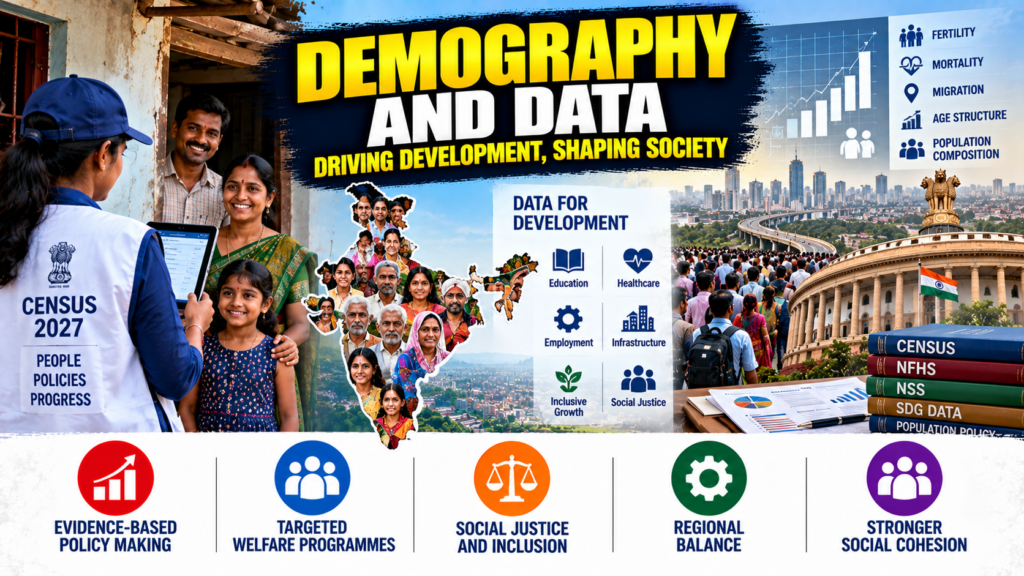
ANSWER: Demographic data on fertility, mortality, migration and population composition are essential for evidence-based policymaking. However, in India’s religiously, linguistically and socially diverse society, the interpretation of such data can influence community identities, political representation and social cohesion.
- Significance of Population Data for Development Planning
- Resource allocation: Census data guide the distribution of resources for education, healthcare, housing and public infrastructure.
- Demographic transition: NFHS-5 recorded India’s Total Fertility Rate at 2.0, highlighting the need to address population ageing alongside youth employment.
- Regional disparities: Variations in fertility and age structure between States such as Bihar and Tamil Nadu necessitate differentiated development strategies.
- Social justice: Caste-wise, gender-wise and regional data help identify disadvantaged groups and design targeted welfare programmes.
- Migration management: Population data support urban planning, labour mobility and the provision of services to migrant populations.
- Social Implications of Demographic Data and Their Interpretation
- Communal polarisation: Interpreting differences in religious population growth without considering education, income and fertility transition can reinforce stereotypes and demographic anxieties.
- Migration and citizenship concerns: Changes in population composition may be attributed to illegal immigration without adequately distinguishing fertility, internal migration and cross-border movement.
- Identity-based mobilisation: Caste and religion-wise data may strengthen demands for representation and affirmative action, but can also intensify competition between communities.
- Regional tensions: Population differences influence debates on delimitation and federal resource sharing, particularly between States at different stages of demographic transition.
- Privacy and social exclusion: Linking demographic information with administrative records without adequate safeguards may create risks of profiling and discrimination.
- Contemporary Relevance:
- Census 2027: India’s first digital Census includes caste enumeration, creating opportunities for inclusive planning while raising questions about data protection and interpretation.
- High-Level Committee on Demographic Change (2026): Constituted to examine demographic changes, including those associated with illegal immigration, and analyse trends across religious and social communities.
- Religion-wise demographic analysis: Proposals to examine birth registrations, school enrolments, property transactions and voter registrations by community highlight the importance of distinguishing demographic trends from assumptions about illegal immigration.
- Special Intensive Revision (SIR): Debates surrounding electoral-roll verification demonstrate the need to distinguish population enumeration, electoral eligibility and citizenship determination.
- Way Forward
- Scientific interpretation: Use Census, NFHS and Civil Registration System data to analyse population changes through socioeconomic and demographic factors.
- Institutional expertise: Involve demographers and institutions such as the International Institute for Population Sciences (IIPS) in demographic assessments.
- Data confidentiality: Strengthen privacy safeguards, consistent with Section 15 of the Census Act, 1948.
- Constitutional safeguards: Ensure demographic exercises respect equality, non-discrimination and fraternity.
- Transparent communication: Publish methodologies and address misinformation to prevent demographic anxieties from weakening social cohesion.
Population data should serve as an instrument of inclusive development rather than social division. Scientific analysis, institutional transparency and constitutional safeguards are essential to ensure that India’s demographic diversity strengthens its social fabric.
|