
|
IN NEWS: ‘Innovate today, nourish tomorrow’ for food security
QUESTION: India has transitioned from food scarcity to foodgrain surplus, but nutritional security remains a major challenge. Discuss. (250 words)
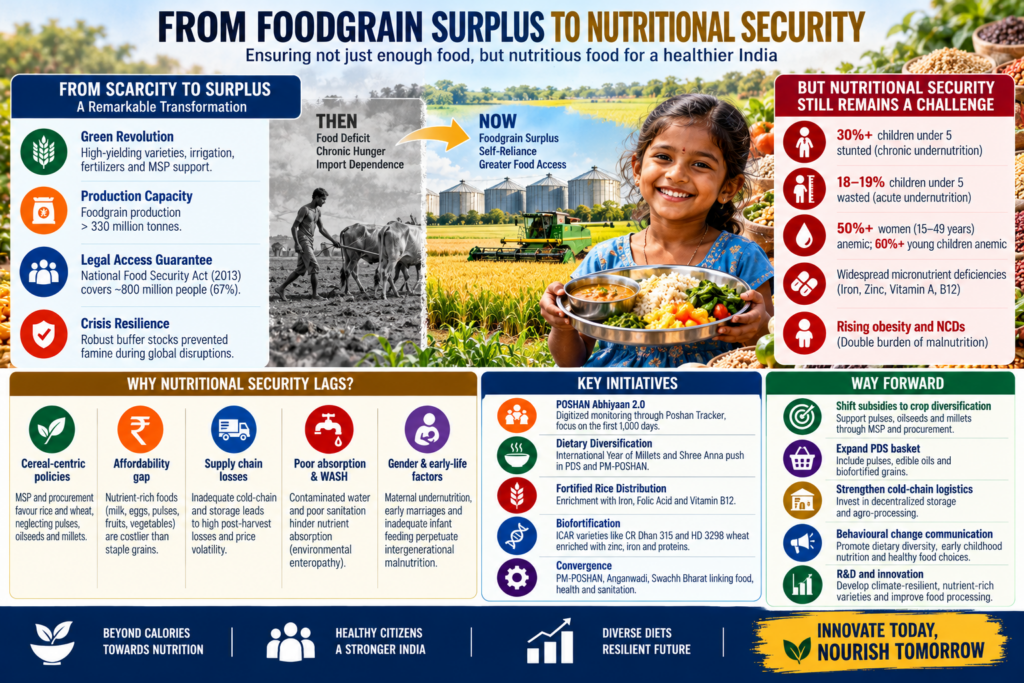
ANSWER: India’s transformation from chronic food scarcity to a foodgrain-surplus nation stands as one of the significant developmental achievements of the post-independence era. However, this quantitative success in cereal production has not automatically translated into nutritional security.
While India has largely managed to prevent famine and severe calorie deprivation, it faces a persistent burden of malnutrition, hidden hunger, and the double burden of disease.
1. The Transition: From Scarcity to Foodgrain Surplus
The Green Revolution introduced high-yielding varieties (HYVs) of wheat and rice, supported by expanded irrigation, synthetic fertilizers, price support mechanisms (Minimum Support Price – MSP), and procurement systems through the Food Corporation of India (FCI).
- Production Capacity: India’s annual foodgrain production has grown to over 330 million tonnes.
- Legal Access Guarantee: The National Food Security Act (NFSA), 2013 legally entitles nearly 800 million citizens (67% of the population) to subsidized foodgrains.
- Crisis Resilience: Robust central buffer stocks allowed India to execute large-scale food distribution during major global disruptions, preventing widespread famine.
2. The Core Paradox: Why Nutritional Security Remains a Challenge
A. The Malnutrition & “Hidden Hunger” Landscape
- Child Malnutrition: Over 30% of children under 5 suffer from stunting (chronic undernutrition), and roughly 18–19% suffer from wasting (acute undernutrition).
- Anemia Epidemic: NFHS surveys indicate that over 50% of women of reproductive age and 60% of young children are anemic.
- Micronutrient Deficiencies: Widespread deficiencies in Iron, Zinc, Vitamin A, and Vitamin B12 lead to “hidden hunger”—where a person receives adequate calories but lacks essential vitamins and minerals.
- The “Double Burden” of Malnutrition: Rising rates of urban and semi-urban obesity alongside persistent undernutrition are leading to a surge in Non-Communicable Diseases (NCDs) like diabetes and cardiovascular conditions.
3. Key Factors Behind the Nutritional Security Gap
- Cereal-Centric Agricultural Policies: Agricultural subsidies, power tariffs, and procurement structures overwhelmingly favor rice and wheat. This incentivized monoculture at the expense of protein-rich pulses, oilseeds, and coarse grains (millets/Shree Anna), reducing crop and dietary diversity.
- Dietary Affordability and Quality: Nutrient-dense foods—such as milk, eggs, pulses, fresh fruits, and vegetables—are significantly more expensive per calorie than subsidized staple grains. Lower-income households often rely heavily on starch to satisfy hunger, missing recommended intake levels for proteins and micronutrients.
- Supply Chain Losses and Infrastructure: A lack of cold-chain storage and processing infrastructure causes significant post-harvest losses in perishable horticultural crops. This creates localized supply bottlenecks and drives up price volatility for fresh produce.
- Poor Absorption & WASH Factors: Nutrient absorption is contingent on health and environmental factors. Frequent exposure to contaminated water and poor sanitation causes conditions like chronic intestinal inflammation (environmental enteropathy), preventing the body from absorbing nutrients effectively even when food intake is adequate.
- Gender Dynamics and Early-Life Interventions: Gender inequality impacts maternal health, with early marriage, adolescent pregnancies, and inadequate maternal nutrition contributing to low-birth-weight infants. Furthermore, the lack of exclusive breastfeeding and timely, appropriate complementary feeding during the critical First 1,000 Days perpetuates intergenerational cycles of malnutrition.
4. Strategic Course Corrections & Government Initiatives
- Nutritional Target Outreach: POSHAN Abhiyaan 2.0 and the Poshan Tracker provide digitized monitoring of maternal-child nutrition, targeting the first 1,000 days.
- Dietary Diversification: The International Year of Millets and Shree Anna Push initiatives integrate climate-resilient coarse grains (ragi, jowar, bajra) into the PDS and PM-POSHAN (Mid-Day Meal) schemes.
- Fortification: Scaling Fortified Rice Distribution (enriching staples with Iron, Folic Acid, and Vitamin B12) through targeted welfare schemes helps tackle widespread anemia.
- Biofortification: ICAR Biofortified Varieties focus on developing staple crop variants enriched with zinc, iron, and proteins (such as CR Dhan 315 and HD 3298 wheat).
- Grassroots Convergence: Schemes like PM-POSHAN, Anganwadi Services, and Swachh Bharat provide inter-ministerial coordination linking food delivery with sanitation, clean drinking water, and regular health checks.
Way Forward
- Shift Subsidies Towards Crop Diversification: Rebalance MSP and procurement support beyond rice and wheat toward pulses, oilseeds, and coarse cereals to encourage broader crop choices.
- Expand the PDS Basket: Integrate pulses, edible oils, and biofortified grains directly into Public Distribution System baskets rather than supplying purely caloric staples.
- Strengthen Cold-Chain Logistics: Invest in decentralized cold storage and agro-processing hubs through the Agriculture Infrastructure Fund (AIF) to make perishables more affordable year-round.
- Behavioral Change Communication (BCC): Scale localized awareness campaigns targeting household dietary choices, caregiving practices, and early childhood feeding.
|
SOURCE: The Hindu epaper – Innovate today, nourish tomorrow’ for food security