
SYLLABUS: Disaster and disaster Management General Studies – : III Disaster and disaster Management
IN NEWS: Beyond religiosity
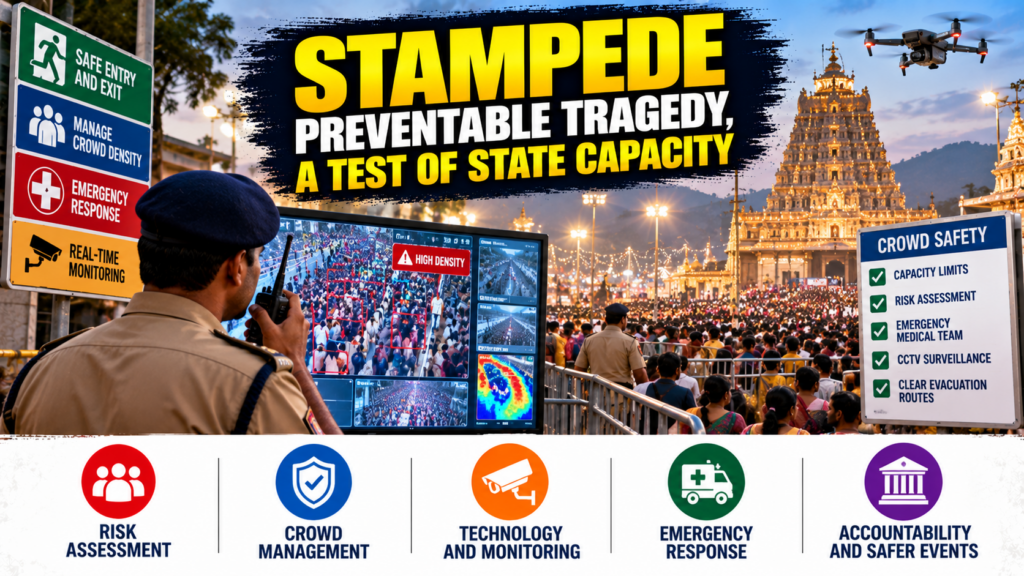
QUESTION: The prevention of avoidable disasters at public gatherings is a test of administrative accountability and state capacity. Examine
ANSWER: Public gatherings—ranging from religious pilgrimages and music festivals to political rallies and sports events—frequently witness preventable tragedies, such as stampedes, structural collapses, fires, and crowd surges.
1. State Capacity: The Ability to Anticipate, Manage, and Mitigate Risk
- Intelligence and Predictive Capacity:
- Gaps: Inadequate crowd forecasting, poor spatial modeling, and failure to analyze historical choke points.
- Impact: Failure to anticipate sudden influxes or bottlenecks leads to rapid escalation of crowd density beyond safe thresholds.
- Regulatory and Infrastructural Readiness:
- Gaps: Weak enforcement of venue capacity limits, insufficient emergency exit clearance, absence of fire safety audits, and substandard temporary structures.
- Impact: Physical hazards directly cause or worsen disasters when panic sets in.
- Inter-Agency Coordination:
- Gaps: Siloed operations among local administration, police forces, medical responders, transport authorities, and private organizers.
- Impact: Slower response times, conflicting communications, and fragmented crisis control during critical moments.
- Technological Integration:
- Gaps: Underutilization of real-time crowd-monitoring technology, such as AI-driven CCTV analytics, drone surveillance, and heat-map tracking.
- Impact: Lack of real-time situational awareness prevents proactive intervention before a crisis peaks.
2. Administrative Accountability: Institutional Responsibility and Incentives
- Ex-Ante Accountability (Proactive Governance):
- Rigorous risk assessments and mandatory safety clearances prior to issuing event permits.
- Clear allocation of responsibilities among specific officers and event managers.
- Ex-Post Accountability (Post-Incident Governance):
- Conducting timely, transparent judicial or administrative inquiries.
- Enforcing penal and disciplinary consequences for negligence rather than scapegoating low-level staff.
- Challenges to Accountability:
- Diffused Responsibility: Multi-agency management often leads to “blame-shifting” between local authorities, law enforcement, and private entities.
- Political and Commercial Pressures: Reluctance to restrict attendance at high-profile political or religious events due to potential fallout or financial interests.
3. Key Measures for Systemic Improvement
- Standardized Event Clearance Protocols: Establish unified statutory guidelines requiring risk assessments, certified capacity limits, and emergency action plans before permits are granted.
- Incident Command Systems (ICS): Implement unified command structures at venue sites so that police, health services, and fire departments operate under a single, clear chain of command.
- Real-Time Data & Technology: Utilize Integrated Command and Control Centers (ICCCs) with real-time video analytics to flag high crowd density, movement bottlenecks, or flow reversals instantly.
- Institutionalizing Accountability: Enforce strict audit mechanisms and fix clear statutory liability for both public administrators and private organizers in cases of gross negligence.
Preventing avoidable disasters at public gatherings is a fundamental duty of modern governance. Moving from reactive post-disaster inquiries to proactive risk governance remains essential to safeguarding public lives.
|