
|
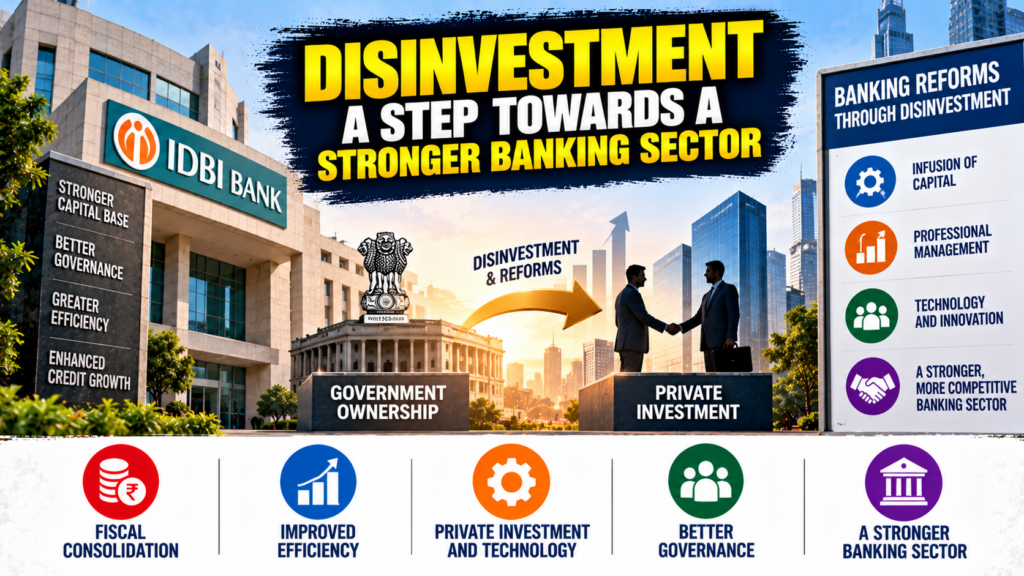
IN NEWS: IDBI disinvestment opens a door to much-needed banking reform
QUESTION: Distinguish between disinvestment, strategic disinvestment and privatisation. Explain their significance in the context of India’s public-sector enterprise reforms.
ANSWER: Public Sector Enterprises (PSEs) were established post-independence to build an industrial base, generate employment, and achieve socio-economic equity. However, structural inefficiencies, persistent fiscal strain, and shifting macroeconomic priorities have driven a transition from state-led manufacturing toward economic rationalization. In Indian fiscal policy, disinvestment, strategic disinvestment, and privatisation represent distinct points on a continuum of state disengagement from commercial enterprise.
Conceptual Distinction
The three terms differ across ownership, management control, and strategic objective:
1. Disinvestment (Minority Stake Sale)
- Definition: Sale of a minority equity stake (less than 50%) in a Central Public Sector Enterprise (CPSE) to financial institutions, retail investors, or the public via stock exchanges.
- Equity Threshold: Government retains 51% or more ownership.
- Management Control: Retained entirely by the Government of India.
- Primary Objective: Fiscal deficit management, raising capital market liquidity, and encouraging public ownership.
- Example: Initial Public Offers (IPOs) or Follow-on Public Offers (FPOs) of CPSEs like LIC, Coal India, or Indian Oil Corporation.
2. Strategic Disinvestment
- Definition: Sale of a substantial portion of government equity (typically 50% or more, or a block of shares that transfers control) along with management control to a strategic buyer.
- Equity Threshold: Government reduces its stake below 51% (often to 26% or 0%).
- Management Control: Transferred completely to the strategic private partner.
- Primary Objective: Infusing private management expertise, technology, and capital to turnaround CPSE performance.
- Example: Transfer of management control in Bharat Aluminium Company (BALCO) or Hindustan Zinc Limited (HZL) in the early 2000s.
3. Privatisation
- Definition: Complete transfer of ownership, control, and assets of a state-owned enterprise to private hands, exiting government involvement entirely.
- Equity Threshold: Government stake reduced to 0% (or a purely non-controlling nominal holding).
- Management Control: Fully private enterprise; government operates solely as a sectoral regulator.
- Primary Objective: Structural market efficiency, ending state monopolies, and reallocating public resources to public goods.
- Example: Complete sale and transfer of Air India to the Tata Group (2021-22).
Key Distinctions at a Glance
- Disinvestment: Minority stake sale (<50%); Government retains management control (≥51% holding); Primary focus on fiscal proceeds and capital market deepening.
- Strategic Disinvestment: Major stake sale (usually ≥50%); Government transfers management control; Primary focus on operational efficiency and technology infusion.
- Privatisation: Complete exit (100% or near 100% transfer); Government yields total ownership and control; Primary focus on market competitiveness and complete state exit.
Significance in Public-Sector Enterprise Reforms
1. Fiscal Consolidation & Capital Rationalization
- Unlocking Non-Tax Revenue: Provides non-debt receipts to bridge fiscal deficits without increasing the public debt burden.
- Reallocation to Social Assets: Capital locked in commercial units (e.g., manufacturing, aviation) is redirected toward public goods—health, education, physical infrastructure, and climate action under the National Infrastructure Pipeline (NIP).
2. Enhancing Operational & Managerial Efficiency
- Depoliticized Governance: Replaces bureaucratic decision-making and administrative delays with professional boards, performance-linked incentives, and market agility.
- Technology & Capital Infusion: Strategic buyers bring modern technological stacks, operational synergies, and fresh capital investment that loss-making CPSEs cannot secure under state budget constraints.
3. Realizing the Principle of “Minimum Government, Maximum Governance”
- New PSE Policy (2021): Categorizes sectors into Strategic (Bare minimum state presence in Atomic Energy, Space, Defence, Transport, Telecommunications, Power, Petroleum, Banking, Insurance) and Non-Strategic (CPSEs to be privatized, merged, or closed).
- Ending Market Distortion: Prevents public funds from subsidizing loss-making state units, creating a level playing field for private competition and reducing systemic inefficiencies.
4. Broadening Capital Markets & Retail Participation
- Minority disinvestments through Exchange Traded Funds (ETFs like Bharat 22) and IPOs deepen Indian capital markets, enabling domestic retail investors to participate in public asset value creation.
Challenges and Structural Constraints
- Valuation & Regulatory Hurdle: Accurately valuing land banks, physical assets, and intellectual property remains complex, risking allegations of under-pricing.
- Labor & Social Welfare Concerns: Private takeover often leads to workforce rationalization, raising concerns over job security, compensation packages, and statutory reservation mandates.
- Market Volatility: Unfavorable global macroeconomic conditions, geo-political uncertainties, and volatile capital markets frequently cause shortfall against annual budget targets set by the Department of Investment and Public Asset Management (DIPAM).
Disinvestment, strategic disinvestment, and privatisation reflect a progressive maturity in India’s economic management—transitioning the State’s primary role from a direct producer of commercial goods to a facilitator, regulator, and provider of core public welfare. Realizing the full potential of these reforms requires transparent valuation frameworks, robust post-privatisation sectoral regulation to prevent private monopolies, and proactive safeguard mechanisms for labor welfare.
|