
|
IN NEWS: Can wildlife thrive in India without active human intervention?
QUESTION: Can wildlife conservation succeed without active human intervention in the present era of habitat degradation and climate change? Discuss.
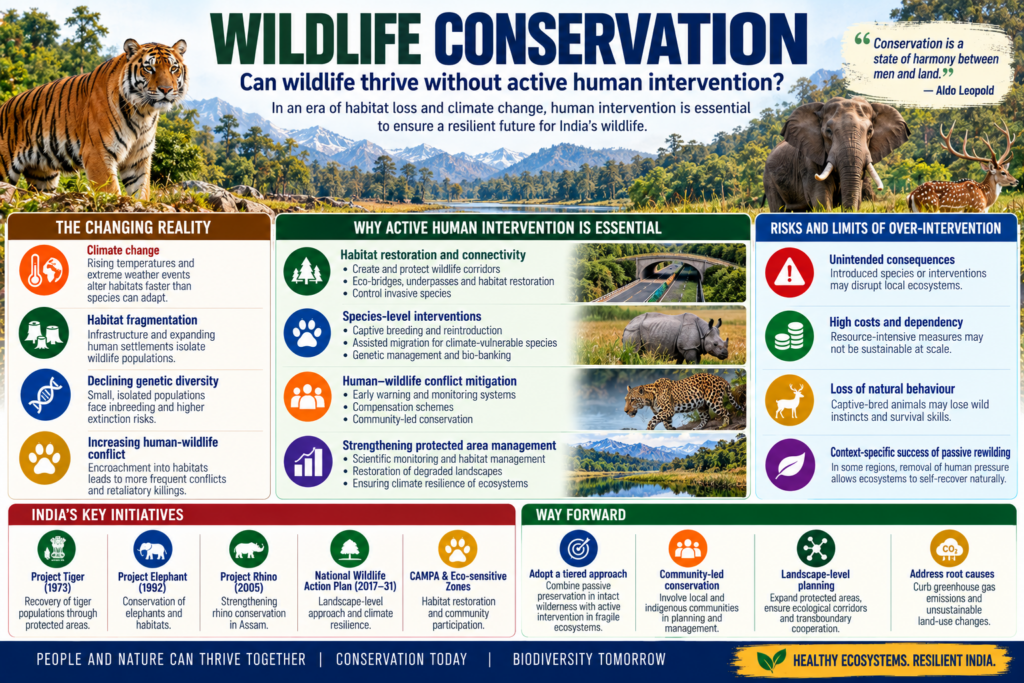
ANSWER: The Anthropocene epoch—marked by unprecedented habitat fragmentation, biodiversity loss, and accelerated climate change—has severely compromised the self-regulating and adaptive capacity of natural ecosystems. In this altered ecological reality, classical “hands-off” preservation is no longer sufficient; active human intervention has become an imperative to prevent irreversible species extinction and maintain ecological balance.
1. The Argument Against Unassisted Natural Resilience
- Rate of Climate Disruption vs. Adaptive Speed: Evolutionary adaptation and natural range shifts occur over centuries or millennia. Anthropogenic climate change is shifting thermal and hydrological regimes within decades, faster than many species can adapt or naturally migrate.
- Habitat Fragmentation as a Barrier: Even if species attempt to migrate northwards or to higher altitudes to escape warming, human infrastructure—such as highways, urban clusters, agricultural fields, and fencing—acts as physical barriers, creating ecological isolated islands.
- Extinction Vortex in Small Populations: Fragmented and declining populations face inbreeding depression, reduced genetic diversity, and vulnerability to sudden stochastic events (e.g., extreme droughts, wildland fires), making self-recovery mathematically improbable.
2. Why Active Human Intervention is Essential in the Current Era
A. Habitat Restoration and Connectivity
- Corridor Management: Constructing eco-bridges, underpasses, and wildlife corridors is necessary to reconnect fragmented habitats, enabling gene flow and climate-induced range shifts.
- Active Habitat Modification: Controlling invasive alien species (e.g., Lantana camara, water hyacinth) and managing water holes, artificial salt licks, and controlled burning regimes are necessary to keep ecosystems functioning.
B. Species-Level Interventions and Ex-Situ Conservation
- Assisted Migration / Colonization: Moving climate-vulnerable species intentionally to new, ecologically suitable habitats outside their historical range when natural dispersal routes are blocked.
- Captive Breeding and Reintroduction: Species such as the California Condor, the Black-Footed Ferret, and India’s Pygmy Hog would have gone extinct without captive breeding programs and subsequent soft-release into protected zones.
- Genetic Management: Assisted gene flow and bio-banking (freezing gametes and tissues) are increasingly used to inject genetic diversity into isolated populations.
C. Human-Wildlife Conflict Mitigation
As human settlements encroach upon natural habitats, active management through geo-fencing, early warning telemetry systems, compensation schemes, and community-led anti-poaching squads is vital to prevent retaliatory killings of apex predators and megafauna.
3. The Counter-Perspective: Risks and Limits of Human Over-Intervention
- Unintended Ecological Consequences: Technological or managerial fixes can cause unintended harm. Introduced species for biological control or assisted migration can become invasive or disrupt local food webs.
- Ecological Dependency and High Costs: Intensive interventions (e.g., supplementary feeding, captive breeding) are resource-heavy, unsustainable at a global scale, and risk breeding animals that lose their wild traits and natural instincts.
- The “Passive Rewilding” Successes: In some context-specific regions, removing human pressure (e.g., abandoned agricultural lands in Europe or restricted exclusion zones) has allowed nature to self-regulate, re-establish trophic cascades, and recover effectively without micro-management.
Way Forward
- Tiered Conservation Strategy: Apply passive preservation in large, intact core wilderness areas to allow natural ecological processes to play out, while deploying intensive, active interventions in highly fragmented or climate-vulnerable biodiversity hotspots.
- Community-Led Co-Management: Active intervention must move beyond top-down engineering to include indigenous communities and local stewards, whose traditional ecological knowledge offers sustainable ecosystem management.
- Landscape-Level Planning: Focus on scale—expanding protected area networks, enforcing buffer zones, and ensuring transboundary conservation corridors so nature retains maximum capacity to adapt autonomously.
- Addressing Root Causes: Human intervention in wildlife management must be paired with global mitigation efforts to curb greenhouse gas emissions and halt unsustainable land-use changes. Without addressing root drivers, active conservation acts merely as a temporary band-aid.
|
SOURCE: The Hindu epaper – Can wildlife thrive in India without active human intervention?