
SYLLABUS: Indian Polity General Studies – : II Structure, organization and functioning of the Executive and the Judiciary—Ministries and Departments of the Government; pressure groups and formal/informal associations and their role in the Polity.
IN NEWS: How has the SC strengthened arrest safeguards?
QUESTION: “Judicial oversight of arrest and remand is essential to prevent the misuse of investigative powers.” Examine
ANSWER: Personal liberty, enshrined under Article 21 of the Constitution of India, is the foundation of a democratic state governed by the rule of law. However, the state’s duty to maintain public order requires granting investigating agencies police powers, including the authority to arrest and detain. Because arrest constitutes a direct deprivation of liberty, judicial oversight of arrest and remand serves as an indispensable constitutional check. It transforms executive discretion into a legally regulated power, ensuring that criminal procedure does not degenerate into administrative oppression.
1. Constitutional and Statutory Framework of Oversight
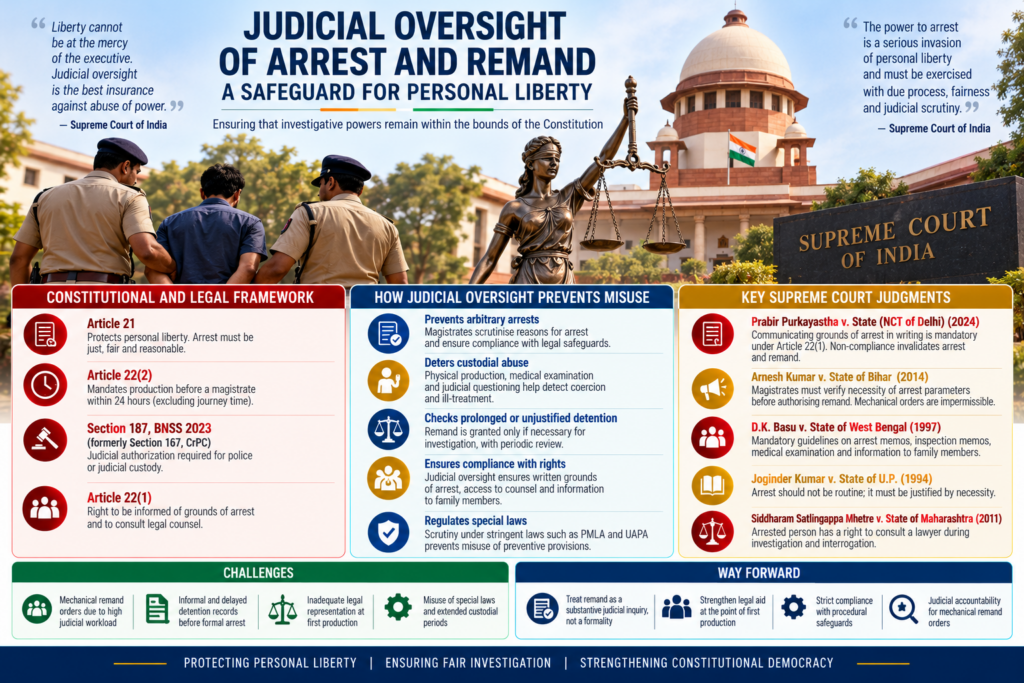
- The 24-Hour Constitutional Mandate: Under Article 22(2) of the Constitution, every person arrested must be produced before the nearest magistrate within 24 hours (excluding journey time). This ensures that custody beyond 24 hours is exclusively governed by judicial permission rather than police discretion.
- Statutory Remand Control: Under Section 187 of the Bharatiya Nagarik Suraksha Sanhita (BNSS), 2023 (formerly Section 167 of the CrPC), a magistrate evaluates whether continued detention—either police custody or judicial custody—is necessary to advance the investigation.
- Right to Written Grounds and Counsel: Article 22(1) guarantees the right to be informed of the grounds of arrest and to consult legal counsel of choice. Judicial supervision ensures these rights are meaningfully communicated at the time of first production.
2. Preventing Misuse of Investigative Powers
- Preventing Arbitrary and Unnecessary Arrests: Police officers are mandated to record written reasons justifying why an arrest is required (e.g., to prevent evidence tampering, witness intimidation, or absconding). Magistrates are required to apply an independent judicial mind to these reasons rather than endorsing police applications mechanically.
- Deterrence of Custodial Abuse and Coercion: Requiring physical production before a judicial magistrate, alongside mandatory medical examinations, provides a critical window to detect physical abuse, illegal detention, or forced confessions.
- Strict Supervision over Special Laws: In statutes with stringent bail conditions—such as the Prevention of Money Laundering Act (PMLA) or the Unlawful Activities (Prevention) Act (UAPA)—magisterial scrutiny at the remand stage prevents the misuse of preventive provisions.
3. Jurisprudential Evolution and Guardrails
- Prabir Purkayastha v. State (NCT of Delhi) (2024): The Supreme Court affirmed that communicating the grounds of arrest in writing is a mandatory constitutional requirement under Article 22(1). Failure to supply written grounds invalidates both the arrest and any subsequent remand order, rendering the detention unconstitutional.
- Arnesh Kumar v. State of Bihar (2014): The apex court issued binding directions requiring magistrates to verify whether the necessity of arrest parameters were met before authorizing remand. Magistrates issuing mechanical remand orders face departmental accountability from High Courts.
- D.K. Basu v. State of West Bengal (1997): Established mandatory guidelines governing arrest memos, inspection memos, and notifications to family members, ensuring that every stage of police custody leaves a verifiable judicial and public audit trail.
4. Operational Challenges to Effective Oversight
- Mechanical Processing of Remand Applications: High judicial pendency and heavy daily caseloads in subordinate courts often lead magistrates to grant remand routinely without deep scrutiny of case diaries.
- Informal and Delayed Detention Records: Informal detentions prior to official arrest logging bypass the statutory 24-hour clock, delaying judicial intervention.
- Inadequate Legal Representation at First Production: Arrested persons from socio-economically weaker backgrounds often lack effective legal counsel during their initial remand hearing, turning judicial production into a procedural formality.
Judicial oversight over arrest and remand marks the boundary line between a police state and a constitutional republic. As the Supreme Court has held, an arrest may be authorized by law, but it becomes arbitrary if executed without necessity or procedural fairness. To make judicial supervision truly effective, subordinate courts must treat remand proceedings as substantive constitutional inquiries into personal liberty rather than routine administrative approvals. Strengthening legal aid at the point of first production, enforcing judicial accountability for mechanical remand, and ensuring strict compliance with procedural safeguards remain essential to preserving individual liberty.
|
SOURCE: The Hindu epaper – How has the SC strengthened arrest safeguards?